Sovi.AI - AI Math Tutor

Scan to solve math questions

QUESTION IMAGE

why did major league baseball owners support segregation by 1890? they …

Question

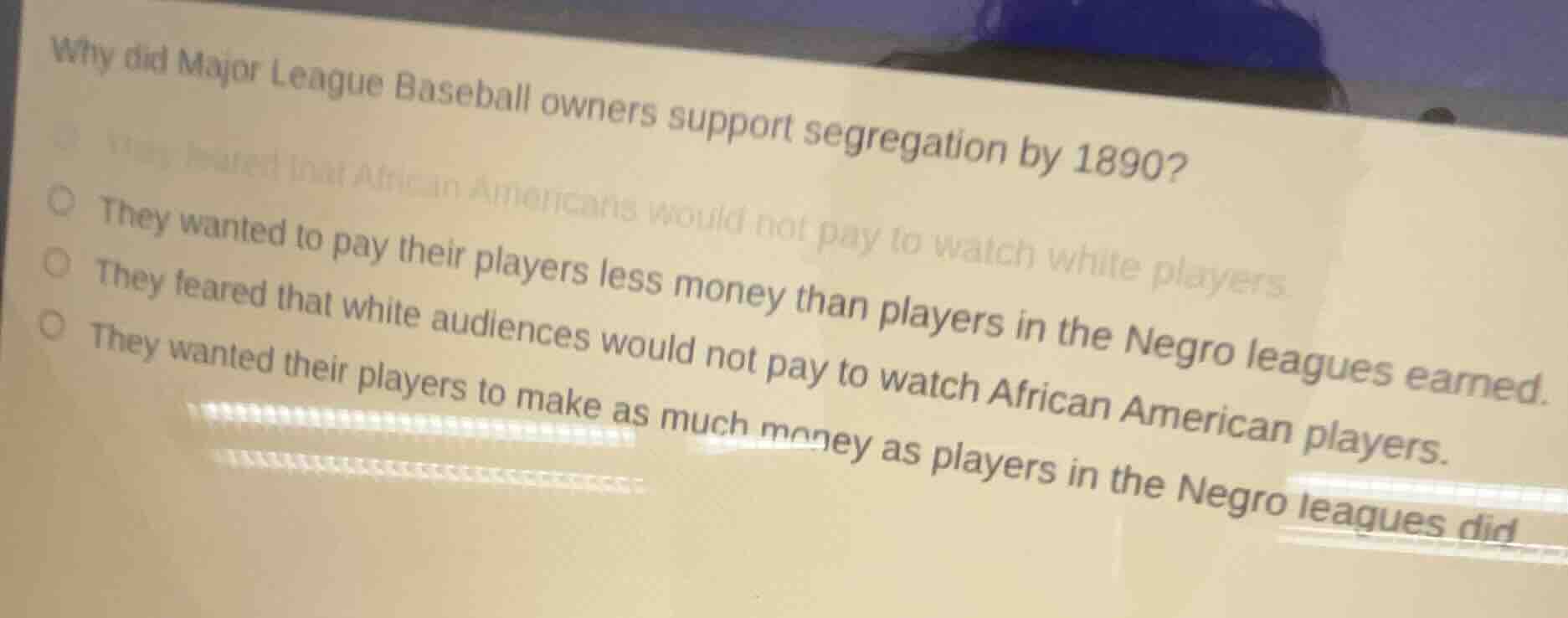
why did major league baseball owners support segregation by 1890?

they feared that african americans would not pay to watch white players.
they wanted to pay their players less money than players in the negro leagues earned.
they feared that white audiences would not pay to watch african american players.
they wanted their players to make as much money as players in the negro leagues did.

Explanation:

Response

<pre_analysis>
{
"quality": "clear",
"question_count": 1,
"skills_matched": [
"direct_cot",
"multiple_choice_formatter",
"explain_then_answer",
"tutor"
],
"needs_drawing": false,
"concepts_used": [],
"new_concepts": [
"Baseball Segregation",
"Jim Crow Sports",
"Negro Leagues History"
],
"current_concepts": [
"Baseball Segregation",
"Jim Crow Sports",
"Negro Leagues History"
]
}
</pre_analysis>

<reasoning>

Analyze the historical context

The question asks why Major League Baseball (MLB) owners supported segregation by 1890. During the late 19th century, the "gentlemen's agreement" informally banned African American players from major and minor league rosters.

Evaluate the economic motivations

Professional baseball was a business driven by profit. Owners made decisions based on what they believed would maximize ticket sales and revenue from their primary customer base.

Assess white audience preferences

During the Jim Crow era, racial prejudice was widespread. Owners feared that white fans, who made up the vast majority of paying spectators, would refuse to attend games or pay admission if African American athletes played alongside white players.

Compare the given options

  • Option 1 suggests fear that African Americans would not pay to watch white players, which was not the primary financial concern for owners.
  • Option 2 discusses paying players less than Negro league players, which is historically inaccurate as Negro leagues were not yet formally established in 1890, and major league salaries were generally higher.
  • Option 3 states owners feared white audiences would not pay to watch African American players. This directly aligns with the economic and social realities of the era.
  • Option 4 suggests owners wanted their players to make as much as Negro league players, which does not align with the competitive business goals of MLB owners.

</reasoning>

<answer>
<mcq-option>They feared that African Americans would not pay to watch white players.</mcq-option>
<mcq-option>They wanted to pay their players less money than players in the Negro leagues earned.</mcq-option>
<mcq-correct>They feared that white audiences would not pay to watch African American players.</mcq-correct>
<mcq-option>They wanted their players to make as much as money as players in the Negro leagues did.</mcq-option>
</answer>

<post_analysis>
{
"subject": "Social Science",
"question_type": "Multiple Choice",
"knowledge_point": [
"Social Science",
"U.S. History",
"Jim Crow Era Segregation"
]
}
</post_analysis>

Answer:

<pre_analysis>
{
"quality": "clear",
"question_count": 1,
"skills_matched": [
"direct_cot",
"multiple_choice_formatter",
"explain_then_answer",
"tutor"
],
"needs_drawing": false,
"concepts_used": [],
"new_concepts": [
"Baseball Segregation",
"Jim Crow Sports",
"Negro Leagues History"
],
"current_concepts": [
"Baseball Segregation",
"Jim Crow Sports",
"Negro Leagues History"
]
}
</pre_analysis>

<reasoning>

Analyze the historical context

The question asks why Major League Baseball (MLB) owners supported segregation by 1890. During the late 19th century, the "gentlemen's agreement" informally banned African American players from major and minor league rosters.

Evaluate the economic motivations

Professional baseball was a business driven by profit. Owners made decisions based on what they believed would maximize ticket sales and revenue from their primary customer base.

Assess white audience preferences

During the Jim Crow era, racial prejudice was widespread. Owners feared that white fans, who made up the vast majority of paying spectators, would refuse to attend games or pay admission if African American athletes played alongside white players.

Compare the given options

  • Option 1 suggests fear that African Americans would not pay to watch white players, which was not the primary financial concern for owners.
  • Option 2 discusses paying players less than Negro league players, which is historically inaccurate as Negro leagues were not yet formally established in 1890, and major league salaries were generally higher.
  • Option 3 states owners feared white audiences would not pay to watch African American players. This directly aligns with the economic and social realities of the era.
  • Option 4 suggests owners wanted their players to make as much as Negro league players, which does not align with the competitive business goals of MLB owners.

</reasoning>

<answer>
<mcq-option>They feared that African Americans would not pay to watch white players.</mcq-option>
<mcq-option>They wanted to pay their players less money than players in the Negro leagues earned.</mcq-option>
<mcq-correct>They feared that white audiences would not pay to watch African American players.</mcq-correct>
<mcq-option>They wanted their players to make as much as money as players in the Negro leagues did.</mcq-option>
</answer>

<post_analysis>
{
"subject": "Social Science",
"question_type": "Multiple Choice",
"knowledge_point": [
"Social Science",
"U.S. History",
"Jim Crow Era Segregation"
]
}
</post_analysis>