QUESTION IMAGE
Question
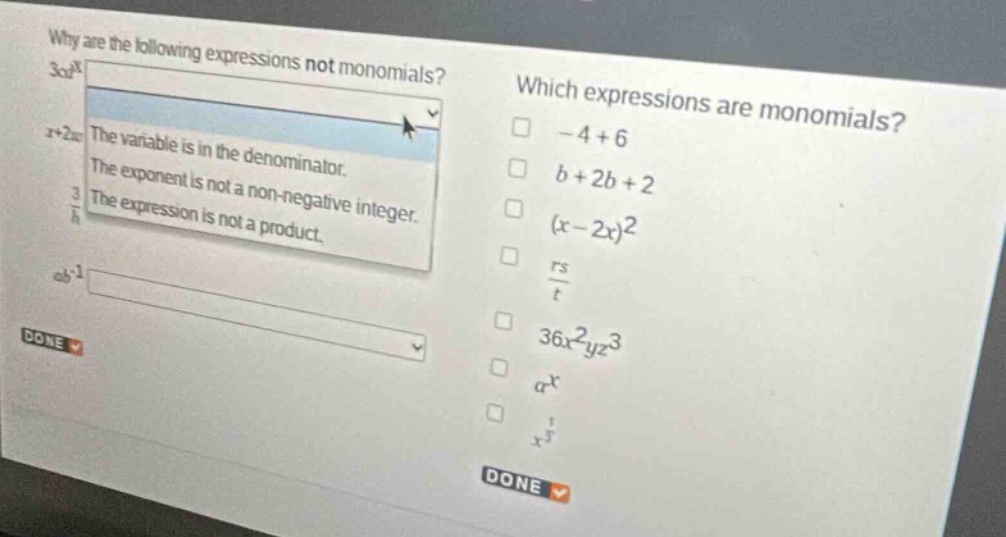
why are the following expressions not monomials?
\\(3a^x\\)
\\(x+2w\\)
\\(\frac{3}{h}\\)
\\(ab^{-1}\\)
dropdown options:
- the variable is in the denominator.
- the exponent is not a non-negative integer.
- the expression is not a product.
which expressions are monomials?
\\(-4+6\\)
\\(b+2b+2\\)
\\((x-2x)^2\\)
\\(\frac{rs}{t}\\)
\\(36x^2yz^3\\)
\\(a^x\\)
\\(x^{-1}\\)
🆕 New Concept Discovered: Identifying Monomials
A single term with non-negative integer exponents.
Step 1: Define a Monomial
A monomial is a number, a variable, or a product of numbers and variables with non-negative integer exponents. This means:
- No variables in denominators (which would mean a negative exponent).
- No fractional or negative exponents on variables.
- No addition or subtraction of terms (it must be a single product).
---
Step 2: Analyze "Why are the following expressions not monomials?"
We evaluate each given expression against the definition of a monomial:
- \( 3a^{x} \)
- The exponent is a variable \( x \), not a fixed non-negative integer.
- Reason: The exponent is not a non-negative integer.
- \( x + 2w \)
- This expression is a sum of two separate terms, not a single product.
- Reason: The expression is not a product.
- \( \frac{3}{h} \)
- The variable \( h \) is in the denominator (which is equivalent to \( 3h^{-1} \)).
- Reason: The variable is in the denominator.
- \( ab^{-1} \)
- The exponent on the variable \( b \) is \(-1\), which is negative.
- Reason: The exponent is not a non-negative integer.
---
Step 3: Analyze "Which expressions are monomials?"
We check each option in the checklist:
- \( -4 + 6 \)
- This simplifies to \( 2 \), which is a constant (a single number). A constant is a monomial.
- Monomial: Yes.
- \( b + 2b + 2 \)
- This contains addition of multiple terms that cannot be simplified into a single product term (it simplifies to \( 3b + 2 \)).
- Monomial: No.
- \( (x - 2x)^2 \)
- This simplifies to \( (-x)^2 = x^2 \), which is a single variable raised to a positive integer power.
- Monomial: Yes.
- \( \frac{rs}{t} \)
- The variable \( t \) is in the denominator.
- Monomial: No.
- \( 36x^2yz^3 \)
- This is a product of a number and variables with positive integer exponents (\( 2 \), \( 1 \), and \( 3 \)).
- Monomial: Yes.
- \( a^x \)
- The exponent is a variable \( x \), not a fixed integer.
- Monomial: No.
- \( x^{\frac{1}{3}} \)
- The exponent is a fraction, not an integer.
- Monomial: No.

Snap & solve any problem in the app
Get step-by-step solutions on Sovi AI
Photo-based solutions with guided steps
Explore more problems and detailed explanations
Part 1: Why are the following expressions not monomials?
- \( 3a^x \): The exponent is not a non-negative integer.
- \( x + 2w \): The expression is not a product.
- \( \frac{3}{h} \): The variable is in the denominator.
- \( ab^{-1} \): The exponent is not a non-negative integer.
Part 2: Which expressions are monomials? (Select these options)
- [x] \( -4 + 6 \)
- [x] \( (x - 2x)^2 \)
- [x] \( 36x^2yz^3 \)