QUESTION IMAGE
Question
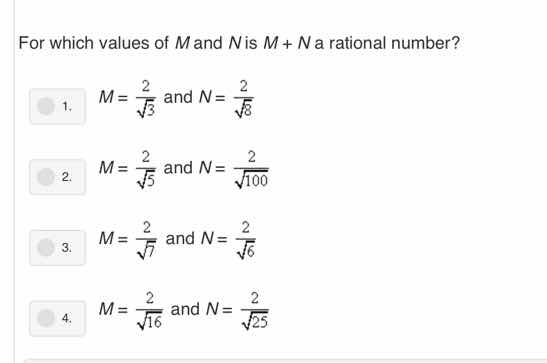
for which values of m and n is m + n a rational number?
- $m = \frac{2}{\sqrt{3}}$ and $n = \frac{2}{\sqrt{3}}$
- $m = \frac{2}{\sqrt{5}}$ and $n = \frac{2}{\sqrt{100}}$
- $m = \frac{2}{\sqrt{7}}$ and $n = \frac{2}{\sqrt{6}}$
- $m = \frac{2}{\sqrt{16}}$ and $n = \frac{2}{\sqrt{25}}$
Step 1: Recall the definition of a rational number
A rational number is a number that can be expressed as \(\frac{p}{q}\) where \(p\) and \(q\) are integers and \(q
eq0\). Also, \(\sqrt{a}\) is rational if and only if \(a\) is a perfect square (for non - negative real numbers \(a\)).
Step 2: Analyze Option 1
Given \(M = \frac{2}{\sqrt{3}}\) and \(N=\frac{2}{\sqrt{8}}\). We rationalize the denominators:
\(M=\frac{2\sqrt{3}}{3}\) (since \(\frac{2}{\sqrt{3}}\times\frac{\sqrt{3}}{\sqrt{3}}=\frac{2\sqrt{3}}{3}\)) and \(N = \frac{2\sqrt{8}}{8}=\frac{2\times2\sqrt{2}}{8}=\frac{\sqrt{2}}{2}\) (since \(\frac{2}{\sqrt{8}}\times\frac{\sqrt{8}}{\sqrt{8}}=\frac{2\sqrt{8}}{8}\) and \(\sqrt{8} = 2\sqrt{2}\)). The sum \(M + N=\frac{2\sqrt{3}}{3}+\frac{\sqrt{2}}{2}\) is irrational because it contains \(\sqrt{2}\) and \(\sqrt{3}\) which are irrational.
Step 3: Analyze Option 2
Given \(M=\frac{2}{\sqrt{5}}\) and \(N = \frac{2}{\sqrt{100}}\). Rationalize \(M\): \(M=\frac{2\sqrt{5}}{5}\) (since \(\frac{2}{\sqrt{5}}\times\frac{\sqrt{5}}{\sqrt{5}}=\frac{2\sqrt{5}}{5}\)). And \(N=\frac{2}{10}=\frac{1}{5}\) (since \(\sqrt{100} = 10\)). The sum \(M + N=\frac{2\sqrt{5}}{5}+\frac{1}{5}=\frac{2\sqrt{5}+1}{5}\) is irrational because of the \(\sqrt{5}\) term.
Step 4: Analyze Option 3
Given \(M=\frac{2}{\sqrt{7}}\) and \(N=\frac{2}{\sqrt{6}}\). Rationalize the denominators: \(M=\frac{2\sqrt{7}}{7}\) ( \(\frac{2}{\sqrt{7}}\times\frac{\sqrt{7}}{\sqrt{7}}=\frac{2\sqrt{7}}{7}\)) and \(N=\frac{2\sqrt{6}}{6}=\frac{\sqrt{6}}{3}\) ( \(\frac{2}{\sqrt{6}}\times\frac{\sqrt{6}}{\sqrt{6}}=\frac{2\sqrt{6}}{6}\)). The sum \(M + N=\frac{2\sqrt{7}}{7}+\frac{\sqrt{6}}{3}\) is irrational as it contains \(\sqrt{6}\) and \(\sqrt{7}\) which are irrational.
Step 5: Analyze Option 4
Given \(M=\frac{2}{\sqrt{16}}\) and \(N=\frac{2}{\sqrt{25}}\). Since \(\sqrt{16}=4\) and \(\sqrt{25} = 5\), we have \(M=\frac{2}{4}=\frac{1}{2}\) and \(N=\frac{2}{5}\). The sum \(M + N=\frac{1}{2}+\frac{2}{5}=\frac{5 + 4}{10}=\frac{9}{10}\), which is a rational number (since it is in the form \(\frac{p}{q}\) with \(p = 9\) and \(q = 10\) integers and \(q
eq0\)).

Snap & solve any problem in the app
Get step-by-step solutions on Sovi AI
Photo-based solutions with guided steps
Explore more problems and detailed explanations
- \(M=\frac{2}{\sqrt{16}}\) and \(N=\frac{2}{\sqrt{25}}\)