QUESTION IMAGE
Question
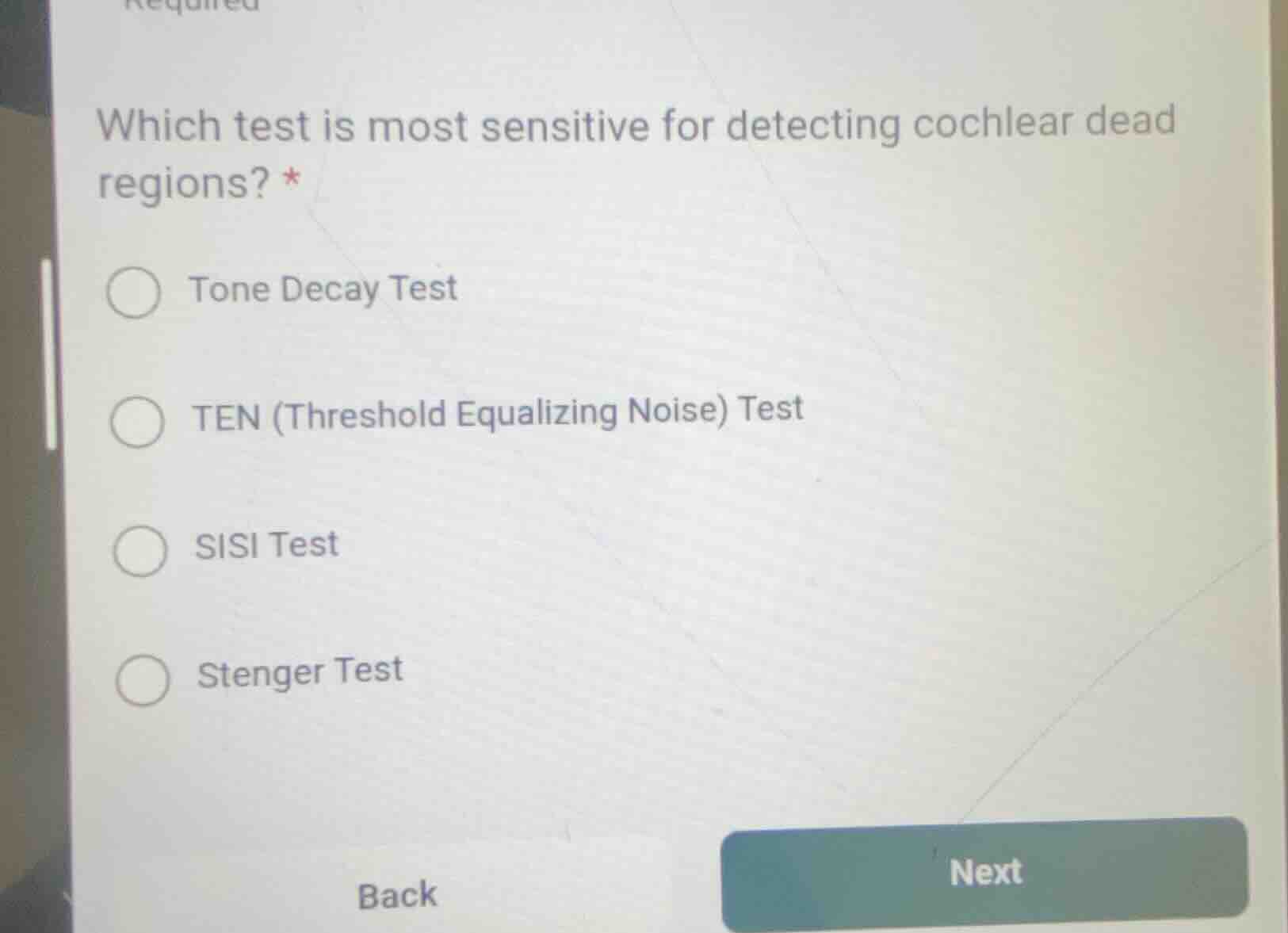
which test is most sensitive for detecting cochlear dead regions? *
tone decay test
ten (threshold equalizing noise) test
sisi test
stenger test
<pre_analysis>
{
"quality": "clear",
"question_count": 1,
"skills_matched": [
"direct_cot",
"multiple_choice_formatter",
"explain_then_answer",
"tutor",
"mastery_adaptive_brevity"
],
"needs_drawing": false,
"concepts_used": [
"Sensitivity and Specificity",
"Functional Hearing Loss"
],
"new_concepts": [
"Cochlear Dead Regions",
"TEN Test"
],
"current_concepts": [
"Sensitivity and Specificity",
"Functional Hearing Loss",
"Cochlear Dead Regions",
"TEN Test"
]
}
</pre_analysis>
<reasoning>
Define cochlear dead regions
Cochlear dead regions are areas along the basilar membrane where inner hair cells and/or adjacent auditory neurons are non-functional. When a pure tone is presented within a dead region, it is detected by neighboring healthy hair cells via off-frequency listening.
Evaluate the TEN Test
The TEN (Threshold Equalizing Noise) test is specifically designed to detect cochlear dead regions. It uses a broadband masking noise (TEN) that produces equal threshold masking across a wide frequency range in normal ears. If a dead region is present, the threshold for a tone in that region will be significantly higher than the level of the TEN because the tone must be detected by healthy fibers outside the dead region, where the masking noise is highly effective.
Evaluate alternative options
Using the Sensitivity and Specificity knowledge point
- Tone Decay Test: Primarily used to detect retrocochlear pathology (auditory nerve adaptation).
- SISI Test: Short Increment Sensitivity Index, used to differentiate cochlear from retrocochlear pathology by testing intensity increment detection.
- Stenger Test: Using the Functional Hearing Loss knowledge point, this test is used to identify unilateral pseudohypacusis (malingering).
Determine the correct choice
The TEN test is the clinical standard and most sensitive test for identifying cochlear dead regions.
</reasoning>
<answer>
<mcq-option>Tone Decay Test</mcq-option>
<mcq-correct>TEN (Threshold Equalizing Noise) Test</mcq-correct>
<mcq-option>SISI Test</mcq-option>
<mcq-option>Stenger Test</mcq-option>
</answer>
<post_analysis>
{
"subject": "Natural Science",
"question_type": "Multiple Choice",
"knowledge_point": [
"Natural Science",
"Others",
"Cochlear Dead Regions"
]
}
</post_analysis>
Snap & solve any problem in the app
Get step-by-step solutions on Sovi AI
Photo-based solutions with guided steps
Explore more problems and detailed explanations
<pre_analysis>
{
"quality": "clear",
"question_count": 1,
"skills_matched": [
"direct_cot",
"multiple_choice_formatter",
"explain_then_answer",
"tutor",
"mastery_adaptive_brevity"
],
"needs_drawing": false,
"concepts_used": [
"Sensitivity and Specificity",
"Functional Hearing Loss"
],
"new_concepts": [
"Cochlear Dead Regions",
"TEN Test"
],
"current_concepts": [
"Sensitivity and Specificity",
"Functional Hearing Loss",
"Cochlear Dead Regions",
"TEN Test"
]
}
</pre_analysis>
<reasoning>
Define cochlear dead regions
Cochlear dead regions are areas along the basilar membrane where inner hair cells and/or adjacent auditory neurons are non-functional. When a pure tone is presented within a dead region, it is detected by neighboring healthy hair cells via off-frequency listening.
Evaluate the TEN Test
The TEN (Threshold Equalizing Noise) test is specifically designed to detect cochlear dead regions. It uses a broadband masking noise (TEN) that produces equal threshold masking across a wide frequency range in normal ears. If a dead region is present, the threshold for a tone in that region will be significantly higher than the level of the TEN because the tone must be detected by healthy fibers outside the dead region, where the masking noise is highly effective.
Evaluate alternative options
Using the Sensitivity and Specificity knowledge point
- Tone Decay Test: Primarily used to detect retrocochlear pathology (auditory nerve adaptation).
- SISI Test: Short Increment Sensitivity Index, used to differentiate cochlear from retrocochlear pathology by testing intensity increment detection.
- Stenger Test: Using the Functional Hearing Loss knowledge point, this test is used to identify unilateral pseudohypacusis (malingering).
Determine the correct choice
The TEN test is the clinical standard and most sensitive test for identifying cochlear dead regions.
</reasoning>
<answer>
<mcq-option>Tone Decay Test</mcq-option>
<mcq-correct>TEN (Threshold Equalizing Noise) Test</mcq-correct>
<mcq-option>SISI Test</mcq-option>
<mcq-option>Stenger Test</mcq-option>
</answer>
<post_analysis>
{
"subject": "Natural Science",
"question_type": "Multiple Choice",
"knowledge_point": [
"Natural Science",
"Others",
"Cochlear Dead Regions"
]
}
</post_analysis>