QUESTION IMAGE
Question
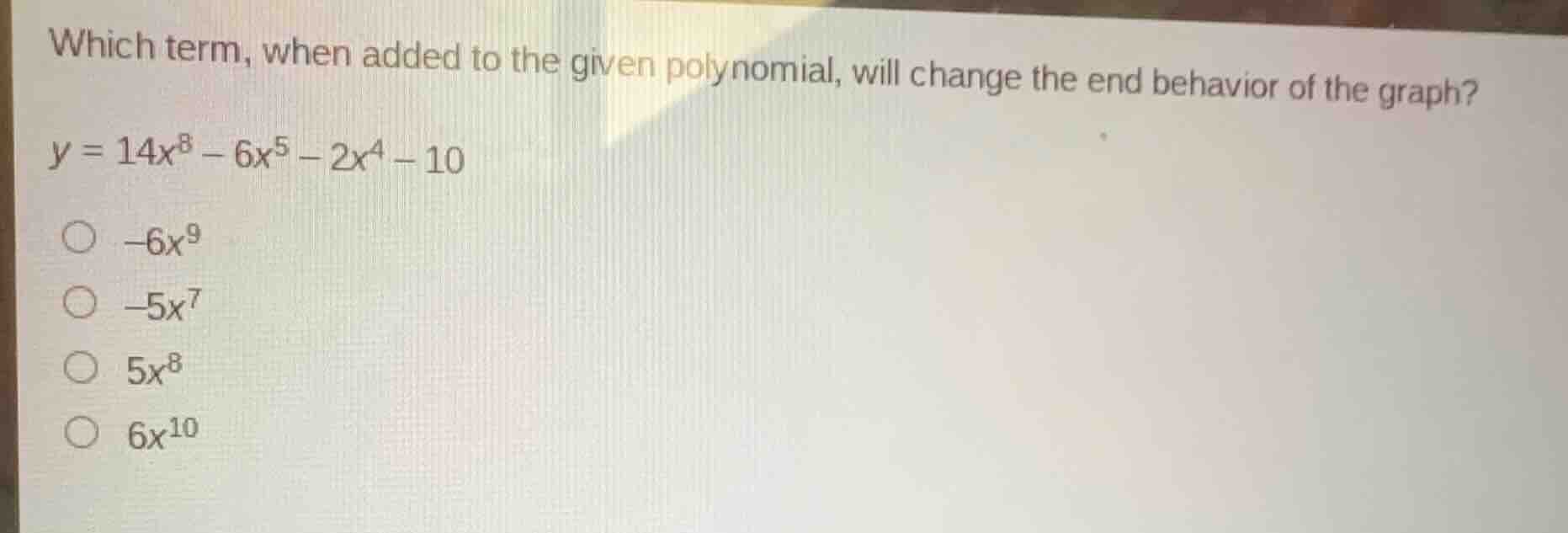
which term, when added to the given polynomial, will change the end behavior of the graph?
(y = 14x^8 - 6x^5 - 2x^4 - 10)
\\(\bigcirc\\) (-6x^9)
\\(\bigcirc\\) (-5x^7)
\\(\bigcirc\\) (5x^8)
\\(\bigcirc\\) (6x^{10})
Analyze the original polynomial's leading term
The given polynomial is:
$$y = 14x^8 - 6x^5 - 2x^4 - 10$$
The leading term is \(14x^8\), which has a degree of \(8\) (even) and a positive leading coefficient (\(14 > 0\)).
Determine the condition for changing end behavior
To change the end behavior of a polynomial, the added term must either:
- Have a higher degree than the current leading term (\(\text{degree} > 8\)), which makes it the new leading term and alters the degree and/or the sign of the leading coefficient.
- Have the same degree (\(8\)) but with a coefficient that, when added to \(14\), changes the sign of the leading coefficient from positive to negative (i.e., the added coefficient must be less than \(-14\)).
Evaluate the given options
- \(-6x^9\): Degree is \(9 > 8\). This becomes the new leading term. Since the degree changes from even (\(8\)) to odd (\(9\)) and the leading coefficient becomes negative (\(-6\)), the end behavior changes.
- \(-5x^7\): Degree is \(7 < 8\). The leading term remains \(14x^8\), so the end behavior does not change.
- \(5x^8\): Degree is \(8\). Adding this gives a leading term of \((14 + 5)x^8 = 19x^8\). The degree remains even and the coefficient remains positive, so the end behavior does not change.
- \(6x^{10}\): Degree is \(10 > 8\). This becomes the new leading term. However, the new leading term \(6x^{10}\) has an even degree (\(10\)) and a positive coefficient (\(6 > 0\)), which results in the same end behavior (both ends pointing up) as the original polynomial.

Snap & solve any problem in the app
Get step-by-step solutions on Sovi AI
Photo-based solutions with guided steps
Explore more problems and detailed explanations
- (A) \(-6x^9\) (Correct answer)
- (B) \(-5x^7\)
- (C) \(5x^8\)
- (D) \(6x^{10}\)