QUESTION IMAGE
Question
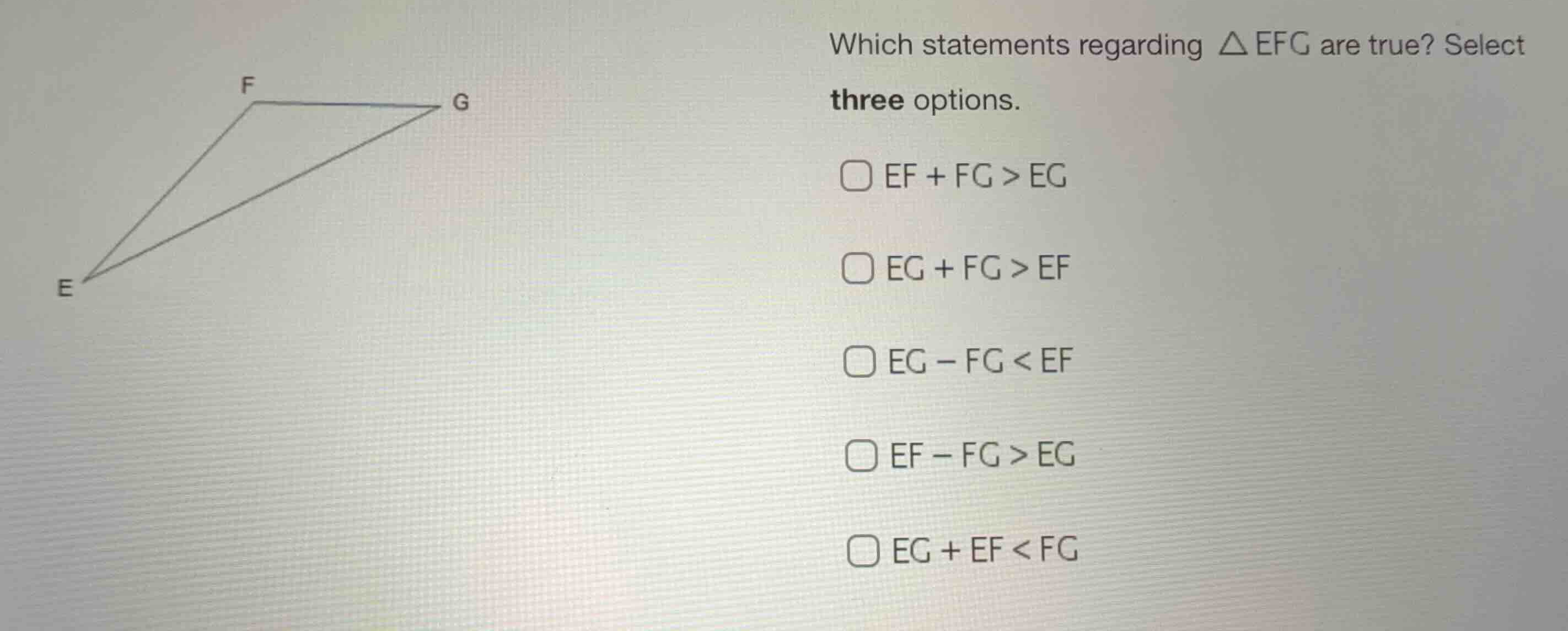
which statements regarding \\(\delta efg\\) are true? select three options.
\\(ef + fg > eg\\)
\\(eg + fg > ef\\)
\\(eg - fg < ef\\)
\\(ef - fg > eg\\)
\\(eg + ef < fg\\)
State the Triangle Inequality Theorem
Using the Triangle Geometry knowledge point, for any triangle with side lengths \(a\), \(b\), and \(c\), the sum of the lengths of any two sides must be strictly greater than the length of the remaining side:
Analyze the first two options
The first option states:
This directly matches one of the standard triangle inequalities, so it is true.
The second option states:
This also directly matches a standard triangle inequality, so it is true.
Analyze the third option
The third option states:
We can rearrange this inequality by adding \(FG\) to both sides:
Since the sum of any two sides is greater than the third side, \(EF + FG > EG\) is true, which means \(EG < EF + FG\) is mathematically equivalent and true. Thus, this option is true.
Analyze the remaining options
The fourth option states:
This contradicts the triangle inequality \(EG + FG > EF\), so it is false.
The fifth option states:
This contradicts the triangle inequality \(EG + EF > FG\), so it is false.

Snap & solve any problem in the app
Get step-by-step solutions on Sovi AI
Photo-based solutions with guided steps
Explore more problems and detailed explanations
- (A) EF + FG > EG (Correct answer)
- (B) EG + FG > EF (Correct answer)
- (C) EG - FG < EF (Correct answer)
- (D) EF - FG > EG
- (E) EG + EF < FG