QUESTION IMAGE
Question
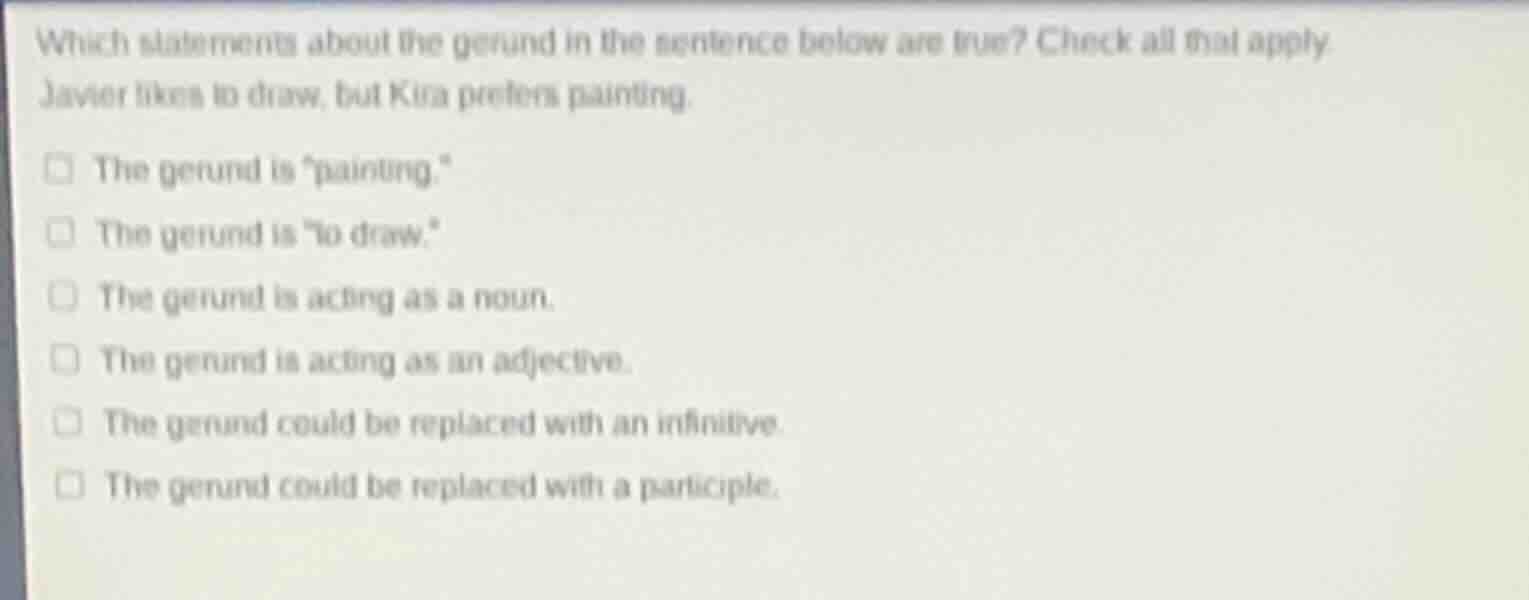
which statements about the gerund in the sentence below are true? check all that apply.
javier likes to draw, but kira prefers painting.
the gerund is \painting.\
the gerund is \to draw.\
the gerund is acting as a noun.
the gerund is acting as an adjective.
the gerund could be replaced with an infinitive.
the gerund could be replaced with a participle.
Identify the verbal elements in the sentence
The sentence is: "Javier likes to draw, but Kira prefers painting."
- "to draw" is an infinitive (to + verb).
- "painting" is a verbal ending in -ing. Since it acts as the direct object of the verb "prefers," it functions as a noun, making it a gerund.
Evaluate the statements
- "The gerund is 'painting.'": True. "painting" is the -ing verbal functioning as a noun.
- "The gerund is 'to draw.'": False. "to draw" is an infinitive.
- "The gerund is acting as a noun.": True. All gerunds function as nouns (here, the direct object of "prefers").
- "The gerund is acting as an adjective.": False. Participles act as adjectives, whereas gerunds act as nouns.
- "The gerund could be replaced with an infinitive.": True. "painting" can be replaced with the infinitive "to paint" ("Kira prefers to paint") while maintaining a grammatically correct and semantically equivalent sentence.
- "The gerund could be replaced with a participle.": False. Replacing it with a participle (which functions as an adjective) would not fit the grammatical slot of a direct object in this context.

Snap & solve any problem in the app
Get step-by-step solutions on Sovi AI
Photo-based solutions with guided steps
Explore more problems and detailed explanations
- The gerund is "painting." (Correct answer)
- The gerund is "to draw."
- The gerund is acting as a noun. (Correct answer)
- The gerund is acting as an adjective.
- The gerund could be replaced with an infinitive. (Correct answer)
- The gerund could be replaced with a participle.