QUESTION IMAGE
Question
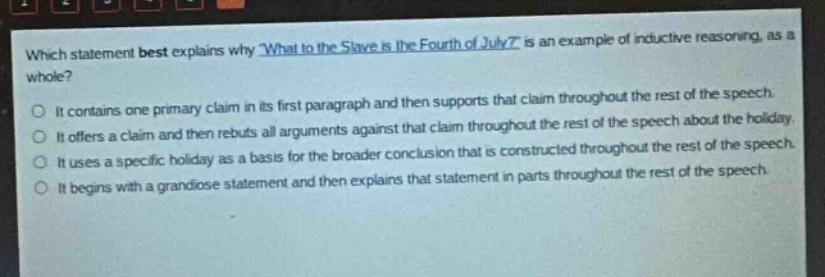
which statement best explains why \what to the slave is the fourth of july?\ is an example of inductive reasoning, as a whole?
it contains one primary claim in its first paragraph and then supports that claim throughout the rest of the speech.
it offers a claim and then rebuts all arguments against that claim throughout the rest of the speech about the holiday.
it uses a specific holiday as a basis for the broader conclusion that is constructed throughout the rest of the speech.
it begins with a grandiose statement and then explains that statement in parts throughout the rest of the speech.
⚡ Using what you learned: Inductive and Deductive Reasoning
Step 1: Define Inductive Reasoning
Inductive reasoning is a logical process where specific observations, examples, or cases are used to build toward a broader, generalized conclusion.
- Inductive: Specific observations $
ightarrow$ General conclusion
- Deductive: General premise $
ightarrow$ Specific application
Step 2: Analyze the Structure of the Speech
In Frederick Douglass's speech, "What to the Slave is the Fourth of July?", he begins by focusing on a highly specific event: the celebration of the Fourth of July and the American signers of the Declaration of Independence.
He uses this specific historical and cultural context as a starting point to build a broader, universal argument about the hypocrisy of American slavery and the true meaning of freedom for all people.
Step 3: Evaluate the Options
- Option 1: "It contains one primary claim in its first paragraph and then supports that claim..." describes a deductive structure (starting with a general thesis/claim and proving it).
- Option 2: "It offers a claim and then rebuts all arguments..." describes a refutation or argumentative structure, not specifically inductive reasoning.
- Option 3: "It uses a specific holiday as a basis for the broader conclusion that is constructed throughout the rest of the speech." perfectly matches the definition of inductive reasoning (moving from a specific instance—the holiday—to a broad conclusion).
- Option 4: "It begins with a grandiose statement and then explains that statement..." describes a top-down, deductive approach.

Snap & solve any problem in the app
Get step-by-step solutions on Sovi AI
Photo-based solutions with guided steps
Explore more problems and detailed explanations
It uses a specific holiday as a basis for the broader conclusion that is constructed throughout the rest of the speech.