QUESTION IMAGE
Question
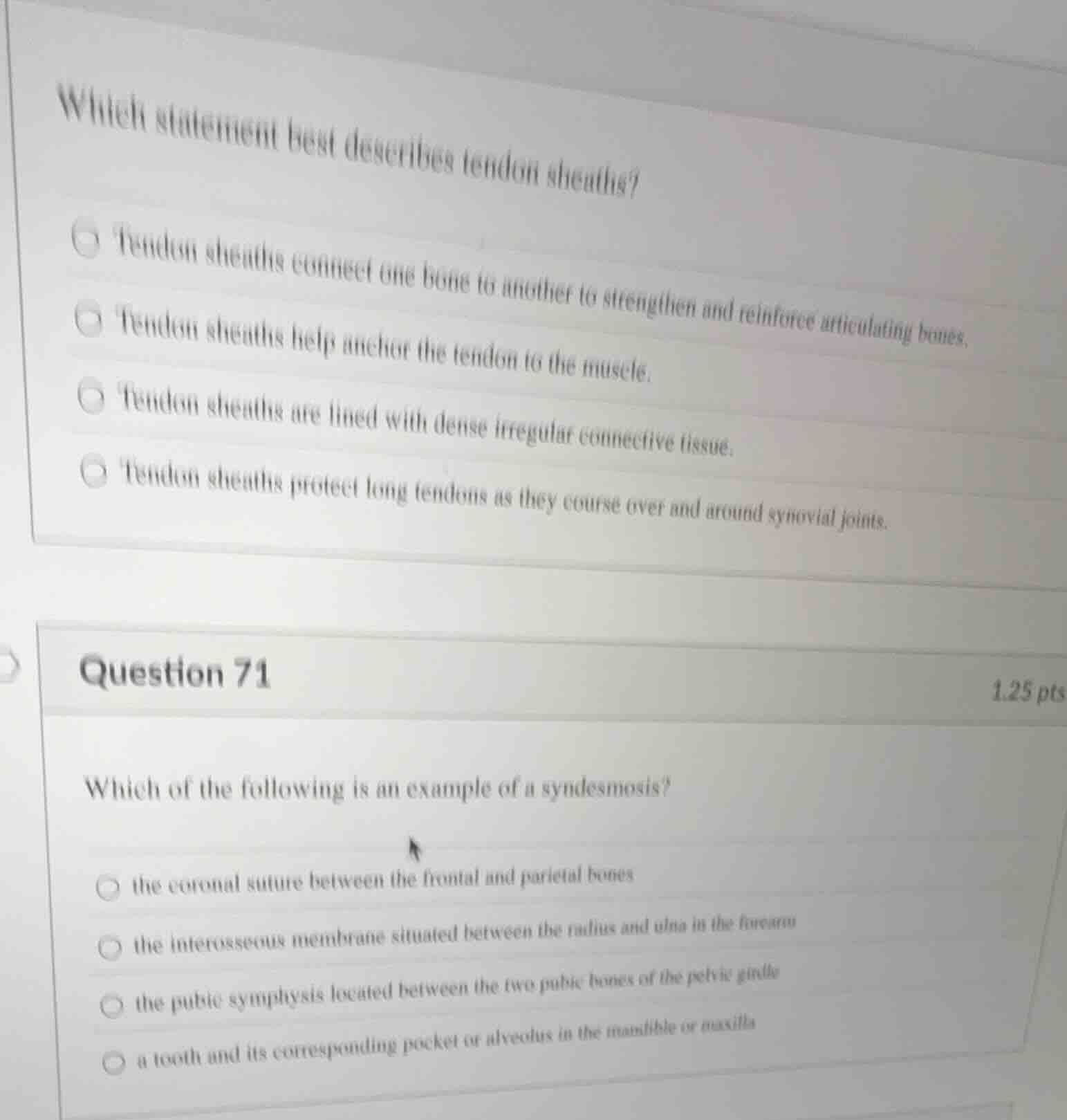
which statement best describes tendon sheaths?
tendon sheaths connect one bone to another to strengthen and reinforce articulating bones.
tendon sheaths help anchor the tendon to the muscle.
tendon sheaths are lined with dense irregular connective tissue.
tendon sheaths protect long tendons as they course over and around synovial joints.
question 71
which of the following is an example of a syndesmosis?
the coronal suture between the frontal and parietal bones
the interosseous membrane situated between the radius and ulna in the forearm
the pubic symphysis located between the two pubic bones of the pelvic girdle
a tooth and its corresponding pocket or alveolus in the mandible or maxilla
Analyze tendon sheath characteristics
We need to identify the statement that best describes tendon sheaths.
- Tendon sheaths are elongated bursa-like structures that wrap completely around tendons subjected to friction.
- They are commonly found where tendons course over and around synovial joints (such as the wrist and ankle) to protect them from friction and wear.
- They do not connect bone to bone (ligaments do) or anchor tendon to muscle (tendons naturally transition from muscle belly to bone).
- They are lined with a synovial membrane (producing synovial fluid) rather than dense irregular connective tissue.
- Therefore, the fourth option is the correct description.
Analyze examples of a syndesmosis
We need to identify which option is an example of a syndesmosis.
- A syndesmosis is a type of fibrous joint in which the bones are united by a ligament or an interosseous membrane.
- Let's evaluate the choices:
- The coronal suture is a suture joint.
- The interosseous membrane between the radius and ulna is a classic example of an amphiarthrotic syndesmosis.
- The pubic symphysis is a cartilaginous joint (specifically a symphysis).
- A tooth in its socket is a gomphosis.
- Therefore, the second option is the correct example.

Snap & solve any problem in the app
Get step-by-step solutions on Sovi AI
Photo-based solutions with guided steps
Explore more problems and detailed explanations
Question 1
- (A) Tendon sheaths connect one bone to another to strengthen and reinforce articulating bones.
- (B) Tendon sheaths help anchor the tendon to the muscle.
- (C) Tendon sheaths are lined with dense irregular connective tissue.
- (D) Tendon sheaths protect long tendons as they course over and around synovial joints. (Correct answer)
Question 2
- (A) the coronal suture between the frontal and parietal bones
- (B) the interosseous membrane situated between the radius and ulna in the forearm (Correct answer)
- (C) the pubic symphysis located between the two pubic bones of the pelvic girdle
- (D) a tooth and its corresponding pocket or alveolus in the mandible or maxilla