Sovi.AI - AI Math Tutor

Scan to solve math questions

QUESTION IMAGE

which statement about the pullman strike is true? - the pullman strike …

Question

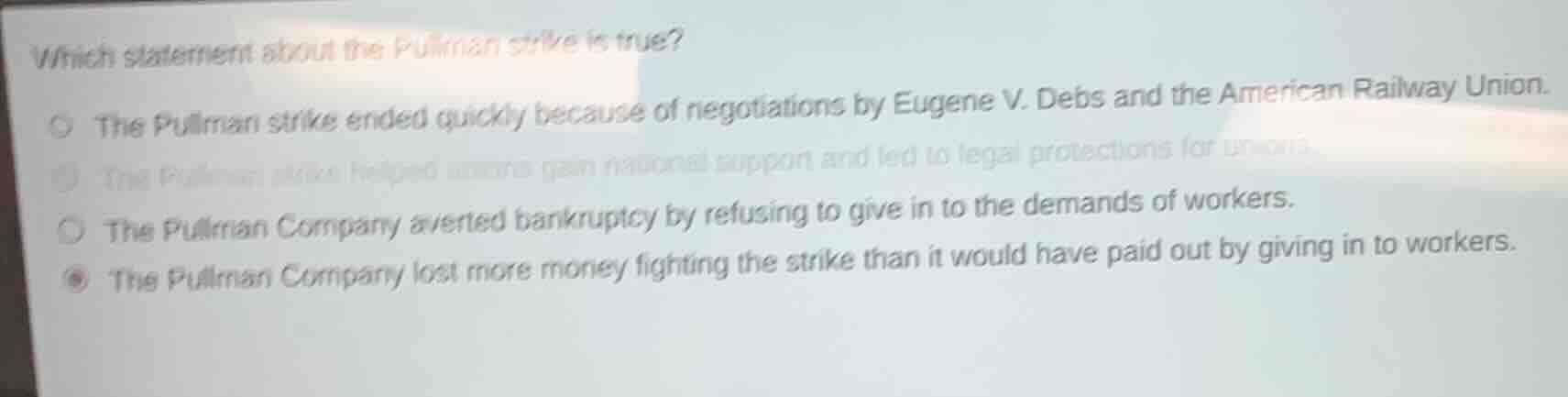
which statement about the pullman strike is true?

  • the pullman strike ended quickly because of negotiations by eugene v. debs and the american railway union.
  • the pullman strike helped unions gain national support and led to legal protections for unions.
  • the pullman company averted bankruptcy by refusing to give in to the demands of workers.
  • the pullman company lost more money fighting the strike than it would have paid out by giving in to workers.

Explanation:

Response

<pre_analysis>
{
"quality": "clear",
"question_count": 1,
"skills_matched": [
"direct_cot",
"multiple_choice_formatter",
"explain_then_answer",
"tutor"
],
"needs_drawing": false,
"concepts_used": [],
"new_concepts": [
"Pullman Strike",
"Labor History",
"Gilded Age Labor"
],
"current_concepts": [
"Pullman Strike",
"Labor History",
"Gilded Age Labor"
]
}
</pre_analysis>

<reasoning>

Analyze the Pullman Strike context

The Pullman Strike of 1894 was a major nationwide railroad strike in the United States. It pitted the American Railway Union (ARU) against the Pullman Company, the main railroads, and the federal government under President Grover Cleveland.

Evaluate the first option

The first option states that the strike ended quickly because of negotiations by Eugene V. Debs and the American Railway Union. This is incorrect. The strike did not end through peaceful negotiations; instead, the federal government intervened by obtaining an injunction and sending federal troops to break the strike, leading to the arrest of Eugene V. Debs.

Evaluate the second option

The second option states that the strike helped unions gain national support and led to legal protections. This is incorrect. The strike actually damaged public opinion of radical unionism at the time, and the federal government's use of court injunctions to break strikes became a powerful legal weapon against unions for decades.

Evaluate the third option

The third option states that the Pullman Company averted bankruptcy by refusing to give in. This is incorrect. While George Pullman refused to negotiate, the company was not on the verge of bankruptcy, and the strike itself caused massive financial losses.

Evaluate the fourth option

The fourth option states that the Pullman Company lost more money fighting the strike than it would have paid out by giving in to workers. This is historically accurate. George Pullman's stubborn refusal to negotiate or lower rents in his company town, despite slashing worker wages, led to a strike that cost his company and the railroads millions of dollars—far exceeding the cost of maintaining original wage levels.

</reasoning>

<answer>
<mcq-option>(A) The Pullman strike ended quickly because of negotiations by Eugene V. Debs and the American Railway Union.</mcq-option>
<mcq-option>(B) The Pullman strike helped unions gain national support and led to legal protections for unions.</mcq-option>
<mcq-option>(C) The Pullman Company averted bankruptcy by refusing to give in to the demands of workers.</mcq-option>
<mcq-correct>(D) The Pullman Company lost more money fighting the strike than it would have paid out by giving in to workers.</mcq-correct>
</answer>

<post_analysis>
{
"subject": "Social Science",
"question_type": "Multiple Choice",
"knowledge_point": [
"Social Science",
"U.S. History",
"Gilded Age Labor Movements"
]
}
</post_analysis>

Answer:

<pre_analysis>
{
"quality": "clear",
"question_count": 1,
"skills_matched": [
"direct_cot",
"multiple_choice_formatter",
"explain_then_answer",
"tutor"
],
"needs_drawing": false,
"concepts_used": [],
"new_concepts": [
"Pullman Strike",
"Labor History",
"Gilded Age Labor"
],
"current_concepts": [
"Pullman Strike",
"Labor History",
"Gilded Age Labor"
]
}
</pre_analysis>

<reasoning>

Analyze the Pullman Strike context

The Pullman Strike of 1894 was a major nationwide railroad strike in the United States. It pitted the American Railway Union (ARU) against the Pullman Company, the main railroads, and the federal government under President Grover Cleveland.

Evaluate the first option

The first option states that the strike ended quickly because of negotiations by Eugene V. Debs and the American Railway Union. This is incorrect. The strike did not end through peaceful negotiations; instead, the federal government intervened by obtaining an injunction and sending federal troops to break the strike, leading to the arrest of Eugene V. Debs.

Evaluate the second option

The second option states that the strike helped unions gain national support and led to legal protections. This is incorrect. The strike actually damaged public opinion of radical unionism at the time, and the federal government's use of court injunctions to break strikes became a powerful legal weapon against unions for decades.

Evaluate the third option

The third option states that the Pullman Company averted bankruptcy by refusing to give in. This is incorrect. While George Pullman refused to negotiate, the company was not on the verge of bankruptcy, and the strike itself caused massive financial losses.

Evaluate the fourth option

The fourth option states that the Pullman Company lost more money fighting the strike than it would have paid out by giving in to workers. This is historically accurate. George Pullman's stubborn refusal to negotiate or lower rents in his company town, despite slashing worker wages, led to a strike that cost his company and the railroads millions of dollars—far exceeding the cost of maintaining original wage levels.

</reasoning>

<answer>
<mcq-option>(A) The Pullman strike ended quickly because of negotiations by Eugene V. Debs and the American Railway Union.</mcq-option>
<mcq-option>(B) The Pullman strike helped unions gain national support and led to legal protections for unions.</mcq-option>
<mcq-option>(C) The Pullman Company averted bankruptcy by refusing to give in to the demands of workers.</mcq-option>
<mcq-correct>(D) The Pullman Company lost more money fighting the strike than it would have paid out by giving in to workers.</mcq-correct>
</answer>

<post_analysis>
{
"subject": "Social Science",
"question_type": "Multiple Choice",
"knowledge_point": [
"Social Science",
"U.S. History",
"Gilded Age Labor Movements"
]
}
</post_analysis>