QUESTION IMAGE
Question
which set of numbers is included in the solution set of the compound inequality?
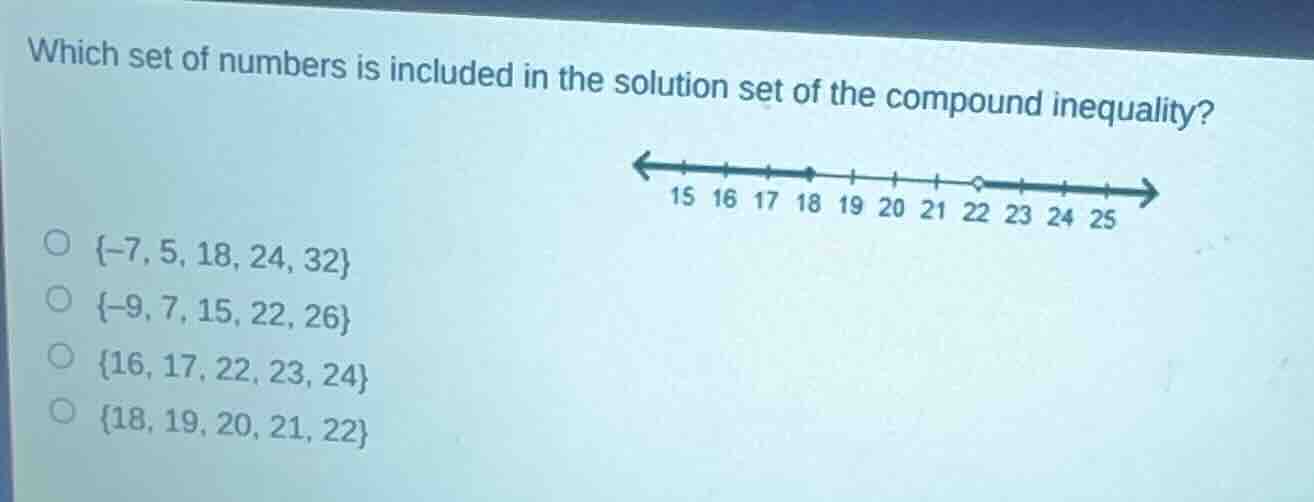
number line from 15 to 25, with a closed dot at 18 and an open dot at 22, shading to the left of 18 and to the right of 22
○ {-7, 5, 18, 24, 32}
○ {-9, 7, 15, 22, 26}
○ {16, 17, 22, 23, 24}
○ {18, 19, 20, 21, 22}
Step1: Analyze the number line
The number line has a closed dot at 18 (meaning 18 is included) and an open dot at 22 (meaning 22 is not included). The arrow to the left from 18 and to the right from 22? Wait, no, looking at the number line: the line is from left (15,16,17,18) with a closed dot at 18, then continues to 19,20,21, and an open dot at 22, then continues to 23,24,25... Wait, actually, the line is drawn from 15 (left) up to 18 (closed dot), then to 19,20,21, and then an open dot at 22, then the line continues to the right (23,24,25...). Wait, no, the direction: the left arrow starts at 15,16,17,18 (closed dot), so the solution set is \( x \leq 18 \) or \( x > 22 \)? Wait, no, the number line: the shaded part is from 15 (left) up to 18 (closed dot), then from 22 (open dot) to the right. Wait, no, the way the number line is drawn: the left part is 15,16,17,18 (closed dot) with a line going left? No, the arrow is to the left at 15, so the left part is \( x \leq 18 \), and the right part is \( x > 22 \) (open dot at 22, arrow to the right). So the solution set is numbers less than or equal to 18, or greater than 22.
Step2: Check each option
- Option 1: \(\{-7, 5, 18, 24, 32\}\). Check each number: -7 ≤18 (yes), 5 ≤18 (yes), 18 ≤18 (yes), 24 >22 (yes), 32 >22 (yes). So all numbers in this set are in the solution set? Wait, but let's check other options. Wait, maybe I misread the number line. Wait, the number line: the closed dot is at 18, and the open dot is at 22. Wait, maybe the solution is \( 18 \leq x < 22 \)? Wait, no, the line is from 15,16,17,18 (closed dot) to 19,20,21, and then open dot at 22. Wait, maybe the solution is \( x \leq 18 \) or \( x > 22 \)? Wait, no, the way the number line is drawn: the shaded region is from 15 (left) up to 18 (closed dot), then from 22 (open dot) to the right. Wait, but let's look at the options again. Wait, maybe I made a mistake. Wait, the number line: the closed dot is at 18, and the open dot is at 22. So the solution is \( 18 \leq x < 22 \)? No, because from 15 to 18 is shaded (left), and from 22 to right is shaded (right). Wait, the number line: the left part is 15,16,17,18 (closed dot) with a line going left (so \( x \leq 18 \)), and the right part is 22 (open dot) with a line going right (so \( x > 22 \)). So the solution set is \( x \leq 18 \) or \( x > 22 \).
Now check each option:
- Option 1: -7 ≤18 (yes), 5 ≤18 (yes), 18 ≤18 (yes), 24 >22 (yes), 32 >22 (yes). So all numbers here are in the solution set? But let's check other options. Wait, maybe I misinterpreted the number line. Wait, the number line: the closed dot is at 18, and the open dot is at 22. Wait, maybe the solution is \( 16 \leq x \leq 18 \) or \( 22 < x \)? No, the numbers on the line: 15,16,17,18 (closed dot), then 19,20,21, 22 (open dot), 23,24,25. Wait, maybe the solution is \( x \geq 16 \) and \( x \leq 18 \), or \( x > 22 \). Wait, let's check the options:
Option 1: -7,5,18,24,32. -7 and 5: are they on the number line? The number line starts at 15, so maybe the solution is within the numbers shown (15-25). So maybe my initial analysis is wrong. Let's look at the number line again: the numbers are 15,16,17,18 (closed dot), 19,20,21, 22 (open dot), 23,24,25. The shaded region: from 15 (left) up to 18 (closed dot), then from 22 (open dot) to the right. But the options have numbers like 16,17,22,23,24. Wait, maybe the solution is \( 16 \leq x \leq 18 \) or \( 22 < x \). Let's check each option:
Option 1: {-7,5,18,24,32} – -7 and 5 are not in 15-25, so maybe invalid.
Option 2: {-9,7,15,22,26} – -9,7,15…

Snap & solve any problem in the app
Get step-by-step solutions on Sovi AI
Photo-based solutions with guided steps
Explore more problems and detailed explanations
\(\{-7, 5, 18, 24, 32\}\) (the first option)