QUESTION IMAGE
Question
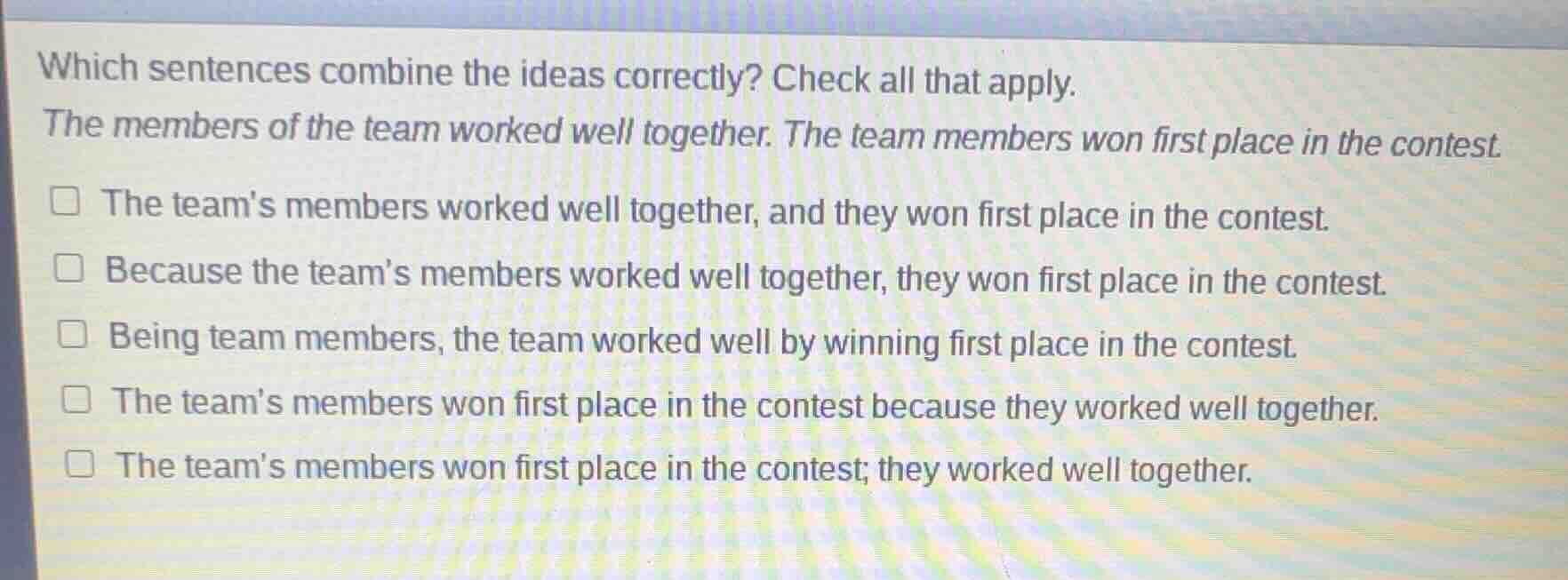
which sentences combine the ideas correctly? check all that apply.
the members of the team worked well together. the team members won first place in the contest.
- the teams members worked well together, and they won first place in the contest.
- because the teams members worked well together, they won first place in the contest.
- being team members, the team worked well by winning first place in the contest.
- the teams members won first place in the contest because they worked well together.
- the teams members won first place in the contest; they worked well together.
<pre_analysis>
{
"quality": "clear",
"question_count": 1,
"skills_matched": [
"direct_cot",
"multiple_choice_formatter",
"explain_then_answer",
"quick"
],
"needs_drawing": false,
"concepts_used": [
"Sentence Combining"
],
"new_concepts": [],
"current_concepts": [
"Sentence Combining",
"Grammar and Mechanics"
]
}
</pre_analysis>
<reasoning>
Analyze grammatical correctness and logical relationships
- Option 1: "The team's members worked well together, and they won first place in the contest."
- Combines two independent clauses using a comma and the coordinating conjunction "and".
- Grammatically correct and logically sound.
- Option 2: "Because the team's members worked well together, they won first place in the contest."
- Uses a subordinating conjunction "Because" to establish a cause-and-effect relationship.
- Grammatically correct and logically sound.
- Option 3: "Being team members, the team worked well by winning first place in the contest."
- Contains a dangling modifier ("Being team members" incorrectly modifies "the team" rather than the members) and distorts the original meaning.
- Grammatically and logically incorrect.
- Option 4: "The team's members won first place in the contest because they worked well together."
- Uses the subordinating conjunction "because" to connect the main clause with a dependent clause.
- Grammatically correct and logically sound.
- Option 5: "The team's members won first place in the contest; they worked well together."
- Connects two closely related independent clauses using a semicolon.
- Grammatically correct and logically sound.
</reasoning>
<answer>
<mcq-correct>(A) The team's members worked well together, and they won first place in the contest.</mcq-correct>
<mcq-correct>(B) Because the team's members worked well together, they won first place in the contest.</mcq-correct>
<mcq-option>(C) Being team members, the team worked well by winning first place in the contest.</mcq-option>
<mcq-correct>(D) The team's members won first place in the contest because they worked well together.</mcq-correct>
<mcq-correct>(E) The team's members won first place in the contest; they worked well together.</mcq-correct>
</answer>
<post_analysis>
{
"subject": "Others",
"question_type": "Multiple Choice",
"knowledge_point": [
"Others",
"Grammar and Mechanics",
"Sentence Combining"
]
}
</post_analysis>
Snap & solve any problem in the app
Get step-by-step solutions on Sovi AI
Photo-based solutions with guided steps
Explore more problems and detailed explanations
<pre_analysis>
{
"quality": "clear",
"question_count": 1,
"skills_matched": [
"direct_cot",
"multiple_choice_formatter",
"explain_then_answer",
"quick"
],
"needs_drawing": false,
"concepts_used": [
"Sentence Combining"
],
"new_concepts": [],
"current_concepts": [
"Sentence Combining",
"Grammar and Mechanics"
]
}
</pre_analysis>
<reasoning>
Analyze grammatical correctness and logical relationships
- Option 1: "The team's members worked well together, and they won first place in the contest."
- Combines two independent clauses using a comma and the coordinating conjunction "and".
- Grammatically correct and logically sound.
- Option 2: "Because the team's members worked well together, they won first place in the contest."
- Uses a subordinating conjunction "Because" to establish a cause-and-effect relationship.
- Grammatically correct and logically sound.
- Option 3: "Being team members, the team worked well by winning first place in the contest."
- Contains a dangling modifier ("Being team members" incorrectly modifies "the team" rather than the members) and distorts the original meaning.
- Grammatically and logically incorrect.
- Option 4: "The team's members won first place in the contest because they worked well together."
- Uses the subordinating conjunction "because" to connect the main clause with a dependent clause.
- Grammatically correct and logically sound.
- Option 5: "The team's members won first place in the contest; they worked well together."
- Connects two closely related independent clauses using a semicolon.
- Grammatically correct and logically sound.
</reasoning>
<answer>
<mcq-correct>(A) The team's members worked well together, and they won first place in the contest.</mcq-correct>
<mcq-correct>(B) Because the team's members worked well together, they won first place in the contest.</mcq-correct>
<mcq-option>(C) Being team members, the team worked well by winning first place in the contest.</mcq-option>
<mcq-correct>(D) The team's members won first place in the contest because they worked well together.</mcq-correct>
<mcq-correct>(E) The team's members won first place in the contest; they worked well together.</mcq-correct>
</answer>
<post_analysis>
{
"subject": "Others",
"question_type": "Multiple Choice",
"knowledge_point": [
"Others",
"Grammar and Mechanics",
"Sentence Combining"
]
}
</post_analysis>