QUESTION IMAGE
Question
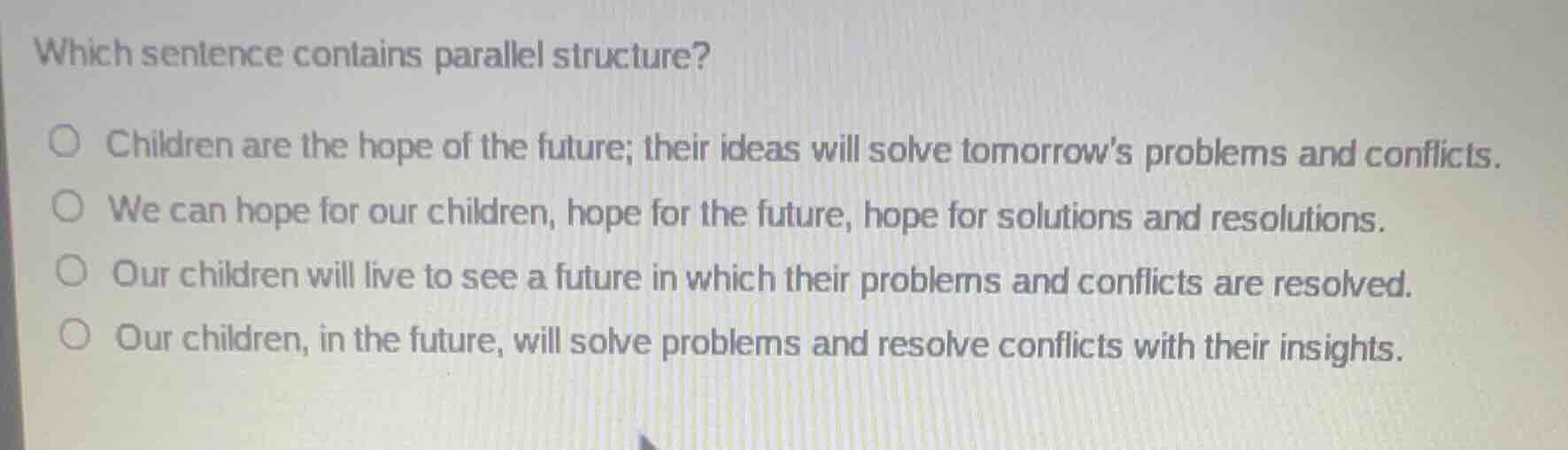
which sentence contains parallel structure?
children are the hope of the future; their ideas will solve tomorrows problems and conflicts.
we can hope for our children, hope for the future, hope for solutions and resolutions.
our children will live to see a future in which their problems and conflicts are resolved.
our children, in the future, will solve problems and resolve conflicts with their insights.
<pre_analysis>
{
"quality": "clear",
"question_count": 1,
"skills_matched": [
"direct_cot",
"multiple_choice_formatter",
"explain_then_answer",
"quick"
],
"needs_drawing": false,
"concepts_used": [],
"new_concepts": [
"Parallel Structure",
"Grammatical Parallelism"
],
"current_concepts": [
"Parallel Structure",
"Grammatical Parallelism"
]
}
</pre_analysis>
<reasoning>
Define parallel structure
Parallel structure (parallelism) is the repetition of a chosen grammatical form within a sentence to create balance and rhythm.
Analyze the given options
- Option 1: "Children are the hope of the future; their ideas will solve tomorrow's problems and conflicts." (No repeating grammatical patterns or lists of parallel phrases).
- Option 2: "We can hope for our children, hope for the future, hope for solutions and resolutions." (Repeats the grammatical pattern "hope for [noun phrase]" three times: "hope for our children," "hope for the future," and "hope for solutions and resolutions").
- Option 3: "Our children will live to see a future in which their problems and conflicts are resolved." (Standard complex sentence structure without parallel lists).
- Option 4: "Our children, in the future, will solve problems and resolve conflicts with their insights." (Standard compound predicate structure, but lacks the distinct rhythmic repetition of Option 2).
Select the correct option
Option 2 demonstrates clear grammatical parallelism through the repetition of the verb-preposition-noun phrase pattern.
</reasoning>
<answer>
<mcq-option>(A) Children are the hope of the future; their ideas will solve tomorrow's problems and conflicts.</mcq-option>
<mcq-correct>(B) We can hope for our children, hope for the future, hope for solutions and resolutions.</mcq-correct>
<mcq-option>(C) Our children will live to see a future in which their problems and conflicts are resolved.</mcq-option>
<mcq-option>(D) Our children, in the future, will solve problems and resolve conflicts with their insights.</mcq-option>
</answer>
<post_analysis>
{
"subject": "Others",
"question_type": "Multiple Choice",
"knowledge_point": [
"Others",
"English Language Arts",
"Grammar and Sentence Structure"
]
}
</post_analysis>
Snap & solve any problem in the app
Get step-by-step solutions on Sovi AI
Photo-based solutions with guided steps
Explore more problems and detailed explanations
<pre_analysis>
{
"quality": "clear",
"question_count": 1,
"skills_matched": [
"direct_cot",
"multiple_choice_formatter",
"explain_then_answer",
"quick"
],
"needs_drawing": false,
"concepts_used": [],
"new_concepts": [
"Parallel Structure",
"Grammatical Parallelism"
],
"current_concepts": [
"Parallel Structure",
"Grammatical Parallelism"
]
}
</pre_analysis>
<reasoning>
Define parallel structure
Parallel structure (parallelism) is the repetition of a chosen grammatical form within a sentence to create balance and rhythm.
Analyze the given options
- Option 1: "Children are the hope of the future; their ideas will solve tomorrow's problems and conflicts." (No repeating grammatical patterns or lists of parallel phrases).
- Option 2: "We can hope for our children, hope for the future, hope for solutions and resolutions." (Repeats the grammatical pattern "hope for [noun phrase]" three times: "hope for our children," "hope for the future," and "hope for solutions and resolutions").
- Option 3: "Our children will live to see a future in which their problems and conflicts are resolved." (Standard complex sentence structure without parallel lists).
- Option 4: "Our children, in the future, will solve problems and resolve conflicts with their insights." (Standard compound predicate structure, but lacks the distinct rhythmic repetition of Option 2).
Select the correct option
Option 2 demonstrates clear grammatical parallelism through the repetition of the verb-preposition-noun phrase pattern.
</reasoning>
<answer>
<mcq-option>(A) Children are the hope of the future; their ideas will solve tomorrow's problems and conflicts.</mcq-option>
<mcq-correct>(B) We can hope for our children, hope for the future, hope for solutions and resolutions.</mcq-correct>
<mcq-option>(C) Our children will live to see a future in which their problems and conflicts are resolved.</mcq-option>
<mcq-option>(D) Our children, in the future, will solve problems and resolve conflicts with their insights.</mcq-option>
</answer>
<post_analysis>
{
"subject": "Others",
"question_type": "Multiple Choice",
"knowledge_point": [
"Others",
"English Language Arts",
"Grammar and Sentence Structure"
]
}
</post_analysis>