QUESTION IMAGE
Question
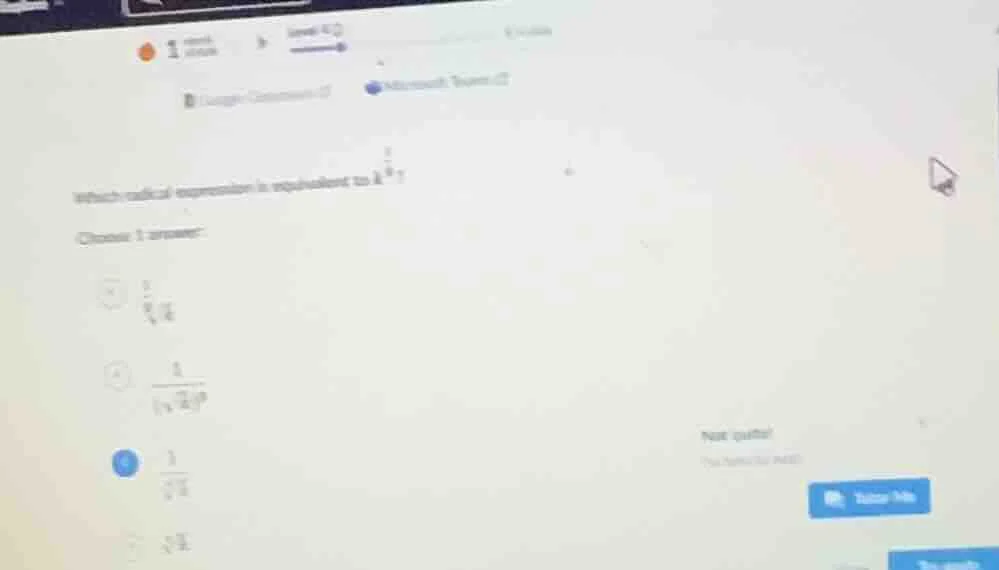
which radical expression is equivalent to ( k^{-\frac{1}{3}} )?
choose 1 answer:
( \frac{1}{sqrt3{k}} )
( \frac{1}{(sqrt{k})^3} )
( \frac{1}{sqrt3{k}} )
( sqrt{k} )
Step1: Recall the exponent - radical rule
The rule for converting a negative fractional exponent to a radical is \(a^{-\frac{m}{n}}=\frac{1}{a^{\frac{m}{n}}}\), and \(a^{\frac{m}{n}}=\sqrt[n]{a^{m}}\) (or equivalently \((\sqrt[n]{a})^{m}\)).
For the expression \(k^{-\frac{1}{5}}\), first apply the negative exponent rule: \(k^{-\frac{1}{5}}=\frac{1}{k^{\frac{1}{5}}}\).
Step2: Convert the fractional exponent to radical
Now, use the rule \(a^{\frac{m}{n}}=\sqrt[n]{a^{m}}\) for \(a = k\), \(m = 1\) and \(n=5\). So \(k^{\frac{1}{5}}=\sqrt[5]{k}\).
Substituting back into \(\frac{1}{k^{\frac{1}{5}}}\), we get \(\frac{1}{\sqrt[5]{k}}\).

Snap & solve any problem in the app
Get step-by-step solutions on Sovi AI
Photo-based solutions with guided steps
Explore more problems and detailed explanations
\(\frac{1}{\sqrt[5]{k}}\) (corresponding to the option with \(\frac{1}{\sqrt[5]{k}}\))