QUESTION IMAGE
Question
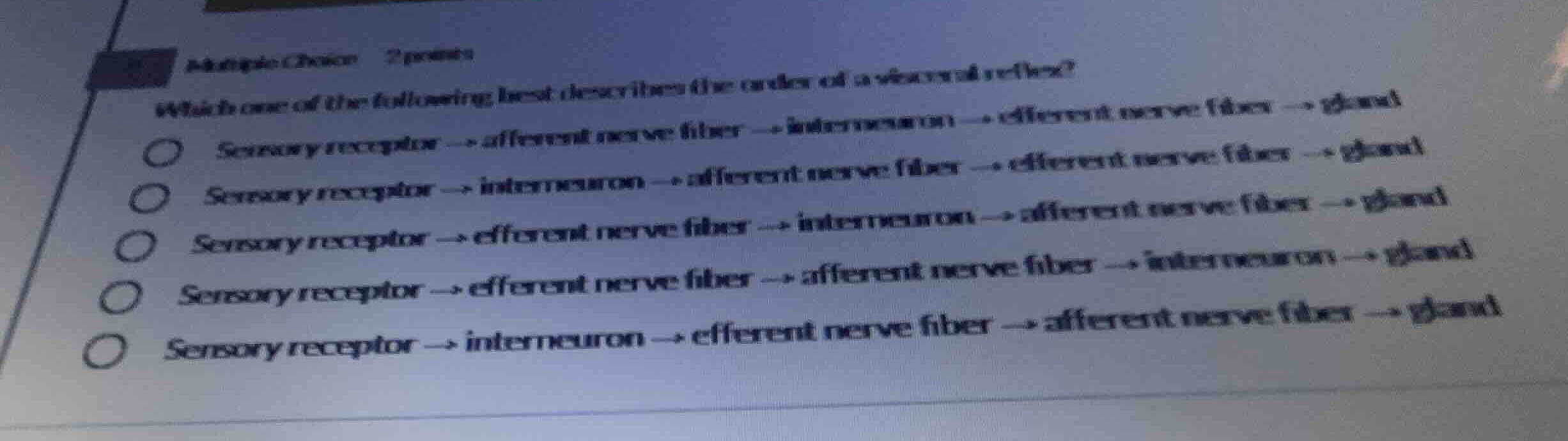
which one of the following best describes the order of a visceral reflex?
sensory receptor \\(\
ightarrow\\) afferent nerve fiber \\(\
ightarrow\\) interneuron \\(\
ightarrow\\) efferent nerve fiber \\(\
ightarrow\\) gland
sensory receptor \\(\
ightarrow\\) interneuron \\(\
ightarrow\\) afferent nerve fiber \\(\
ightarrow\\) efferent nerve fiber \\(\
ightarrow\\) gland
sensory receptor \\(\
ightarrow\\) efferent nerve fiber \\(\
ightarrow\\) interneuron \\(\
ightarrow\\) afferent nerve fiber \\(\
ightarrow\\) gland
sensory receptor \\(\
ightarrow\\) efferent nerve fiber \\(\
ightarrow\\) afferent nerve fiber \\(\
ightarrow\\) interneuron \\(\
ightarrow\\) gland
sensory receptor \\(\
ightarrow\\) interneuron \\(\
ightarrow\\) efferent nerve fiber \\(\
ightarrow\\) afferent nerve fiber \\(\
ightarrow\\) gland
Identify the components of a reflex arc
A standard reflex arc consists of five basic components in sequential order:
- Sensory receptor: Detects the internal or external stimulus.
- Afferent nerve fiber: Transmits the sensory signal from the receptor to the central nervous system (CNS).
- Interneuron: Integrates the incoming signal within the CNS (spinal cord or brain).
- Efferent nerve fiber: Carries the motor command from the CNS to the effector organ.
- Effector: The organ (such as a muscle or gland) that responds to the motor command.
Apply to a visceral reflex
Using the Afferent and Efferent Fibers knowledge point
- Afferent fibers conduct signals toward the CNS, while efferent fibers conduct signals away from the CNS to effectors like glands.
- Therefore, the correct sequence must progress from receptor to afferent fiber, then to the interneuron, followed by the efferent fiber, and finally to the effector (gland).
Evaluate the given options
- Option 1: Sensory receptor \(
ightarrow\) afferent nerve fiber \(
ightarrow\) interneuron \(
ightarrow\) efferent nerve fiber \(
ightarrow\) gland. This perfectly matches the physiological pathway.
- Option 2: Places the interneuron before the afferent fiber, which is incorrect.
- Option 3: Places the efferent fiber before the interneuron and afferent fiber, which is incorrect.
- Option 4: Places the efferent fiber before the afferent fiber, which is incorrect.
- Option 5: Places the interneuron before the efferent and afferent fibers, which is incorrect.

Snap & solve any problem in the app
Get step-by-step solutions on Sovi AI
Photo-based solutions with guided steps
Explore more problems and detailed explanations
- **(A) Sensory receptor \(
ightarrow\) afferent nerve fiber \(
ightarrow\) interneuron \(
ightarrow\) efferent nerve fiber \(
ightarrow\) gland (Correct answer)**
- (B) Sensory receptor \(
ightarrow\) interneuron \(
ightarrow\) afferent nerve fiber \(
ightarrow\) efferent nerve fiber \(
ightarrow\) gland
- (C) Sensory receptor \(
ightarrow\) efferent nerve fiber \(
ightarrow\) interneuron \(
ightarrow\) afferent nerve fiber \(
ightarrow\) gland
- (D) Sensory receptor \(
ightarrow\) efferent nerve fiber \(
ightarrow\) afferent nerve fiber \(
ightarrow\) interneuron \(
ightarrow\) gland
- (E) Sensory receptor \(
ightarrow\) interneuron \(
ightarrow\) efferent nerve fiber \(
ightarrow\) afferent nerve fiber \(
ightarrow\) gland