Sovi.AI - AI Math Tutor

Scan to solve math questions

QUESTION IMAGE

which narrator is most clearly omniscient? a. people like to pass judgm…

Question

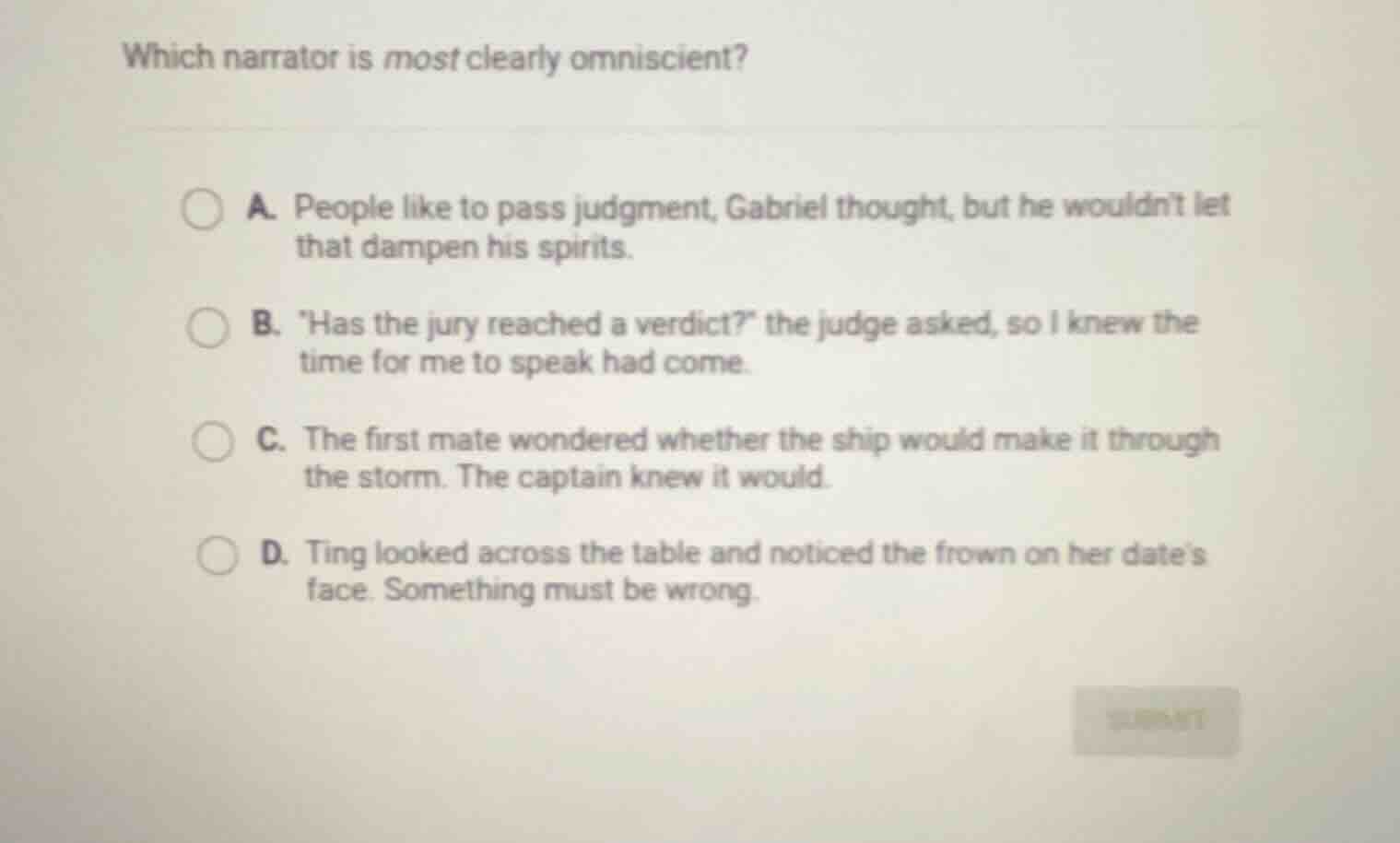
which narrator is most clearly omniscient?

a. people like to pass judgment, gabriel thought, but he wouldnt let that dampen his spirits.
b. \has the jury reached a verdict?\ the judge asked, so i knew the time for me to speak had come.
c. the first mate wondered whether the ship would make it through the storm. the captain knew it would.
d. ting looked across the table and noticed the frown on her dates face. something must be wrong.

Explanation:

Response

<pre_analysis>
{
"quality": "clear",
"question_count": 1,
"skills_matched": [
"direct_cot",
"multiple_choice_formatter",
"explain_then_answer",
"tutor"
],
"needs_drawing": false,
"concepts_used": [],
"new_concepts": [
"Narrative Point of View",
"Omniscient Narrator",
"Limited vs Omniscient"
],
"current_concepts": [
"Narrative Point of View",
"Omniscient Narrator",
"Limited vs Omniscient"
]
}
</pre_analysis>

<reasoning>

Define omniscient narration

An omniscient (all-knowing) narrator has access to the inner thoughts, feelings, and motivations of multiple characters in a story. This differs from a limited third-person narrator, who only knows the thoughts of a single character, and a first-person narrator, who tells the story from their own perspective using "I."

Analyze each option for narrative perspective

  • Option A: "People like to pass judgment, Gabriel thought, but he wouldn't let that dampen his spirits." This uses third-person limited perspective because we only access the thoughts of one character, Gabriel.
  • Option B: "'Has the jury reached a verdict?' the judge asked, so I knew the time for me to speak had come." This uses first-person perspective, indicated by the pronoun "I."
  • Option C: "The first mate wondered whether the ship would make it through the storm. The captain knew it would." This narrator knows the internal state of two different characters: the first mate's doubt ("wondered") and the captain's certainty ("knew"). This demonstrates omniscience.
  • Option D: "Ting looked across the table and noticed the frown on her date's face. Something must be wrong." This is third-person limited or objective. The narrator observes Ting's actions and guesses what her date is thinking based on external cues ("noticed the frown", "Something must be wrong"), rather than knowing the date's thoughts directly.

Identify the correct choice

Option C is the only choice where the narrator directly reveals the internal thoughts and feelings of more than one character, making it the most clearly omniscient narrator.
</reasoning>

<answer>
<mcq-option>A. People like to pass judgment, Gabriel thought, but he wouldn't let that dampen his spirits.</mcq-option>
<mcq-option>B. "Has the jury reached a verdict?" the judge asked, so I knew the time for me to speak had come.</mcq-option>
<mcq-correct>C. The first mate wondered whether the ship would make it through the storm. The captain knew it would.</mcq-correct>
<mcq-option>D. Ting looked across the table and noticed the frown on her date's face. Something must be wrong.</mcq-option>
</answer>

<post_analysis>
{
"subject": "Others",
"question_type": "Multiple Choice",
"knowledge_point": [
"Others",
"Literature",
"Narrative Point of View"
]
}
</post_analysis>

Answer:

<pre_analysis>
{
"quality": "clear",
"question_count": 1,
"skills_matched": [
"direct_cot",
"multiple_choice_formatter",
"explain_then_answer",
"tutor"
],
"needs_drawing": false,
"concepts_used": [],
"new_concepts": [
"Narrative Point of View",
"Omniscient Narrator",
"Limited vs Omniscient"
],
"current_concepts": [
"Narrative Point of View",
"Omniscient Narrator",
"Limited vs Omniscient"
]
}
</pre_analysis>

<reasoning>

Define omniscient narration

An omniscient (all-knowing) narrator has access to the inner thoughts, feelings, and motivations of multiple characters in a story. This differs from a limited third-person narrator, who only knows the thoughts of a single character, and a first-person narrator, who tells the story from their own perspective using "I."

Analyze each option for narrative perspective

  • Option A: "People like to pass judgment, Gabriel thought, but he wouldn't let that dampen his spirits." This uses third-person limited perspective because we only access the thoughts of one character, Gabriel.
  • Option B: "'Has the jury reached a verdict?' the judge asked, so I knew the time for me to speak had come." This uses first-person perspective, indicated by the pronoun "I."
  • Option C: "The first mate wondered whether the ship would make it through the storm. The captain knew it would." This narrator knows the internal state of two different characters: the first mate's doubt ("wondered") and the captain's certainty ("knew"). This demonstrates omniscience.
  • Option D: "Ting looked across the table and noticed the frown on her date's face. Something must be wrong." This is third-person limited or objective. The narrator observes Ting's actions and guesses what her date is thinking based on external cues ("noticed the frown", "Something must be wrong"), rather than knowing the date's thoughts directly.

Identify the correct choice

Option C is the only choice where the narrator directly reveals the internal thoughts and feelings of more than one character, making it the most clearly omniscient narrator.
</reasoning>

<answer>
<mcq-option>A. People like to pass judgment, Gabriel thought, but he wouldn't let that dampen his spirits.</mcq-option>
<mcq-option>B. "Has the jury reached a verdict?" the judge asked, so I knew the time for me to speak had come.</mcq-option>
<mcq-correct>C. The first mate wondered whether the ship would make it through the storm. The captain knew it would.</mcq-correct>
<mcq-option>D. Ting looked across the table and noticed the frown on her date's face. Something must be wrong.</mcq-option>
</answer>

<post_analysis>
{
"subject": "Others",
"question_type": "Multiple Choice",
"knowledge_point": [
"Others",
"Literature",
"Narrative Point of View"
]
}
</post_analysis>