QUESTION IMAGE
Question
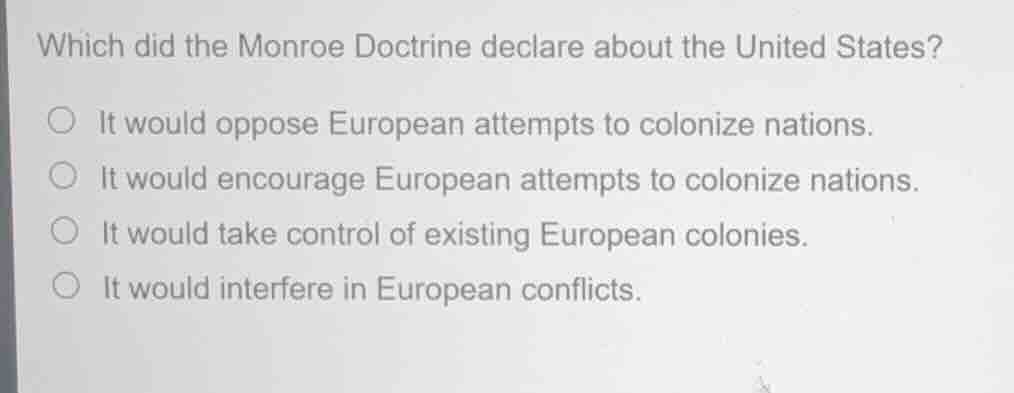
which did the monroe doctrine declare about the united states?
it would oppose european attempts to colonize nations.
it would encourage european attempts to colonize nations.
it would take control of existing european colonies.
it would interfere in european conflicts.
<pre_analysis>
{
"quality": "clear",
"question_count": 1,
"skills_matched": [
"direct_cot",
"multiple_choice_formatter",
"explain_then_answer",
"quick"
],
"needs_drawing": false,
"concepts_used": [
"Monroe Doctrine"
],
"new_concepts": [],
"current_concepts": [
"Monroe Doctrine",
"US Foreign Policy"
]
}
</pre_analysis>
<reasoning>
Analyze the core principles of the Monroe Doctrine
The Monroe Doctrine, introduced by President James Monroe in 1823, established key tenets of United States foreign policy regarding the Western Hemisphere. Its primary declaration was that the American continents were no longer open to future colonization by European powers.
Evaluate the given options against historical facts
- Option 1: "It would oppose European attempts to colonize nations." This aligns directly with the doctrine's warning that any European intervention or colonization in the Americas would be viewed as a hostile act toward the United States.
- Option 2: "It would encourage European attempts to colonize nations." This is the opposite of the doctrine's intent.
- Option 3: "It would take control of existing European colonies." The doctrine explicitly stated that the United States would not interfere with existing European colonies.
- Option 4: "It would interfere in European conflicts." The doctrine declared that the United States would remain neutral and not meddle in the internal affairs or wars of European nations.
Select the correct option
Based on the analysis, the Monroe Doctrine declared that the United States would oppose any new European colonization efforts in the Western Hemisphere.
</reasoning>
<answer>
<mcq-correct>It would oppose European attempts to colonize nations.</mcq-correct>
<mcq-option>It would encourage European attempts to colonize nations.</mcq-option>
<mcq-option>It would take control of existing European colonies.</mcq-option>
<mcq-option>It would interfere in European conflicts.</mcq-option>
</answer>
<post_analysis>
{
"subject": "Social Science",
"question_type": "Multiple Choice",
"knowledge_point": [
"Social Science",
"U.S. History",
"Monroe Doctrine"
]
}
</post_analysis>
Snap & solve any problem in the app
Get step-by-step solutions on Sovi AI
Photo-based solutions with guided steps
Explore more problems and detailed explanations
<pre_analysis>
{
"quality": "clear",
"question_count": 1,
"skills_matched": [
"direct_cot",
"multiple_choice_formatter",
"explain_then_answer",
"quick"
],
"needs_drawing": false,
"concepts_used": [
"Monroe Doctrine"
],
"new_concepts": [],
"current_concepts": [
"Monroe Doctrine",
"US Foreign Policy"
]
}
</pre_analysis>
<reasoning>
Analyze the core principles of the Monroe Doctrine
The Monroe Doctrine, introduced by President James Monroe in 1823, established key tenets of United States foreign policy regarding the Western Hemisphere. Its primary declaration was that the American continents were no longer open to future colonization by European powers.
Evaluate the given options against historical facts
- Option 1: "It would oppose European attempts to colonize nations." This aligns directly with the doctrine's warning that any European intervention or colonization in the Americas would be viewed as a hostile act toward the United States.
- Option 2: "It would encourage European attempts to colonize nations." This is the opposite of the doctrine's intent.
- Option 3: "It would take control of existing European colonies." The doctrine explicitly stated that the United States would not interfere with existing European colonies.
- Option 4: "It would interfere in European conflicts." The doctrine declared that the United States would remain neutral and not meddle in the internal affairs or wars of European nations.
Select the correct option
Based on the analysis, the Monroe Doctrine declared that the United States would oppose any new European colonization efforts in the Western Hemisphere.
</reasoning>
<answer>
<mcq-correct>It would oppose European attempts to colonize nations.</mcq-correct>
<mcq-option>It would encourage European attempts to colonize nations.</mcq-option>
<mcq-option>It would take control of existing European colonies.</mcq-option>
<mcq-option>It would interfere in European conflicts.</mcq-option>
</answer>
<post_analysis>
{
"subject": "Social Science",
"question_type": "Multiple Choice",
"knowledge_point": [
"Social Science",
"U.S. History",
"Monroe Doctrine"
]
}
</post_analysis>