Sovi.AI - AI Math Tutor

Scan to solve math questions

QUESTION IMAGE

which legal case forced the university of maryland to admit an african …

Question

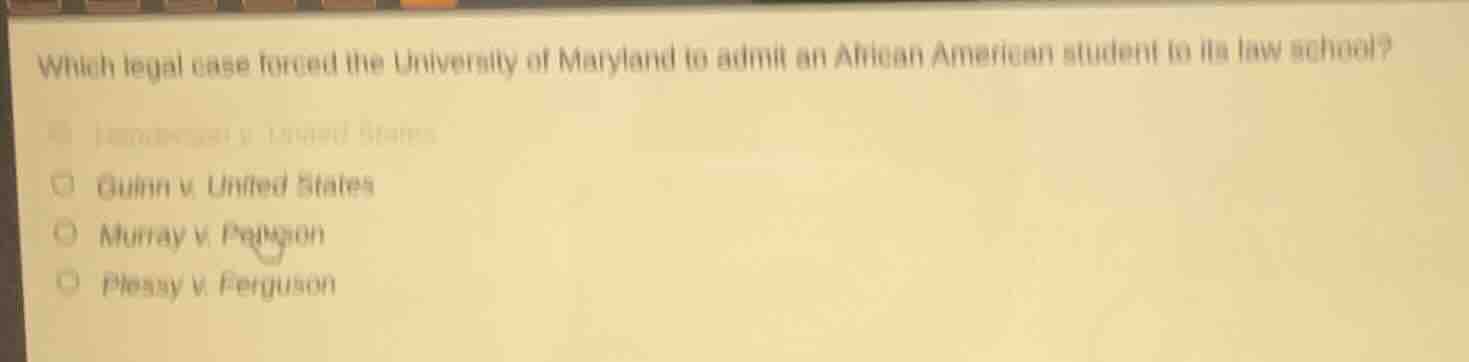
which legal case forced the university of maryland to admit an african american student to its law school?

henderson v. united states
guinn v. united states
murray v. pearson
plessy v. ferguson

Explanation:

Response

<pre_analysis>
{
"quality": "clear",
"question_count": 1,
"skills_matched": [
"direct_cot",
"multiple_choice_formatter",
"explain_then_answer",
"tutor"
],
"needs_drawing": false,
"concepts_used": [
"NAACP Mission",
"Civil Rights Movement"
],
"new_concepts": [
"Murray v. Pearson",
"Desegregation of Higher Education"
],
"current_concepts": [
"NAACP Mission",
"Civil Rights Movement",
"Murray v. Pearson",
"Desegregation of Higher Education"
]
}
</pre_analysis>

<reasoning>

Identify the core historical question

The question asks for the specific legal case that forced the University of Maryland to admit an African American student to its law school.

Analyze the historical context and legal cases

  • Henderson v. United States (1950): Focused on ending segregation in railroad dining cars.
  • Guinn v. United States (1915): Addressed voting rights, specifically striking down grandfather clauses.
  • Murray v. Pearson (1936): A landmark Maryland Court of Appeals decision. Donald Gaines Murray, represented by Thurgood Marshall and Charles Hamilton Houston of the NAACP Mission, sued after being denied admission to the University of Maryland School of Law based on his race. The court ruled that the state must provide equal educational opportunities, forcing the law school to admit him.
  • Plessy v. Ferguson (1896): Established the "separate but equal" doctrine, which upheld state-imposed racial segregation.

Connect to the student's background

This legal victory was a crucial early milestone in the broader Civil Rights Movement legal strategy to dismantle segregation in public education, laying the groundwork for Brown v. Board of Education.
</reasoning>

<answer>
<mcq-option>(A) Henderson v. United States</mcq-option>
<mcq-option>(B) Guinn v. United States</mcq-option>
<mcq-correct>(C) Murray v. Pearson</mcq-correct>
<mcq-option>(D) Plessy v. Ferguson</mcq-option>
</answer>

<post_analysis>
{
"subject": "Social Science",
"question_type": "Multiple Choice",
"knowledge_point": [
"Social Science",
"History",
"Civil Rights Movement"
]
}
</post_analysis>

Answer:

<pre_analysis>
{
"quality": "clear",
"question_count": 1,
"skills_matched": [
"direct_cot",
"multiple_choice_formatter",
"explain_then_answer",
"tutor"
],
"needs_drawing": false,
"concepts_used": [
"NAACP Mission",
"Civil Rights Movement"
],
"new_concepts": [
"Murray v. Pearson",
"Desegregation of Higher Education"
],
"current_concepts": [
"NAACP Mission",
"Civil Rights Movement",
"Murray v. Pearson",
"Desegregation of Higher Education"
]
}
</pre_analysis>

<reasoning>

Identify the core historical question

The question asks for the specific legal case that forced the University of Maryland to admit an African American student to its law school.

Analyze the historical context and legal cases

  • Henderson v. United States (1950): Focused on ending segregation in railroad dining cars.
  • Guinn v. United States (1915): Addressed voting rights, specifically striking down grandfather clauses.
  • Murray v. Pearson (1936): A landmark Maryland Court of Appeals decision. Donald Gaines Murray, represented by Thurgood Marshall and Charles Hamilton Houston of the NAACP Mission, sued after being denied admission to the University of Maryland School of Law based on his race. The court ruled that the state must provide equal educational opportunities, forcing the law school to admit him.
  • Plessy v. Ferguson (1896): Established the "separate but equal" doctrine, which upheld state-imposed racial segregation.

Connect to the student's background

This legal victory was a crucial early milestone in the broader Civil Rights Movement legal strategy to dismantle segregation in public education, laying the groundwork for Brown v. Board of Education.
</reasoning>

<answer>
<mcq-option>(A) Henderson v. United States</mcq-option>
<mcq-option>(B) Guinn v. United States</mcq-option>
<mcq-correct>(C) Murray v. Pearson</mcq-correct>
<mcq-option>(D) Plessy v. Ferguson</mcq-option>
</answer>

<post_analysis>
{
"subject": "Social Science",
"question_type": "Multiple Choice",
"knowledge_point": [
"Social Science",
"History",
"Civil Rights Movement"
]
}
</post_analysis>