QUESTION IMAGE
Question
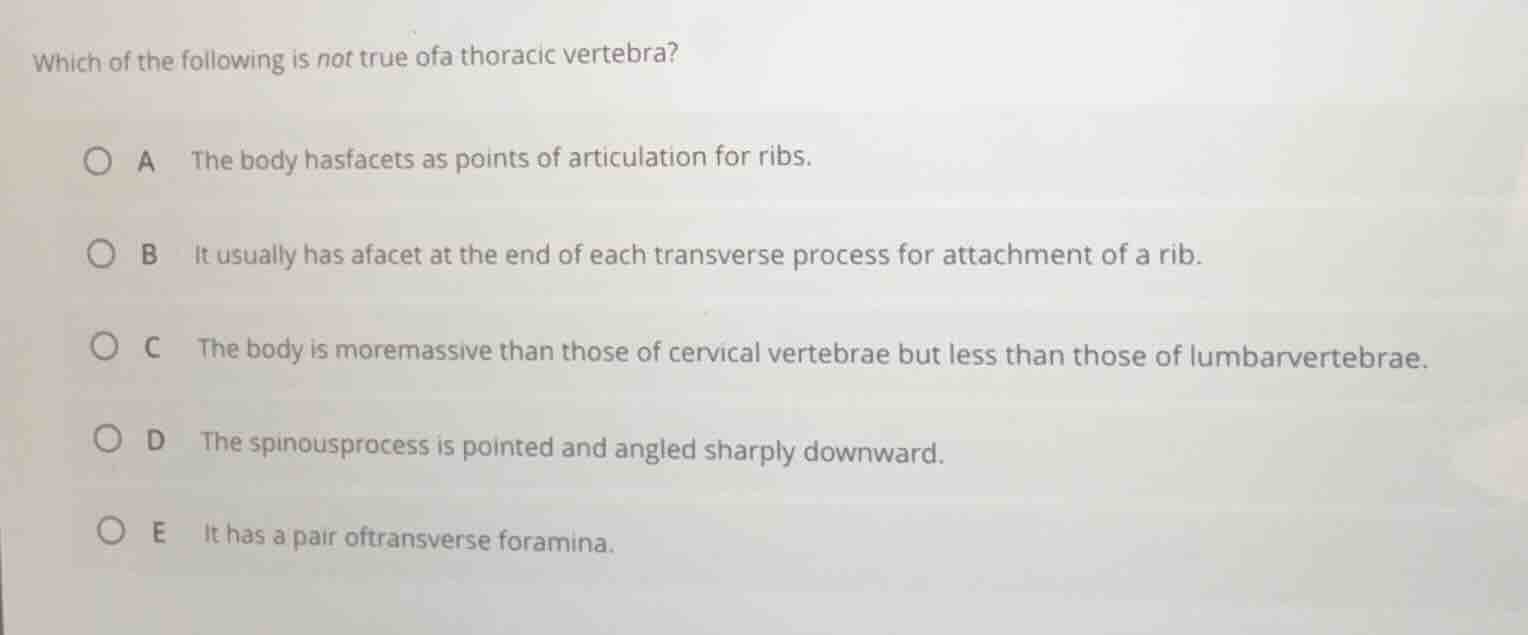
which of the following is not true of a thoracic vertebra?
a the body has facets as points of articulation for ribs.
b it usually has a facet at the end of each transverse process for attachment of a rib.
c the body is more massive than those of cervical vertebrae but less than those of lumbar vertebrae.
d the spinous process is pointed and angled sharply downward.
e it has a pair of transverse foramina.
Analyze thoracic vertebral body features
Using the Skeletal Anatomy and Joint Articulation knowledge points, we evaluate option A. Thoracic vertebrae articulate with ribs. The vertebral bodies have superior and inferior costal facets (demifacets) for head of rib articulation. Thus, option A is true.
Evaluate transverse process facets
Using the Skeletal Anatomy and Joint Articulation knowledge points, we evaluate option B. Thoracic vertebrae T1–T10 have transverse costal facets on their transverse processes to articulate with the tubercle of a rib. Thus, option B is true.
Compare vertebral body sizes
Using the Skeletal Anatomy knowledge point, we evaluate option C. Vertebral body size increases down the column to support more weight. Cervical bodies are the smallest, thoracic are intermediate, and lumbar are the largest. Thus, option C is true.
Examine spinous process orientation
Using the Skeletal Anatomy knowledge point, we evaluate option D. The spinous processes of thoracic vertebrae are long, slender, pointed, and project sharply downward. Thus, option D is true.
Identify transverse foramina location
Using the Skeletal Anatomy knowledge point, we evaluate option E. Transverse foramina are openings in the transverse processes that transmit the vertebral artery. These are unique features found exclusively in cervical vertebrae, not thoracic vertebrae. Thus, option E is false.

Snap & solve any problem in the app
Get step-by-step solutions on Sovi AI
Photo-based solutions with guided steps
Explore more problems and detailed explanations
- (A) The body has facets as points of articulation for ribs.
- (B) It usually has a facet at the end of each transverse process for attachment of a rib.
- (C) The body is more massive than those of cervical vertebrae but less than those of lumbar vertebrae.
- (D) The spinous process is pointed and angled sharply downward.
- (E) It has a pair of transverse foramina. (Correct answer)