Sovi.AI - AI Math Tutor

Scan to solve math questions

QUESTION IMAGE

which of the following is not true about mental health disorders? * - i…

Question

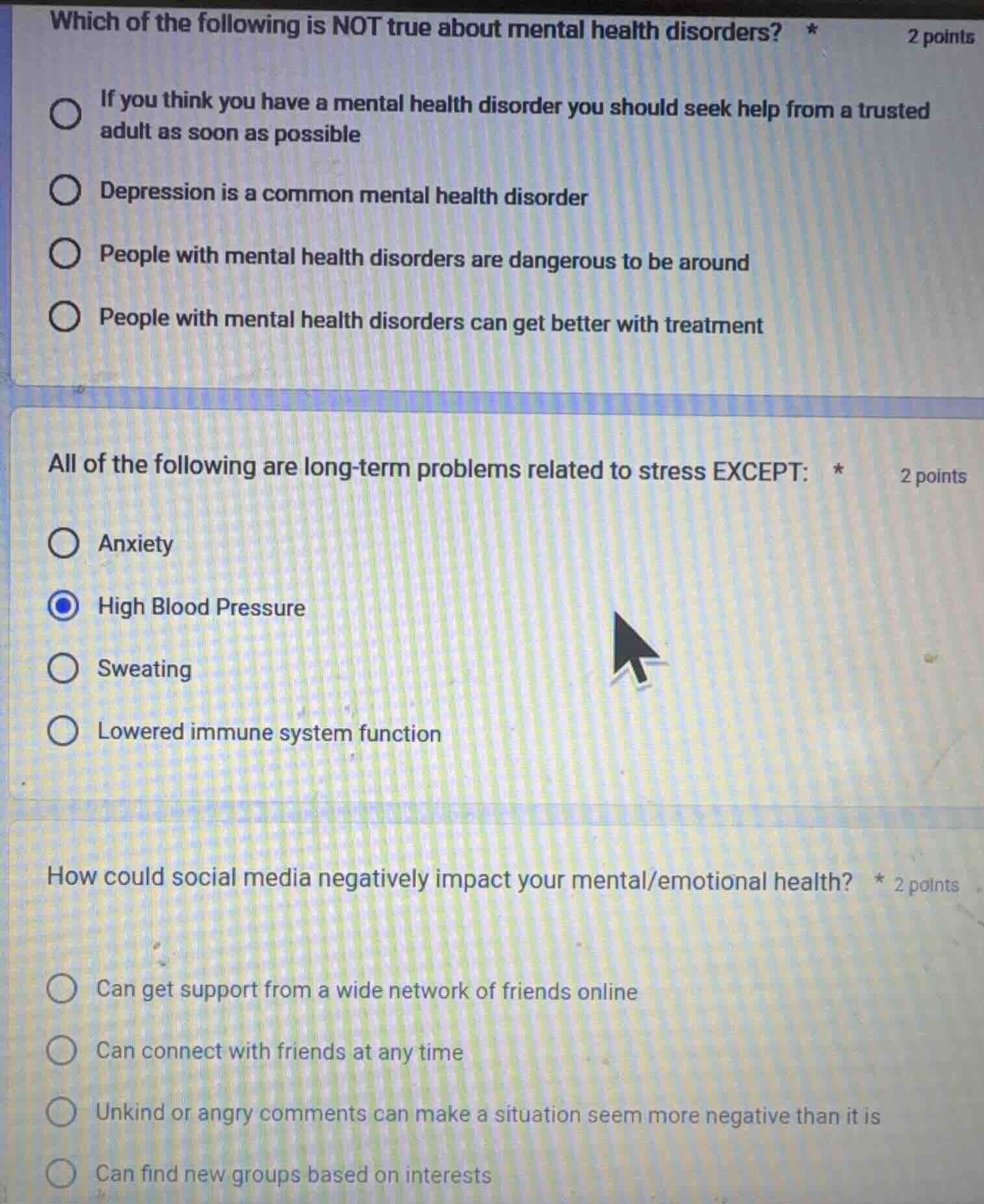
which of the following is not true about mental health disorders? *

  • if you think you have a mental health disorder you should seek help from a trusted adult as soon as possible
  • depression is a common mental health disorder
  • people with mental health disorders are dangerous to be around
  • people with mental health disorders can get better with treatment

all of the following are long-term problems related to stress except: *

  • anxiety
  • high blood pressure
  • sweating
  • lowered immune system function

how could social media negatively impact your mental/emotional health? *

  • can get support from a wide network of friends online
  • can connect with friends at any time
  • unkind or angry comments can make a situation seem more negative than it is
  • can find new groups based on interests

Explanation:

Response

<pre_analysis>
{
"quality": "clear",
"question_count": 3,
"skills_matched": [
"direct_cot",
"multiple_choice_formatter",
"explain_then_answer",
"tutor"
],
"needs_drawing": false,
"concepts_used": [],
"new_concepts": [
"Mental Health Disorders",
"Stress Physiology",
"Social Media Impact"
],
"current_concepts": [
"Mental Health Disorders",
"Stress Physiology",
"Social Media Impact"
]
}
</pre_analysis>

<reasoning>

Analyze Question 1: Misconceptions about mental health disorders

To identify which statement is NOT true, we evaluate each option:

  • Seeking help from a trusted adult is a recommended and positive step. This statement is true.
  • Depression is indeed one of the most common mental health disorders globally. This statement is true.
  • The belief that people with mental health disorders are inherently dangerous is a harmful stereotype; the vast majority of individuals with mental illnesses are not violent. This statement is NOT true.
  • Many mental health conditions can be managed effectively, and individuals can recover or improve with appropriate treatment. This statement is true.

Analyze Question 2: Long-term vs. short-term stress responses

We evaluate the physiological and psychological effects of stress to find the exception to long-term problems:

  • Anxiety can develop into a chronic, long-term mental health issue under prolonged stress.
  • High blood pressure (hypertension) is a well-documented long-term cardiovascular consequence of chronic stress.
  • Sweating is an immediate, acute physiological response triggered by the sympathetic nervous system during the "fight-or-flight" response, not a chronic long-term condition.
  • Prolonged stress elevates cortisol levels, which is known to cause a long-term decline in immune system function.

Analyze Question 3: Negative impacts of social media

We look for the option that describes a negative outcome rather than a positive benefit:

  • Getting support from a wide network is a positive impact.
  • Connecting with friends at any time is a positive impact.
  • Receiving unkind or angry comments is a negative experience that can distort perception and harm emotional well-being. This is a negative impact.
  • Finding new interest groups is a positive impact.

</reasoning>

<answer>

Question 1

<mcq-option>(A) If you think you have a mental health disorder you should seek help from a trusted adult as soon as possible</mcq-option>
<mcq-option>(B) Depression is a common mental health disorder</mcq-option>
<mcq-correct>(C) People with mental health disorders are dangerous to be around</mcq-correct>
<mcq-option>(D) People with mental health disorders can get better with treatment</mcq-option>

Question 2

<mcq-option>(A) Anxiety</mcq-option>
<mcq-option>(B) High Blood Pressure</mcq-option>
<mcq-correct>(C) Sweating</mcq-correct>
<mcq-option>(D) Lowered immune system function</mcq-option>

Question 3

<mcq-option>(A) Can get support from a wide network of friends online</mcq-option>
<mcq-option>(B) Can connect with friends at any time</mcq-correct>
<mcq-correct>(C) Unkind or angry comments can make a situation seem more negative than it is</mcq-correct>
<mcq-option>(D) Can find new groups based on interests</mcq-option>
</answer>

<post_analysis>
{
"subject": "Natural Science",
"question_type": "Multiple Choice",
"knowledge_point": [
"Natural Science",
"Health and Medicine",
"Mental and Emotional Health"
]
}
</post_analysis>

Answer:

<pre_analysis>
{
"quality": "clear",
"question_count": 3,
"skills_matched": [
"direct_cot",
"multiple_choice_formatter",
"explain_then_answer",
"tutor"
],
"needs_drawing": false,
"concepts_used": [],
"new_concepts": [
"Mental Health Disorders",
"Stress Physiology",
"Social Media Impact"
],
"current_concepts": [
"Mental Health Disorders",
"Stress Physiology",
"Social Media Impact"
]
}
</pre_analysis>

<reasoning>

Analyze Question 1: Misconceptions about mental health disorders

To identify which statement is NOT true, we evaluate each option:

  • Seeking help from a trusted adult is a recommended and positive step. This statement is true.
  • Depression is indeed one of the most common mental health disorders globally. This statement is true.
  • The belief that people with mental health disorders are inherently dangerous is a harmful stereotype; the vast majority of individuals with mental illnesses are not violent. This statement is NOT true.
  • Many mental health conditions can be managed effectively, and individuals can recover or improve with appropriate treatment. This statement is true.

Analyze Question 2: Long-term vs. short-term stress responses

We evaluate the physiological and psychological effects of stress to find the exception to long-term problems:

  • Anxiety can develop into a chronic, long-term mental health issue under prolonged stress.
  • High blood pressure (hypertension) is a well-documented long-term cardiovascular consequence of chronic stress.
  • Sweating is an immediate, acute physiological response triggered by the sympathetic nervous system during the "fight-or-flight" response, not a chronic long-term condition.
  • Prolonged stress elevates cortisol levels, which is known to cause a long-term decline in immune system function.

Analyze Question 3: Negative impacts of social media

We look for the option that describes a negative outcome rather than a positive benefit:

  • Getting support from a wide network is a positive impact.
  • Connecting with friends at any time is a positive impact.
  • Receiving unkind or angry comments is a negative experience that can distort perception and harm emotional well-being. This is a negative impact.
  • Finding new interest groups is a positive impact.

</reasoning>

<answer>

Question 1

<mcq-option>(A) If you think you have a mental health disorder you should seek help from a trusted adult as soon as possible</mcq-option>
<mcq-option>(B) Depression is a common mental health disorder</mcq-option>
<mcq-correct>(C) People with mental health disorders are dangerous to be around</mcq-correct>
<mcq-option>(D) People with mental health disorders can get better with treatment</mcq-option>

Question 2

<mcq-option>(A) Anxiety</mcq-option>
<mcq-option>(B) High Blood Pressure</mcq-option>
<mcq-correct>(C) Sweating</mcq-correct>
<mcq-option>(D) Lowered immune system function</mcq-option>

Question 3

<mcq-option>(A) Can get support from a wide network of friends online</mcq-option>
<mcq-option>(B) Can connect with friends at any time</mcq-correct>
<mcq-correct>(C) Unkind or angry comments can make a situation seem more negative than it is</mcq-correct>
<mcq-option>(D) Can find new groups based on interests</mcq-option>
</answer>

<post_analysis>
{
"subject": "Natural Science",
"question_type": "Multiple Choice",
"knowledge_point": [
"Natural Science",
"Health and Medicine",
"Mental and Emotional Health"
]
}
</post_analysis>