Sovi.AI - AI Math Tutor

Scan to solve math questions

QUESTION IMAGE

which of the following statements does not represent assumptions that s…

Question

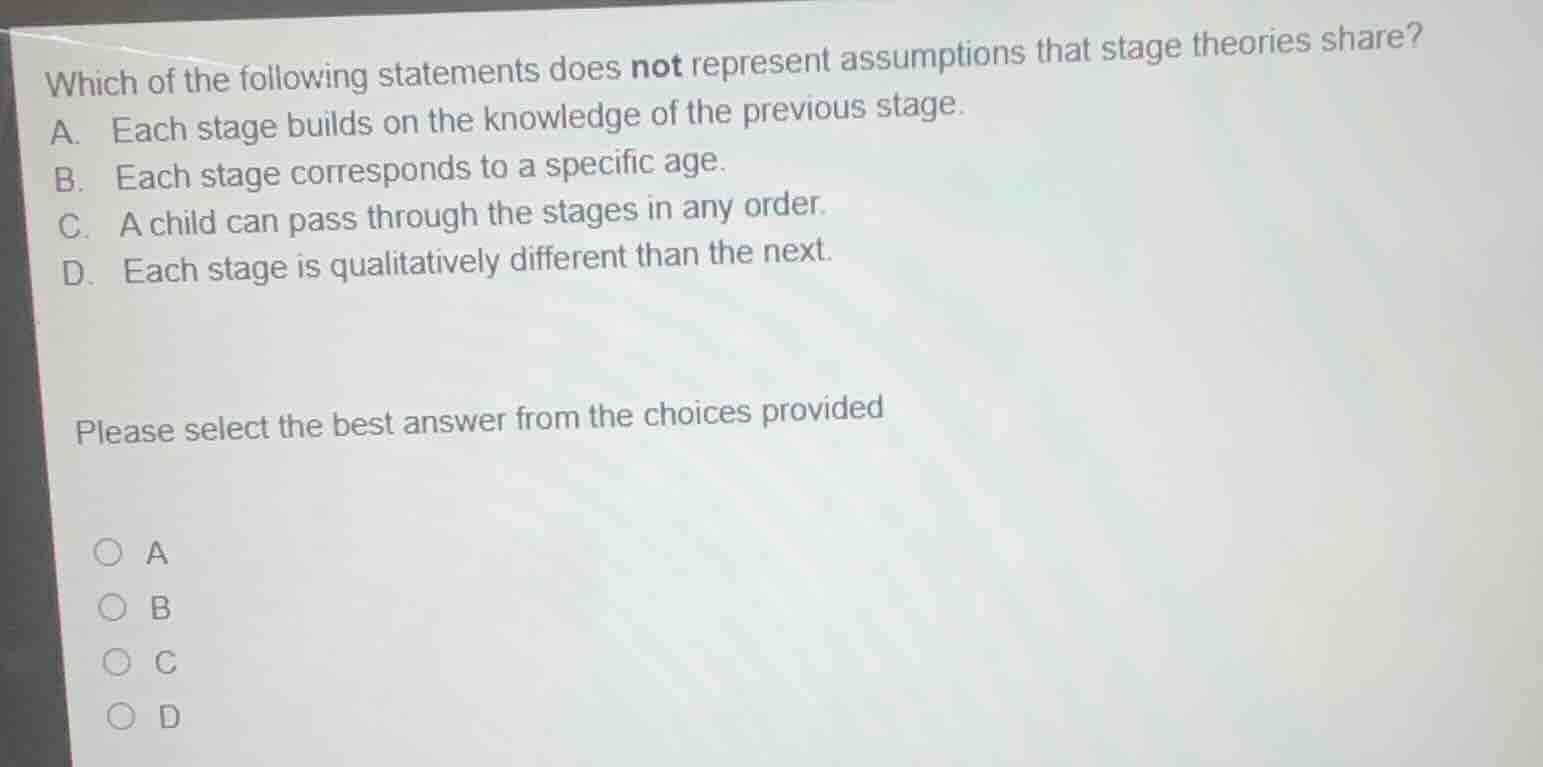
which of the following statements does not represent assumptions that stage theories share?
a. each stage builds on the knowledge of the previous stage.
b. each stage corresponds to a specific age.
c. a child can pass through the stages in any order.
d. each stage is qualitatively different than the next.

please select the best answer from the choices provided

a
b
c
d

Explanation:

Response

<pre_analysis>
{
"quality": "clear",
"question_count": 1,
"skills_matched": [
"direct_cot",
"multiple_choice_formatter",
"explain_then_answer",
"quick"
],
"needs_drawing": false,
"concepts_used": [
"Stage Theories"
],
"new_concepts": [],
"current_concepts": [
"Stage Theories",
"Developmental Psychology"
]
}
</pre_analysis>

<reasoning>

Analyze the core assumptions of stage theories

Stage theories in developmental psychology assume that development occurs in a predictable, invariant sequence of distinct stages. This means that individuals must progress through the stages in a specific, fixed order, and cannot skip stages or pass through them in any arbitrary sequence.

Evaluate the given options

  • A. Each stage builds on the knowledge of the previous stage. This is a standard assumption of stage theories (cumulative progression).
  • B. Each stage corresponds to a specific age. Stage theories typically associate developmental stages with general age ranges.
  • C. A child can pass through the stages in any order. This directly contradicts the fundamental assumption of invariant, sequential progression.
  • D. Each stage is qualitatively different than the next. This is a defining characteristic of stage theories (discontinuous, qualitative shifts).

Identify the non-representative statement

Since the question asks for the statement that does not represent assumptions that stage theories share, option C is the correct choice.
</reasoning>

<answer>
<mcq-option>A. Each stage builds on the knowledge of the previous stage.</mcq-option>
<mcq-option>B. Each stage corresponds to a specific age.</mcq-option>
<mcq-correct>C. A child can pass through the stages in any order.</mcq-correct>
<mcq-option>D. Each stage is qualitatively different than the next.</mcq-option>
</answer>

<post_analysis>
{
"subject": "Social Science",
"question_type": "Multiple Choice",
"knowledge_point": [
"Social Science",
"Psychology",
"Stage Theories"
]
}
</post_analysis>

Answer:

<pre_analysis>
{
"quality": "clear",
"question_count": 1,
"skills_matched": [
"direct_cot",
"multiple_choice_formatter",
"explain_then_answer",
"quick"
],
"needs_drawing": false,
"concepts_used": [
"Stage Theories"
],
"new_concepts": [],
"current_concepts": [
"Stage Theories",
"Developmental Psychology"
]
}
</pre_analysis>

<reasoning>

Analyze the core assumptions of stage theories

Stage theories in developmental psychology assume that development occurs in a predictable, invariant sequence of distinct stages. This means that individuals must progress through the stages in a specific, fixed order, and cannot skip stages or pass through them in any arbitrary sequence.

Evaluate the given options

  • A. Each stage builds on the knowledge of the previous stage. This is a standard assumption of stage theories (cumulative progression).
  • B. Each stage corresponds to a specific age. Stage theories typically associate developmental stages with general age ranges.
  • C. A child can pass through the stages in any order. This directly contradicts the fundamental assumption of invariant, sequential progression.
  • D. Each stage is qualitatively different than the next. This is a defining characteristic of stage theories (discontinuous, qualitative shifts).

Identify the non-representative statement

Since the question asks for the statement that does not represent assumptions that stage theories share, option C is the correct choice.
</reasoning>

<answer>
<mcq-option>A. Each stage builds on the knowledge of the previous stage.</mcq-option>
<mcq-option>B. Each stage corresponds to a specific age.</mcq-option>
<mcq-correct>C. A child can pass through the stages in any order.</mcq-correct>
<mcq-option>D. Each stage is qualitatively different than the next.</mcq-option>
</answer>

<post_analysis>
{
"subject": "Social Science",
"question_type": "Multiple Choice",
"knowledge_point": [
"Social Science",
"Psychology",
"Stage Theories"
]
}
</post_analysis>