QUESTION IMAGE
Question
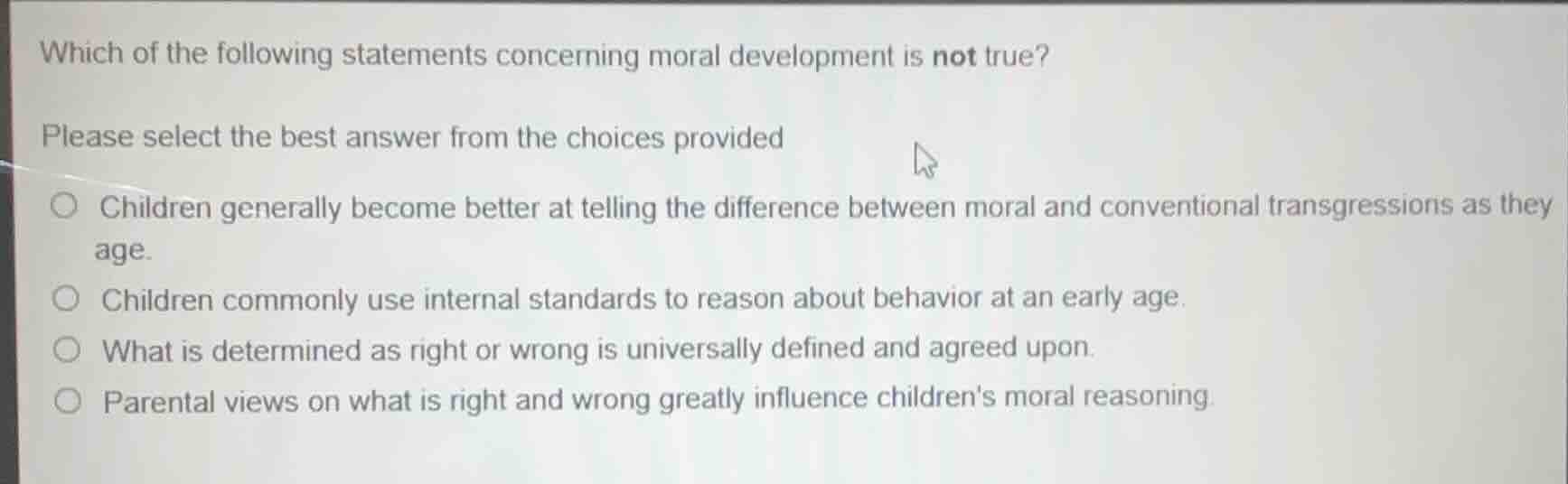
which of the following statements concerning moral development is not true?
please select the best answer from the choices provided
children generally become better at telling the difference between moral and conventional transgressions as they age.
children commonly use internal standards to reason about behavior at an early age.
what is determined as right or wrong is universally defined and agreed upon.
parental views on what is right and wrong greatly influence childrens moral reasoning.
Analyze the statements regarding moral development
- Statement 1: Children distinguish moral transgressions (harming others) from conventional transgressions (social rules) better as they age. This is a well-documented finding in developmental psychology.
- Statement 2: Young children primarily rely on external standards (rules, authority, punishment) rather than internal standards to reason about behavior, which aligns with Kohlberg's preconventional stage. However, some research shows they can use basic internal standards early on, making this a nuanced but generally accepted developmental trend.
- Statement 3: What is determined as right or wrong is highly dependent on cultural, societal, and individual contexts, meaning it is not universally defined or agreed upon.
- Statement 4: Parents and caregivers play a significant role in shaping a child's moral reasoning through socialization and modeling.
Identify the false statement
- The claim that right and wrong are "universally defined and agreed upon" is false because moral standards vary significantly across different cultures, historical periods, and philosophical frameworks.

Snap & solve any problem in the app
Get step-by-step solutions on Sovi AI
Photo-based solutions with guided steps
Explore more problems and detailed explanations
- Children generally become better at telling the difference between moral and conventional transgressions as they age.
- Children commonly use internal standards to reason about behavior at an early age.
- What is determined as right or wrong is universally defined and agreed upon. (Correct answer)
- Parental views on what is right and wrong greatly influence children's moral reasoning.