QUESTION IMAGE
Question
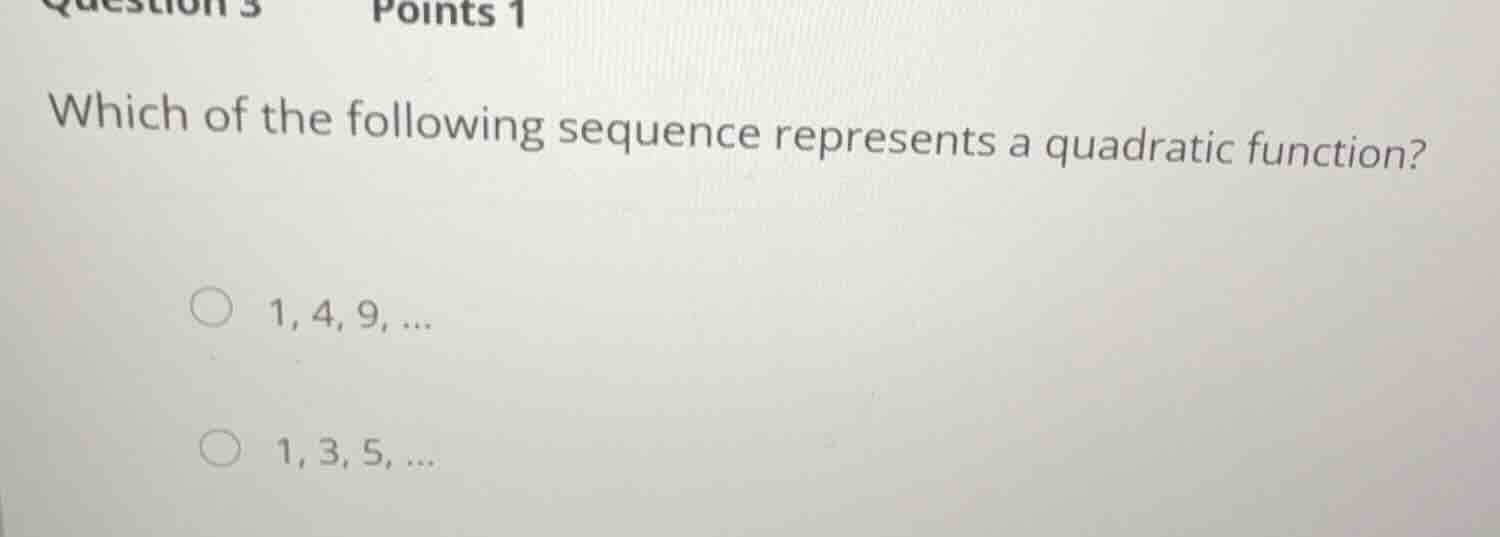
which of the following sequence represents a quadratic function?
\\(1, 4, 9, \dots\\)
\\(1, 3, 5, \dots\\)
Define quadratic sequence properties
A sequence represents a quadratic function if its general term can be written in the form \(a_n = an^2 + bn + c\), where \(a
eq 0\). For a quadratic sequence, the first differences between consecutive terms change linearly, meaning the second differences (the differences of the differences) are constant.
Analyze the first sequence
Let's examine the sequence \(1, 4, 9, \dots\):
- The terms are \(a_1 = 1\), \(a_2 = 4\), \(a_3 = 9\).
- These are the perfect squares: \(a_n = n^2\).
- The first differences are:
- The second difference is:
Since the second differences are constant, this sequence is quadratic.
Analyze the second sequence
Let's examine the sequence \(1, 3, 5, \dots\):
- The terms are \(a_1 = 1\), \(a_2 = 3\), \(a_3 = 5\).
- The first differences are:
Since the first differences are constant, this is an arithmetic sequence represented by a linear function \(a_n = 2n - 1\), not a quadratic function.
Identify the correct option
The sequence \(1, 4, 9, \dots\) is represented by the quadratic function \(f(n) = n^2\). Therefore, it is the correct choice.

Snap & solve any problem in the app
Get step-by-step solutions on Sovi AI
Photo-based solutions with guided steps
Explore more problems and detailed explanations
- (A) 1, 4, 9, ... (Correct answer)
- (B) 1, 3, 5, ...