QUESTION IMAGE
Question
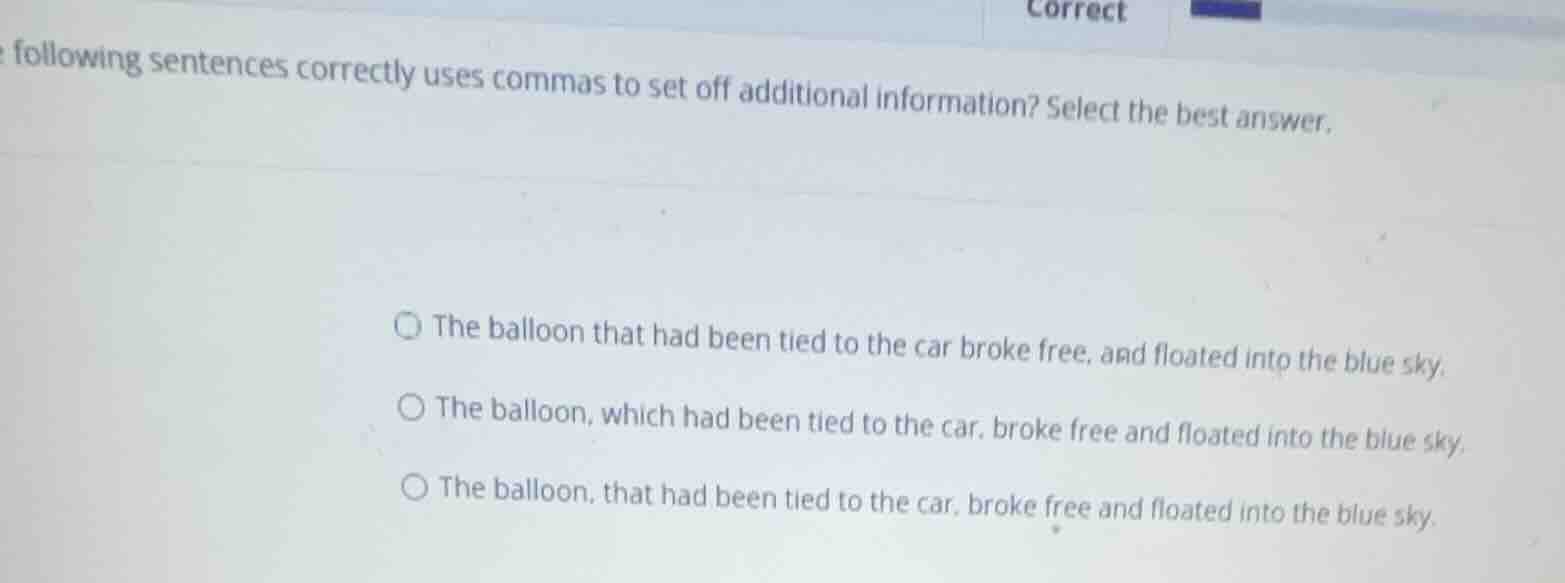
which of the following sentences correctly uses commas to set off additional information? select the best answer.
- the balloon that had been tied to the car broke free, and floated into the blue sky.
- the balloon, which had been tied to the car, broke free and floated into the blue sky.
- the balloon, that had been tied to the car, broke free and floated into the blue sky.
🆕 New Concept Discovered: Non-essential vs. Essential Clauses
Using commas to set off extra information.
Step 1: Identify the extra information
To determine which sentence is correct, we need to find the "additional information" (also called a non-essential or non-restrictive clause). This is information that can be removed from the sentence without changing its core meaning.
The core message of the sentence is:
The balloon broke free and floated into the blue sky.
The additional information is:
which had been tied to the car (or that had been tied to the car)
Step 2: Apply comma rules for non-essential clauses
When adding extra, non-essential details to a sentence:
- We must surround the entire extra clause with commas (one before and one after).
- We use the relative pronoun "which" for non-essential information. We do not use "that" with commas for non-essential information.
Let's evaluate the options:
- Option 1:
"The balloon that had been tied to the car broke free, and floated into the blue sky." - Incorrect. The comma before "and" is incorrect because "floated into the blue sky" is not an independent clause (it has no subject). Also, the extra information is not set off by commas.
- Option 2:
"The balloon, which had been tied to the car, broke free and floated into the blue sky." - Correct. The non-essential clause starts with "which" and is perfectly set off by a pair of commas. Removing it leaves a complete, grammatically correct sentence.
- Option 3:
"The balloon, that had been tied to the car, broke free and floated into the blue sky." - Incorrect. We do not use commas to set off clauses starting with "that". "That" is reserved for essential information that should not have commas.

Snap & solve any problem in the app
Get step-by-step solutions on Sovi AI
Photo-based solutions with guided steps
Explore more problems and detailed explanations
The balloon, which had been tied to the car, broke free and floated into the blue sky.