QUESTION IMAGE
Question
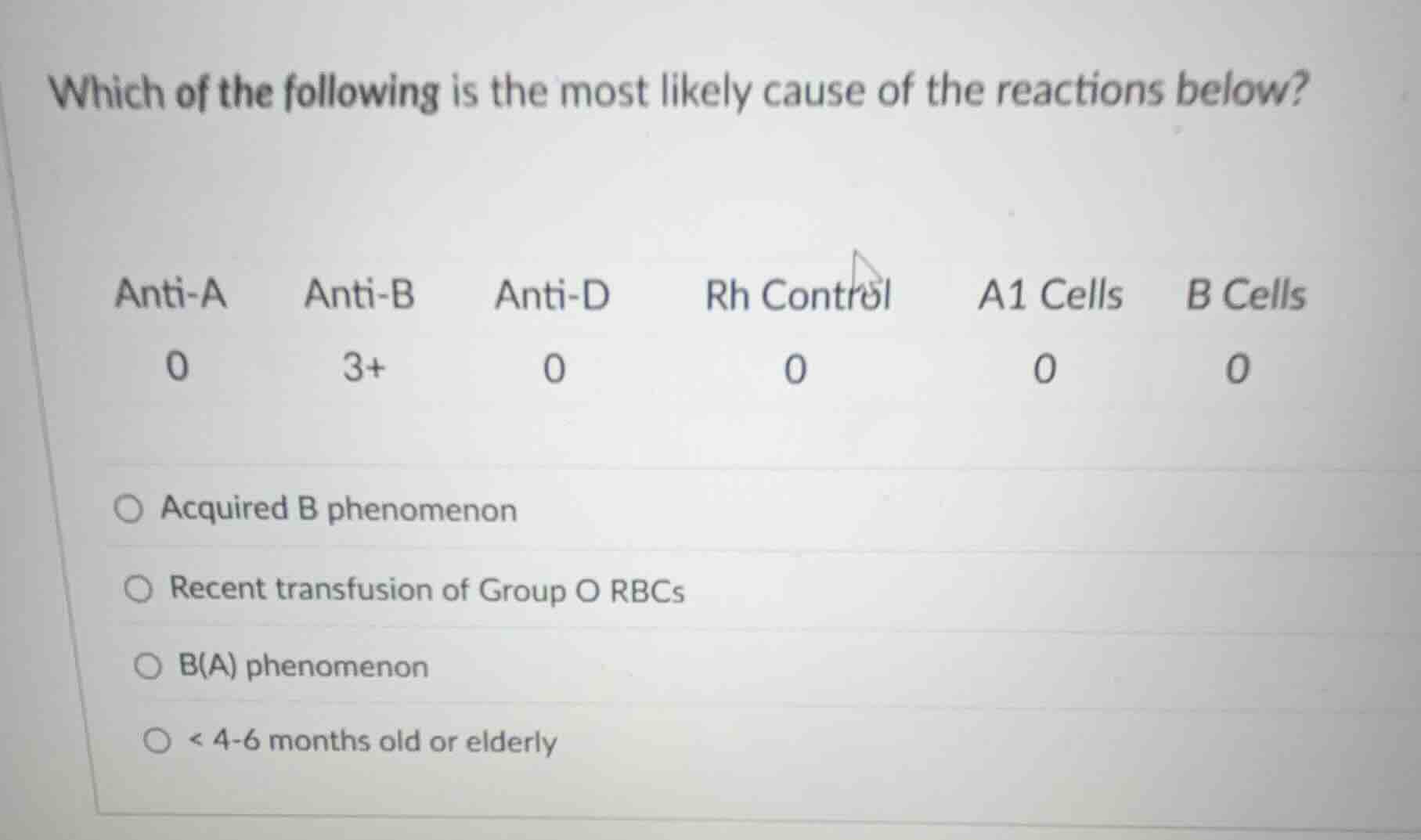
which of the following is the most likely cause of the reactions below?
anti-a: 0
anti-b: 3+
anti-d: 0
rh control: 0
a1 cells: 0
b cells: 0
- acquired b phenomenon
- recent transfusion of group o rbcs
- b(a) phenomenon
- < 4-6 months old or elderly
Analyze forward typing results
The forward typing results show:
- Anti-A: \(0\)
- Anti-B: \(3+\)
- Anti-D: \(0\)
- Rh Control: \(0\)
This indicates the patient's red blood cells express the B antigen but not the A or D antigens. The forward typing suggests blood group B, Rh-negative.
Analyze reverse typing results
The reverse typing results show:
- A1 Cells: \(0\)
- B Cells: \(0\)
A group B individual is expected to have naturally occurring anti-A antibodies in their serum, which should react with A1 cells to show agglutination (typically \(3+\) or \(4+\)). Here, the reaction with A1 cells is \(0\), indicating missing expected antibodies.
Identify the discrepancy
Using the ABO Discrepancy knowledge point, we compare the forward and reverse typing. The forward typing indicates Group B, but the reverse typing shows no antibodies (resembling Group AB). This is a Group I ABO discrepancy characterized by unexpectedly weak or missing antibodies in the reverse grouping.
Evaluate the options
- Acquired B phenomenon: Typically occurs in Group A1 individuals where bacterial enzymes modify the A antigen to react with anti-B, showing an unexpected reaction in forward typing.
- Recent transfusion of Group O RBCs: Would typically cause mixed-field agglutination in forward typing, not a complete loss of reverse typing antibodies.
- B(A) phenomenon: Occurs when Group B individuals have a highly active B transferase that attaches trace amounts of A sugar, causing weak forward reaction with anti-A.
- < 4-6 months old or elderly: Newborns (under 4–6 months) have not yet produced their own ABO antibodies, and elderly individuals can have significantly depressed antibody production, leading to missing expected antibodies in reverse typing.
Determine the most likely cause
The complete absence of expected anti-A antibodies in a Group B individual is most commonly caused by age-related factors, specifically infants under 4–6 months of age or elderly patients with weakened immune systems.

Snap & solve any problem in the app
Get step-by-step solutions on Sovi AI
Photo-based solutions with guided steps
Explore more problems and detailed explanations
- O Acquired B phenomenon
- O Recent transfusion of Group O RBCs
- O B(A) phenomenon
- O < 4-6 months old or elderly (Correct answer)