QUESTION IMAGE
Question
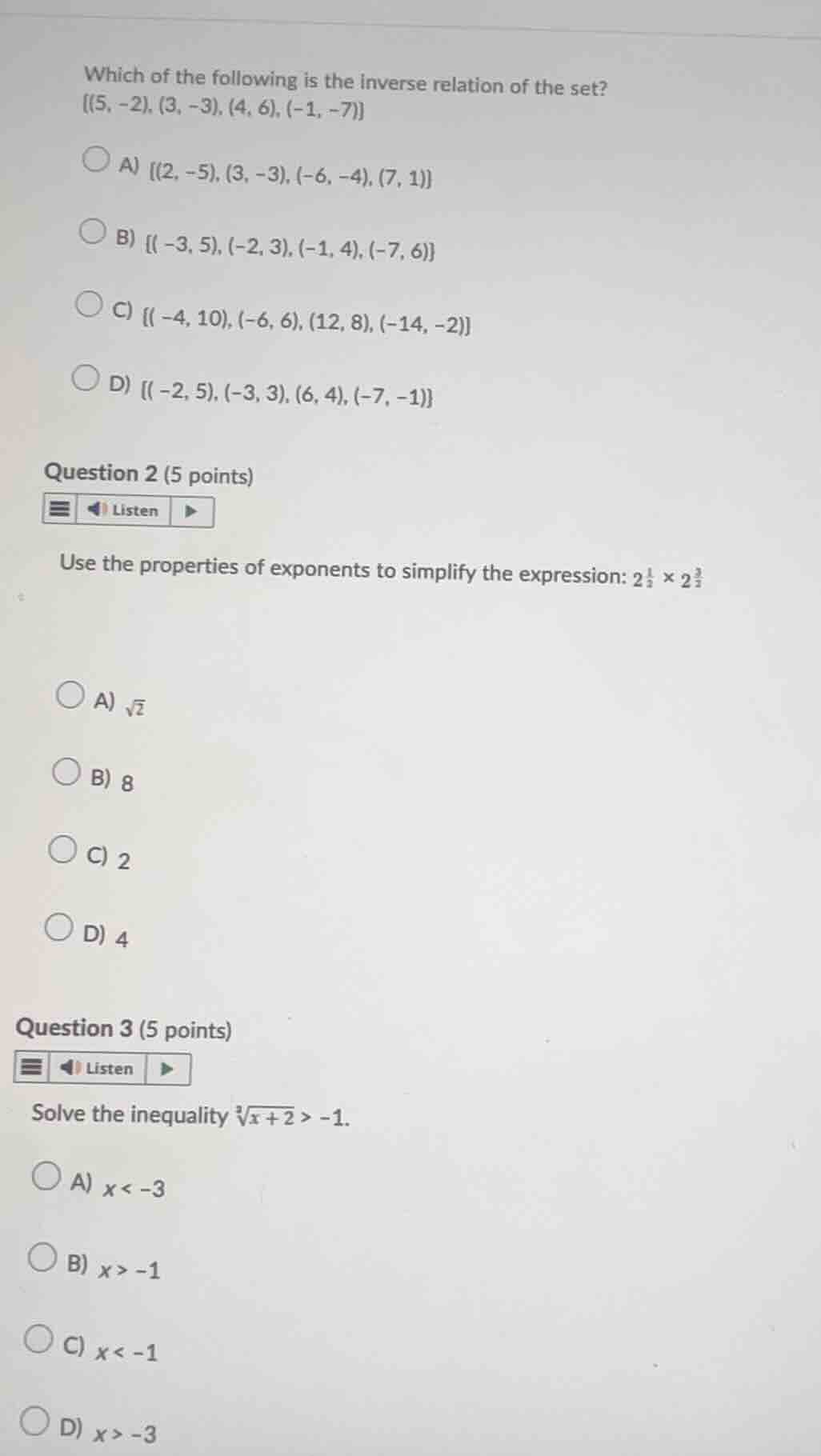
which of the following is the inverse relation of the set?
\\(\\{(5, -2), (3, -3), (4, 6), (-1, -7)\\}\\)
a) \\(\\{((2, -5), (3, -3), (-6, -4), (7, 1))\\}\\)
b) \\(\\{((-3, 5), (-2, 3), (-1, 4), (-7, 6))\\}\\)
c) \\(\\{((-4, 10), (-6, 6), (12, 8), (-14, -2))\\}\\)
d) \\(\\{((-2, 5), (-3, 3), (6, 4), (-7, -1))\\}\\)
question 2 (5 points)
use the properties of exponents to simplify the expression: \\(2^{\frac{1}{2}} \times 2^{\frac{3}{2}}\\)
a) \\(\sqrt{2}\\)
b) 8
c) 2
d) 4
question 3 (5 points)
solve the inequality \\(\sqrt3{x+2} > -1\\).
a) \\(x < -3\\)
b) \\(x > -1\\)
c) \\(x < -1\\)
d) \\(x > -3\\)
Find the inverse relation of the set
$$
LATEXBLOCK0
$$
Simplify the exponential expression
$$
LATEXBLOCK1
$$
Solve the radical inequality
$$
LATEXBLOCK2
$$

Snap & solve any problem in the app
Get step-by-step solutions on Sovi AI
Photo-based solutions with guided steps
Explore more problems and detailed explanations
Question 1
- A) \(\{(-2, -5), (3, -3), (-6, -4), (7, 1)\}\)
- B) \(\{(-3, 5), (-2, 3), (-1, 4), (-7, 6)\}\)
- C) \(\{(-4, 10), (-6, 6), (12, 8), (-14, -2)\}\)
- D) \(\{(-2, 5), (-3, 3), (6, 4), (-7, -1)\}\) (Correct answer)
Question 2
- A) \(\sqrt{2}\)
- B) 8
- C) 2 (Correct answer)
- D) 4
Question 3
- A) \(x < -3\)
- B) \(x > -1\)
- C) \(x < -1\)
- D) \(x > -3\) (Correct answer)