QUESTION IMAGE
Question
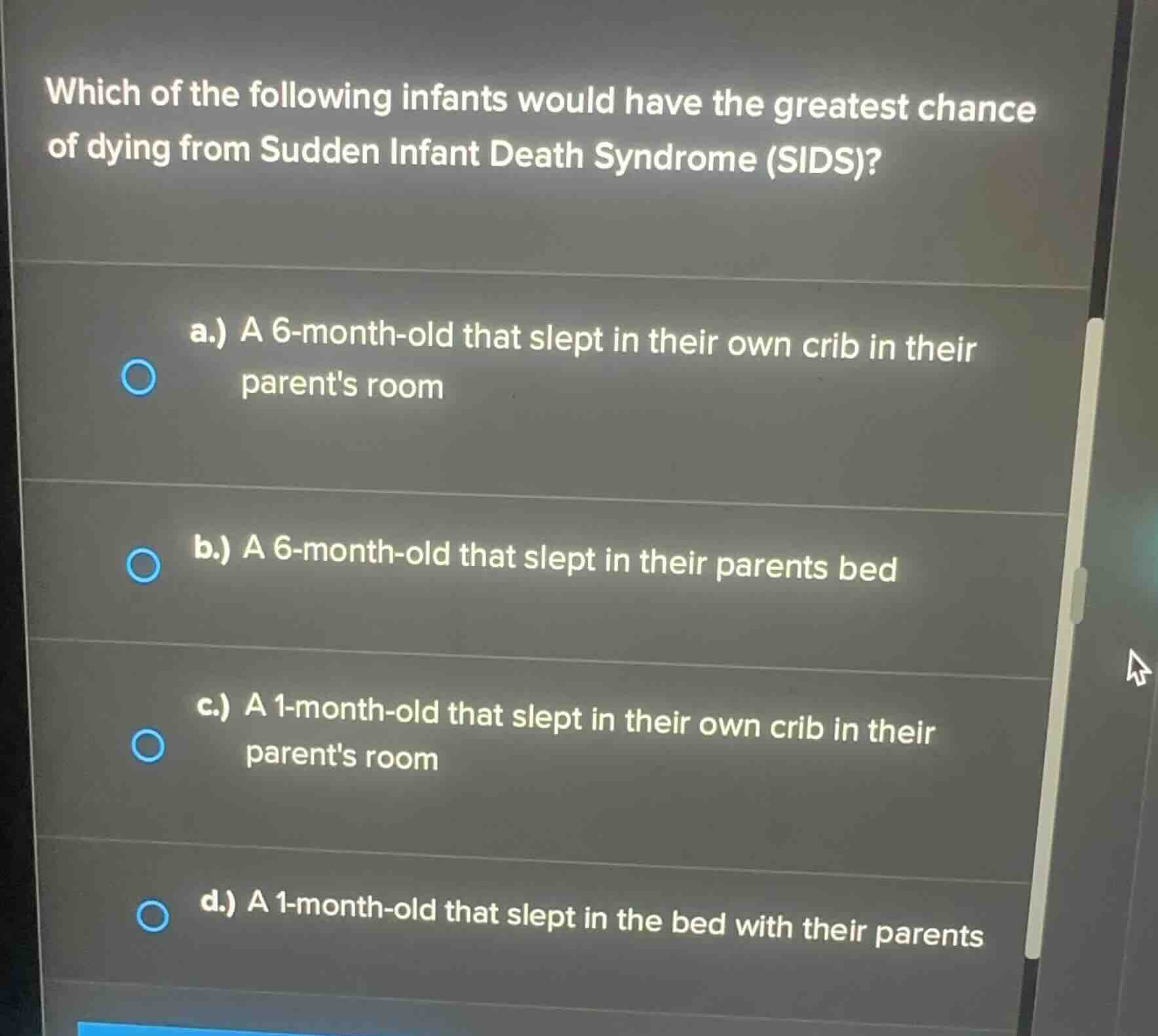
which of the following infants would have the greatest chance of dying from sudden infant death syndrome (sids)?
a.) a 6-month-old that slept in their own crib in their parents room
b.) a 6-month-old that slept in their parents bed
c.) a 1-month-old that slept in their own crib in their parents room
d.) a 1-month-old that slept in the bed with their parents
Analyze the risk factors of SIDS
Sudden Infant Death Syndrome (SIDS) risk is heavily influenced by both developmental age and sleep environment. Statistically, SIDS risk peaks between 1 and 4 months of age, making younger infants (like a 1-month-old) more vulnerable than older infants (like a 6-month-old).
Evaluate the sleep environments
Safe sleep guidelines strongly discourage bed-sharing (sleeping in the parents' bed) because it significantly increases the risk of accidental suffocation, entrapment, and SIDS. Conversely, room-sharing (sleeping in their own crib in the parents' room) is recommended as a protective factor that reduces the risk of SIDS.
Compare the options
- Option a & c (Crib in parent's room): This is the safest recommended sleep arrangement, which minimizes SIDS risk.
- Option b (6-month-old in parents' bed): Bed-sharing increases risk, but a 6-month-old has better motor control and a lower baseline SIDS risk than a younger infant.
- Option d (1-month-old in parents' bed): This combines the highest-risk age group (1-month-old) with the highest-risk sleep environment (bed-sharing), resulting in the greatest overall risk.

Snap & solve any problem in the app
Get step-by-step solutions on Sovi AI
Photo-based solutions with guided steps
Explore more problems and detailed explanations
- a.) A 6-month-old that slept in their own crib in their parent's room
- b.) A 6-month-old that slept in their parents bed
- c.) A 1-month-old that slept in their own crib in their parent's room
- d.) A 1-month-old that slept in the bed with their parents (Correct answer)