QUESTION IMAGE
Question
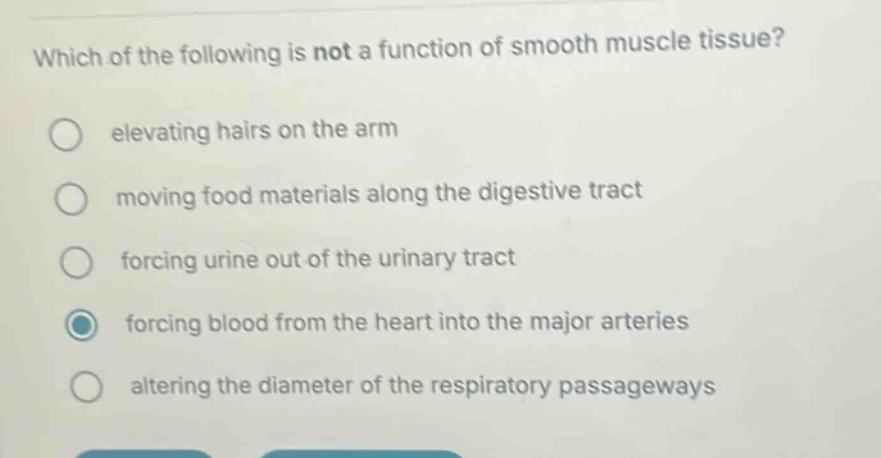
which of the following is not a function of smooth muscle tissue?
elevating hairs on the arm
moving food materials along the digestive tract
forcing urine out of the urinary tract
forcing blood from the heart into the major arteries
altering the diameter of the respiratory passageways
🆕 New Concept Discovered: Muscle Tissue Types
Characteristics and locations of skeletal, cardiac, and smooth muscle.
Step 1: Understand the characteristics of smooth muscle
Smooth muscle is an involuntary, non-striated muscle tissue. It is found in the walls of hollow organs and structures throughout the body, where it helps squeeze or regulate the flow of materials.
Common locations and functions include:
- Skin: Arrector pili muscles (smooth muscle) contract to elevate hairs (causing "goosebumps").
- Digestive tract: Smooth muscle contracts rhythmically (peristalsis) to move food.
- Urinary tract: Smooth muscle in the bladder wall (detrusor muscle) contracts to expel urine.
- Respiratory tract: Smooth muscle in the walls of airways (bronchioles) regulates airway diameter.
Step 2: Identify the function of cardiac muscle
The heart is a highly specialized organ made of a distinct type of muscle tissue called cardiac muscle.
- Cardiac muscle is striated and involuntary.
- Its sole responsibility is to pump blood out of the heart chambers and into the major blood vessels (like the aorta and pulmonary trunk).
- Because this action is performed by cardiac muscle, it is not a function of smooth muscle tissue.

Snap & solve any problem in the app
Get step-by-step solutions on Sovi AI
Photo-based solutions with guided steps
Explore more problems and detailed explanations
forcing blood from the heart into the major arteries