QUESTION IMAGE
Question
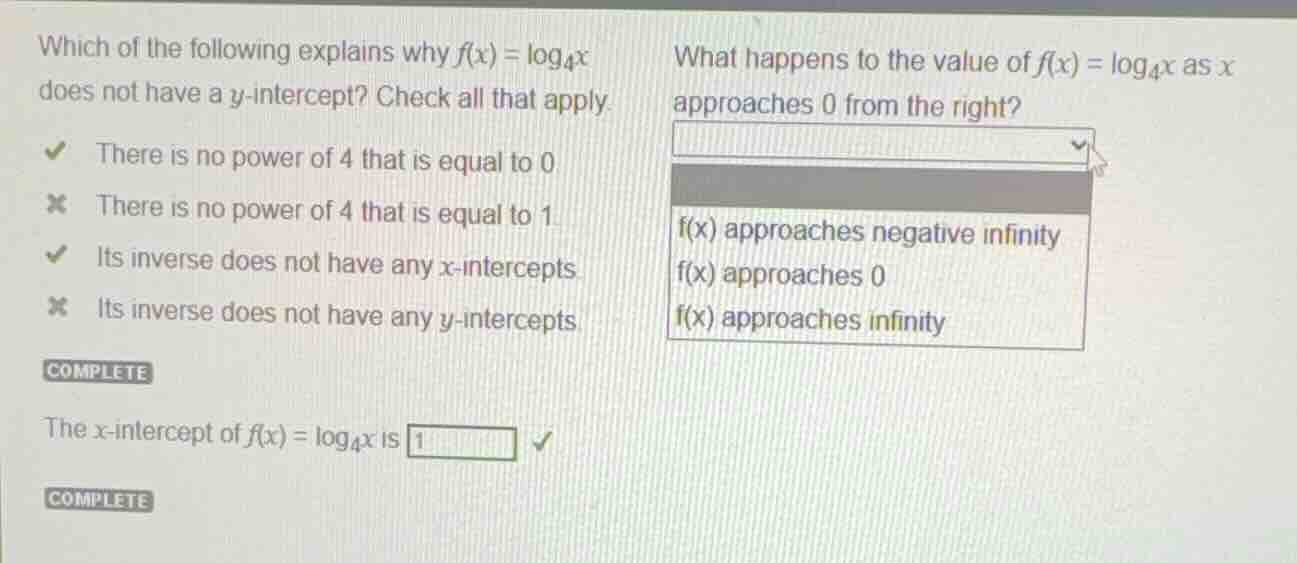
which of the following explains why (f(x) = log_4 x) does not have a (y)-intercept? check all that apply.
there is no power of 4 that is equal to 0
there is no power of 4 that is equal to 1
its inverse does not have any (x)-intercepts
its inverse does not have any (y)-intercepts
what happens to the value of (f(x) = log_4 x) as (x) approaches 0 from the right?
(f(x)) approaches negative infinity
(f(x)) approaches 0
(f(x)) approaches infinity
the (x)-intercept of (f(x) = log_4 x) is 1
Analyze the y-intercept of the logarithmic function
Using the Logarithmic Functions and Logarithmic and Exponential Inverses knowledge points
Determine the x-intercept of the logarithmic function
Using the Logarithmic Functions knowledge point
Evaluate the limit behavior as x approaches 0 from the right
For the function \(f(x) = \log_4(x)\), as the input \(x\) approaches \(0\) from the positive side (\(x \to 0^+\)), the exponent \(y\) in \(4^y = x\) must become an increasingly large negative number to yield a value close to \(0\). Therefore:
This means \(f(x)\) approaches negative infinity.

Snap & solve any problem in the app
Get step-by-step solutions on Sovi AI
Photo-based solutions with guided steps
Explore more problems and detailed explanations
Question 1
Which of the following explains why \(f(x) = \log_4x\) does not have a \(y\)-intercept? Check all that apply.
- There is no power of 4 that is equal to 0 (Correct answer)
- There is no power of 4 that is equal to 1
- Its inverse does not have any x-intercepts (Correct answer)
- Its inverse does not have any y-intercepts
Question 2
The \(x\)-intercept of \(f(x) = \log_4x\) is <blank>1</blank>.
Question 3
What happens to the value of \(f(x) = \log_4x\) as \(x\) approaches 0 from the right?
- f(x) approaches negative infinity (Correct answer)
- f(x) approaches 0
- f(x) approaches infinity