QUESTION IMAGE
Question
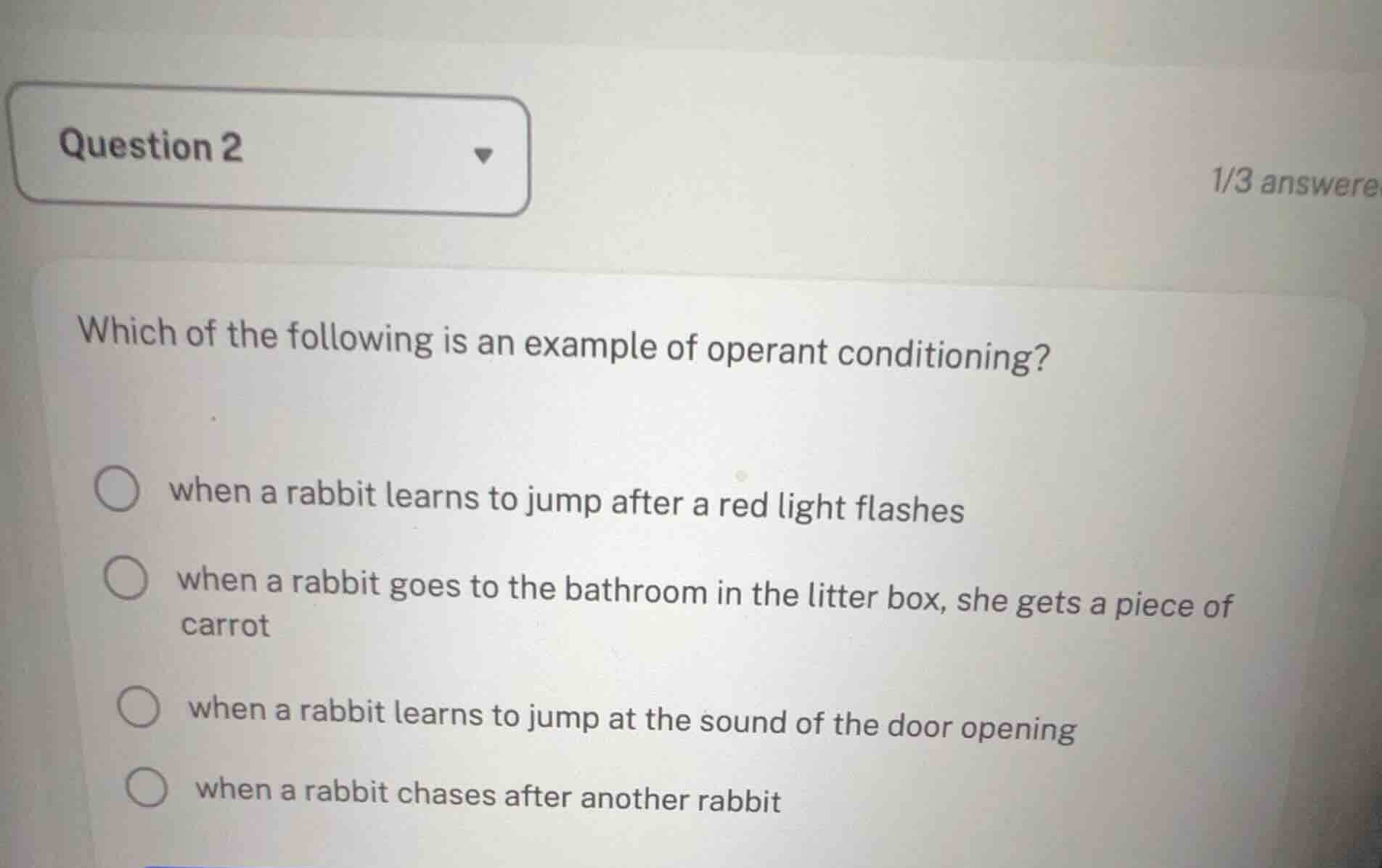
which of the following is an example of operant conditioning?
when a rabbit learns to jump after a red light flashes
when a rabbit goes to the bathroom in the litter box, she gets a piece of carrot
when a rabbit learns to jump at the sound of the door opening
when a rabbit chases after another rabbit
<pre_analysis>
{
"quality": "clear",
"question_count": 1,
"skills_matched": [
"direct_cot",
"multiple_choice_formatter",
"explain_then_answer",
"tutor",
"mastery_adaptive_brevity"
],
"needs_drawing": false,
"concepts_used": [
"Operant Conditioning",
"Classical Conditioning"
],
"new_concepts": [],
"current_concepts": [
"Operant Conditioning",
"Classical Conditioning"
]
}
</pre_analysis>
<reasoning>
Define operant conditioning
Using the Operant Conditioning knowledge point
- Operant conditioning is a learning process where behaviors are influenced by their consequences (reinforcements or punishments).
- A voluntary behavior is followed by a reward or consequence, which increases or decreases the likelihood of that behavior occurring again.
Analyze the given scenarios
Using the Classical Conditioning knowledge point
- Scenario 1: "when a rabbit learns to jump after a red light flashes"
- This is an association between an environmental stimulus (red light) and an involuntary or reflexive response (jumping), which is characteristic of classical conditioning.
- Scenario 2: "when a rabbit goes to the bathroom in the litter box, she gets a piece of carrot"
- Going to the bathroom in a specific spot is a voluntary behavior.
- Receiving a carrot acts as positive reinforcement, increasing the likelihood of this behavior. This is a clear example of operant conditioning.
- Scenario 3: "when a rabbit learns to jump at the sound of the door opening"
- This is an association between a neutral stimulus (sound of door) and a response, which is characteristic of classical conditioning.
- Scenario 4: "when a rabbit chases after another rabbit"
- This is a natural, unconditioned social or instinctual behavior, not a conditioned learning process.
Select the correct option
- The second option describes a voluntary behavior followed by a reinforcing consequence, which perfectly matches operant conditioning.
</reasoning>
<answer>
<mcq-option>when a rabbit learns to jump after a red light flashes</mcq-option>
<mcq-correct>when a rabbit goes to the bathroom in the litter box, she gets a piece of carrot</mcq-correct>
<mcq-option>when a rabbit learns to jump at the sound of the door opening</mcq-option>
<mcq-option>when a rabbit chases after another rabbit</mcq-option>
</answer>
<post_analysis>
{
"subject": "Natural Science",
"question_type": "Multiple Choice",
"knowledge_point": [
"Natural Science",
"Psychology",
"Operant Conditioning"
]
}
</post_analysis>
Snap & solve any problem in the app
Get step-by-step solutions on Sovi AI
Photo-based solutions with guided steps
Explore more problems and detailed explanations
<pre_analysis>
{
"quality": "clear",
"question_count": 1,
"skills_matched": [
"direct_cot",
"multiple_choice_formatter",
"explain_then_answer",
"tutor",
"mastery_adaptive_brevity"
],
"needs_drawing": false,
"concepts_used": [
"Operant Conditioning",
"Classical Conditioning"
],
"new_concepts": [],
"current_concepts": [
"Operant Conditioning",
"Classical Conditioning"
]
}
</pre_analysis>
<reasoning>
Define operant conditioning
Using the Operant Conditioning knowledge point
- Operant conditioning is a learning process where behaviors are influenced by their consequences (reinforcements or punishments).
- A voluntary behavior is followed by a reward or consequence, which increases or decreases the likelihood of that behavior occurring again.
Analyze the given scenarios
Using the Classical Conditioning knowledge point
- Scenario 1: "when a rabbit learns to jump after a red light flashes"
- This is an association between an environmental stimulus (red light) and an involuntary or reflexive response (jumping), which is characteristic of classical conditioning.
- Scenario 2: "when a rabbit goes to the bathroom in the litter box, she gets a piece of carrot"
- Going to the bathroom in a specific spot is a voluntary behavior.
- Receiving a carrot acts as positive reinforcement, increasing the likelihood of this behavior. This is a clear example of operant conditioning.
- Scenario 3: "when a rabbit learns to jump at the sound of the door opening"
- This is an association between a neutral stimulus (sound of door) and a response, which is characteristic of classical conditioning.
- Scenario 4: "when a rabbit chases after another rabbit"
- This is a natural, unconditioned social or instinctual behavior, not a conditioned learning process.
Select the correct option
- The second option describes a voluntary behavior followed by a reinforcing consequence, which perfectly matches operant conditioning.
</reasoning>
<answer>
<mcq-option>when a rabbit learns to jump after a red light flashes</mcq-option>
<mcq-correct>when a rabbit goes to the bathroom in the litter box, she gets a piece of carrot</mcq-correct>
<mcq-option>when a rabbit learns to jump at the sound of the door opening</mcq-option>
<mcq-option>when a rabbit chases after another rabbit</mcq-option>
</answer>
<post_analysis>
{
"subject": "Natural Science",
"question_type": "Multiple Choice",
"knowledge_point": [
"Natural Science",
"Psychology",
"Operant Conditioning"
]
}
</post_analysis>