QUESTION IMAGE
Question
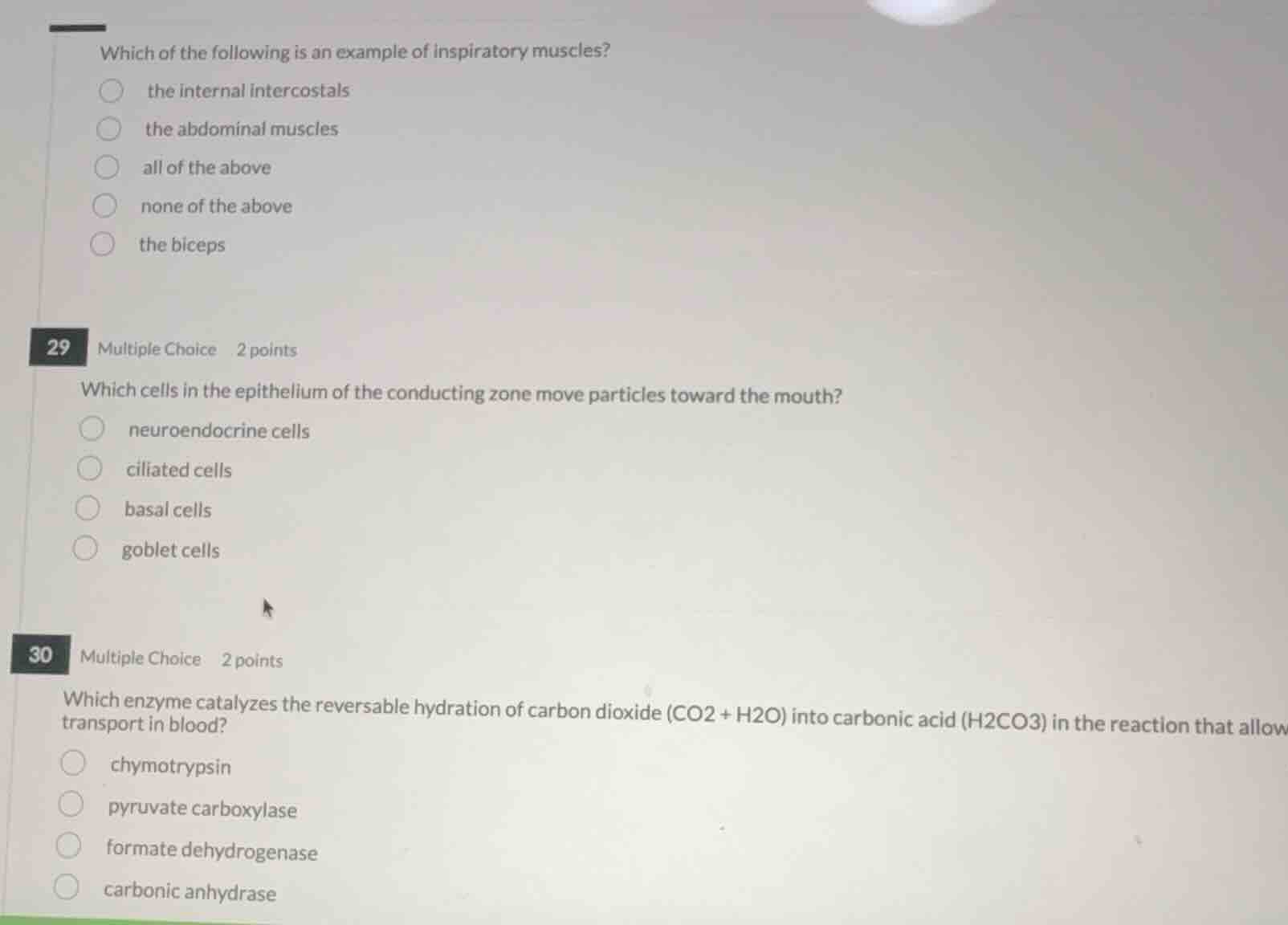
which of the following is an example of inspiratory muscles?
the internal intercostals
the abdominal muscles
all of the above
none of the above
the biceps
29 multiple choice 2 points
which cells in the epithelium of the conducting zone move particles toward the mouth?
neuroendocrine cells
ciliated cells
basal cells
goblet cells
30 multiple choice 2 points
which enzyme catalyzes the reversable hydration of carbon dioxide (co2 + h2o) into carbonic acid (h2co3) in the reaction that allows transport in blood?
chymotrypsin
pyruvate carboxylase
formate dehydrogenase
carbonic anhydrase
Identify the inspiratory muscle
The diaphragm and external intercostals are the primary muscles of inspiration. Internal intercostals and abdominal muscles are expiratory muscles. Therefore, none of the listed options are inspiratory muscles.
Identify the cells that move particles in the conducting zone
Ciliated cells in the respiratory epithelium possess cilia that beat rhythmically to move mucus and trapped particles upward toward the pharynx/mouth (the mucociliary escalator).
Identify the enzyme for carbon dioxide hydration
Carbonic anhydrase catalyzes the reversible reaction:
This reaction is essential for carbon dioxide transport in the blood.

Snap & solve any problem in the app
Get step-by-step solutions on Sovi AI
Photo-based solutions with guided steps
Explore more problems and detailed explanations
Question 1
- the internal intercostals
- the abdominal muscles
- all of the above</mcq-correct>
- none of the above (Correct answer)
<mcq-option>the biceps
Question 2
- neuroendocrine cells
- ciliated cells (Correct answer)
- basal cells
- goblet cells
Question 3
- chymotrypsin
- pyruvate carboxylase
- formate dehydrogenase
- carbonic anhydrase (Correct answer)