QUESTION IMAGE
Question
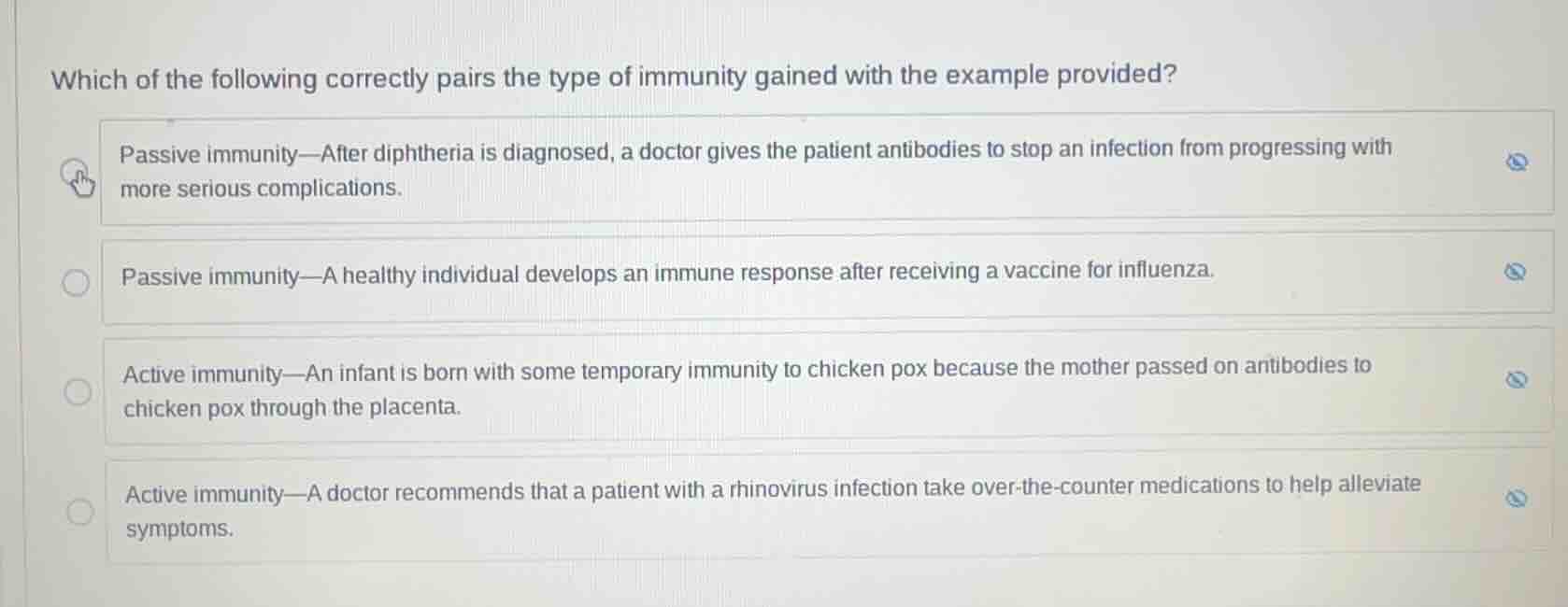
which of the following correctly pairs the type of immunity gained with the example provided?
passive immunity-after diphtheria is diagnosed, a doctor gives the patient antibodies to stop an infection from progressing with more serious complications.
passive immunity-a healthy individual develops an immune response after receiving a vaccine for influenza.
active immunity-an infant is born with some temporary immunity to chicken pox because the mother passed on antibodies to chicken pox through the placenta.
active immunity-a doctor recommends that a patient with a rhinovirus infection take over-the-counter medications to help alleviate symptoms.
🆕 New Concept Discovered: Active vs. Passive Immunity
How the body acquires protection against pathogens.
Step 1: Understand the core concepts
To solve this problem, we need to distinguish between two main types of acquired immunity:
- Active Immunity: This occurs when your own body's immune system is stimulated to produce its own antibodies. This happens either naturally (by catching an illness) or artificially (through a vaccine containing weakened or dead pathogens). Because your body makes memory cells, active immunity is usually long-lasting.
- Passive Immunity: This occurs when you are given antibodies made by someone or something else, rather than producing them yourself. Because your body does not make memory cells, passive immunity is temporary. This can happen naturally (antibodies passed from mother to baby through the placenta or breast milk) or artificially (receiving an injection of antibodies/antiserum to treat an immediate threat).
Step 2: Evaluate the options
Let's analyze each option based on these definitions:
- Passive immunity—After diphtheria is diagnosed, a doctor gives the patient antibodies to stop an infection from progressing with more serious complications.
- Analysis: The patient is receiving pre-made antibodies directly from an external source (artificial passive immunity). Their own immune system did not produce them. This is a correct pairing.
- Passive immunity—A healthy individual develops an immune response after receiving a vaccine for influenza.
- Analysis: A vaccine stimulates the individual's own immune system to produce antibodies and memory cells. This is an example of active immunity, not passive.
- Active immunity—An infant is born with some temporary immunity to chicken pox because the mother passed on antibodies to chicken pox through the placenta.
- Analysis: The infant received pre-made antibodies from the mother. The infant's own immune system did not produce them. This is an example of passive immunity, not active.
- Active immunity—A doctor recommends that a patient with a rhinovirus infection take over-the-counter medications to help alleviate symptoms.
- Analysis: Over-the-counter symptom-relief medications (like pain relievers or decongestants) do not stimulate antibody production or transfer antibodies. This does not describe a mechanism of acquiring immunity.

Snap & solve any problem in the app
Get step-by-step solutions on Sovi AI
Photo-based solutions with guided steps
Explore more problems and detailed explanations
Passive immunity—After diphtheria is diagnosed, a doctor gives the patient antibodies to stop an infection from progressing with more serious complications.