Sovi.AI - AI Math Tutor

Scan to solve math questions

QUESTION IMAGE

which feature of dna is most closely related to the ability of a cell t…

Question

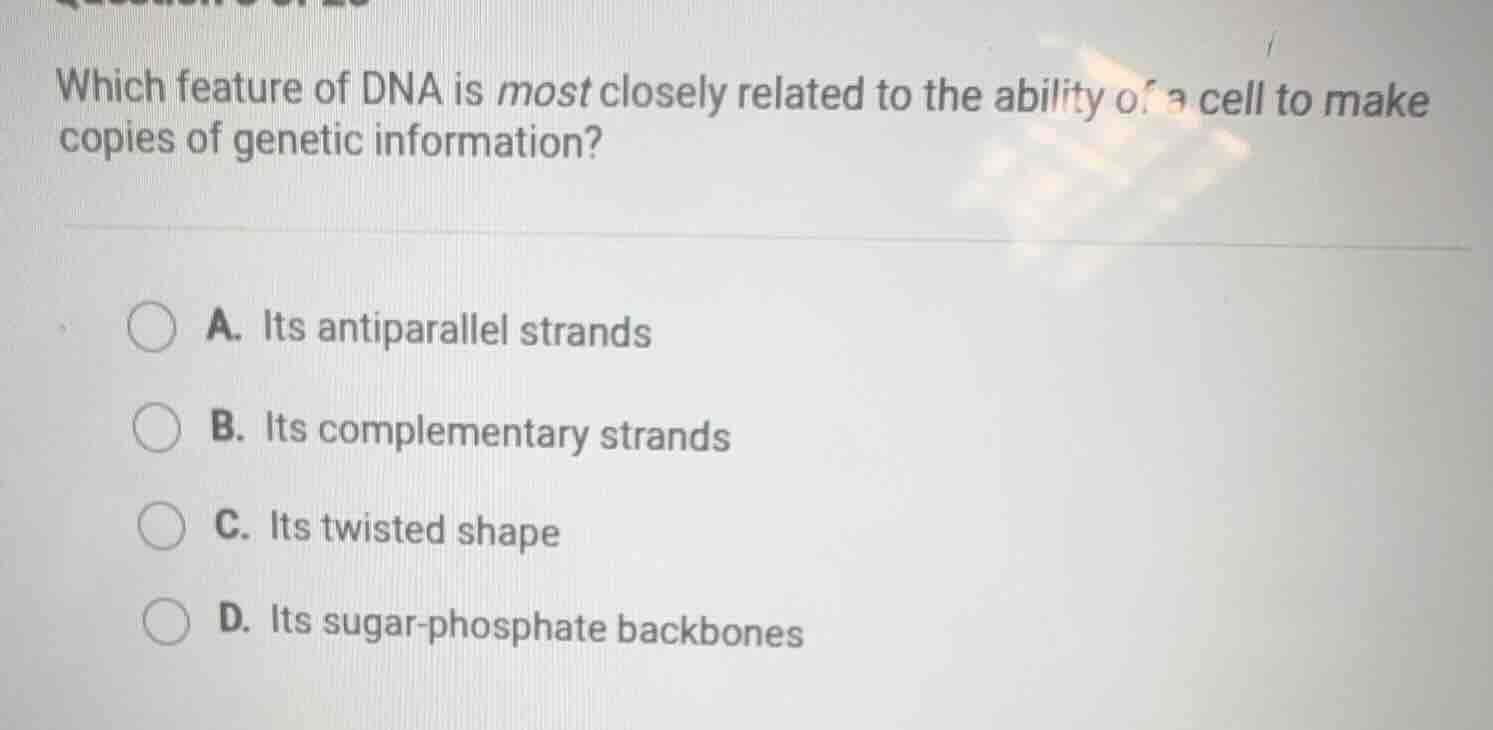
which feature of dna is most closely related to the ability of a cell to make copies of genetic information?

a. its antiparallel strands
b. its complementary strands
c. its twisted shape
d. its sugar-phosphate backbones

Explanation:

Response

<pre_analysis>
{
"quality": "clear",
"question_count": 1,
"skills_matched": [
"direct_cot",
"multiple_choice_formatter",
"explain_then_answer",
"tutor"
],
"needs_drawing": false,
"concepts_used": [
"DNA Structure",
"DNA Replication Purpose"
],
"new_concepts": [
"Complementary Base Pairing"
],
"current_concepts": [
"DNA Structure",
"DNA Replication Purpose",
"Complementary Base Pairing"
]
}
</pre_analysis>

<reasoning>

Identify the core biological process

The question asks which feature of DNA is most closely related to the cell's ability to make copies of its genetic information. Making copies of genetic information refers to the process of DNA replication.

Analyze the role of DNA structure

In DNA Structure, the molecule consists of two strands. During replication, these strands separate, and each serves as a template for synthesizing a new strand.

Evaluate complementary base pairing

For replication to occur accurately, the cell relies on the specific pairing of nitrogenous bases (adenine with thymine, and cytosine with guanine). This feature of complementary strands ensures that each new strand is an exact copy of the original.

Assess the given options

  • A. Its antiparallel strands: While important for the directionality of replication enzymes, it is not the primary mechanism that ensures accurate copying of the sequence.
  • B. Its complementary strands: This is the direct basis for replication, as one strand dictates the sequence of the other.
  • C. Its twisted shape: The double helix provides stability but does not directly facilitate the copying mechanism.
  • D. Its sugar-phosphate backbones: This provides structural support but does not carry the sequence information used for copying.

</reasoning>

<answer>
<mcq-option>(A) Its antiparallel strands</mcq-option>
<mcq-correct>(B) Its complementary strands</mcq-correct>
<mcq-option>(C) Its twisted shape</mcq-option>
<mcq-option>(D) Its sugar-phosphate backbones</mcq-option>
</answer>

<post_analysis>
{
"subject": "Natural Science",
"question_type": "Multiple Choice",
"knowledge_point": [
"Natural Science",
"Biology",
"DNA Replication"
]
}
</post_analysis>

Answer:

<pre_analysis>
{
"quality": "clear",
"question_count": 1,
"skills_matched": [
"direct_cot",
"multiple_choice_formatter",
"explain_then_answer",
"tutor"
],
"needs_drawing": false,
"concepts_used": [
"DNA Structure",
"DNA Replication Purpose"
],
"new_concepts": [
"Complementary Base Pairing"
],
"current_concepts": [
"DNA Structure",
"DNA Replication Purpose",
"Complementary Base Pairing"
]
}
</pre_analysis>

<reasoning>

Identify the core biological process

The question asks which feature of DNA is most closely related to the cell's ability to make copies of its genetic information. Making copies of genetic information refers to the process of DNA replication.

Analyze the role of DNA structure

In DNA Structure, the molecule consists of two strands. During replication, these strands separate, and each serves as a template for synthesizing a new strand.

Evaluate complementary base pairing

For replication to occur accurately, the cell relies on the specific pairing of nitrogenous bases (adenine with thymine, and cytosine with guanine). This feature of complementary strands ensures that each new strand is an exact copy of the original.

Assess the given options

  • A. Its antiparallel strands: While important for the directionality of replication enzymes, it is not the primary mechanism that ensures accurate copying of the sequence.
  • B. Its complementary strands: This is the direct basis for replication, as one strand dictates the sequence of the other.
  • C. Its twisted shape: The double helix provides stability but does not directly facilitate the copying mechanism.
  • D. Its sugar-phosphate backbones: This provides structural support but does not carry the sequence information used for copying.

</reasoning>

<answer>
<mcq-option>(A) Its antiparallel strands</mcq-option>
<mcq-correct>(B) Its complementary strands</mcq-correct>
<mcq-option>(C) Its twisted shape</mcq-option>
<mcq-option>(D) Its sugar-phosphate backbones</mcq-option>
</answer>

<post_analysis>
{
"subject": "Natural Science",
"question_type": "Multiple Choice",
"knowledge_point": [
"Natural Science",
"Biology",
"DNA Replication"
]
}
</post_analysis>