QUESTION IMAGE
Question
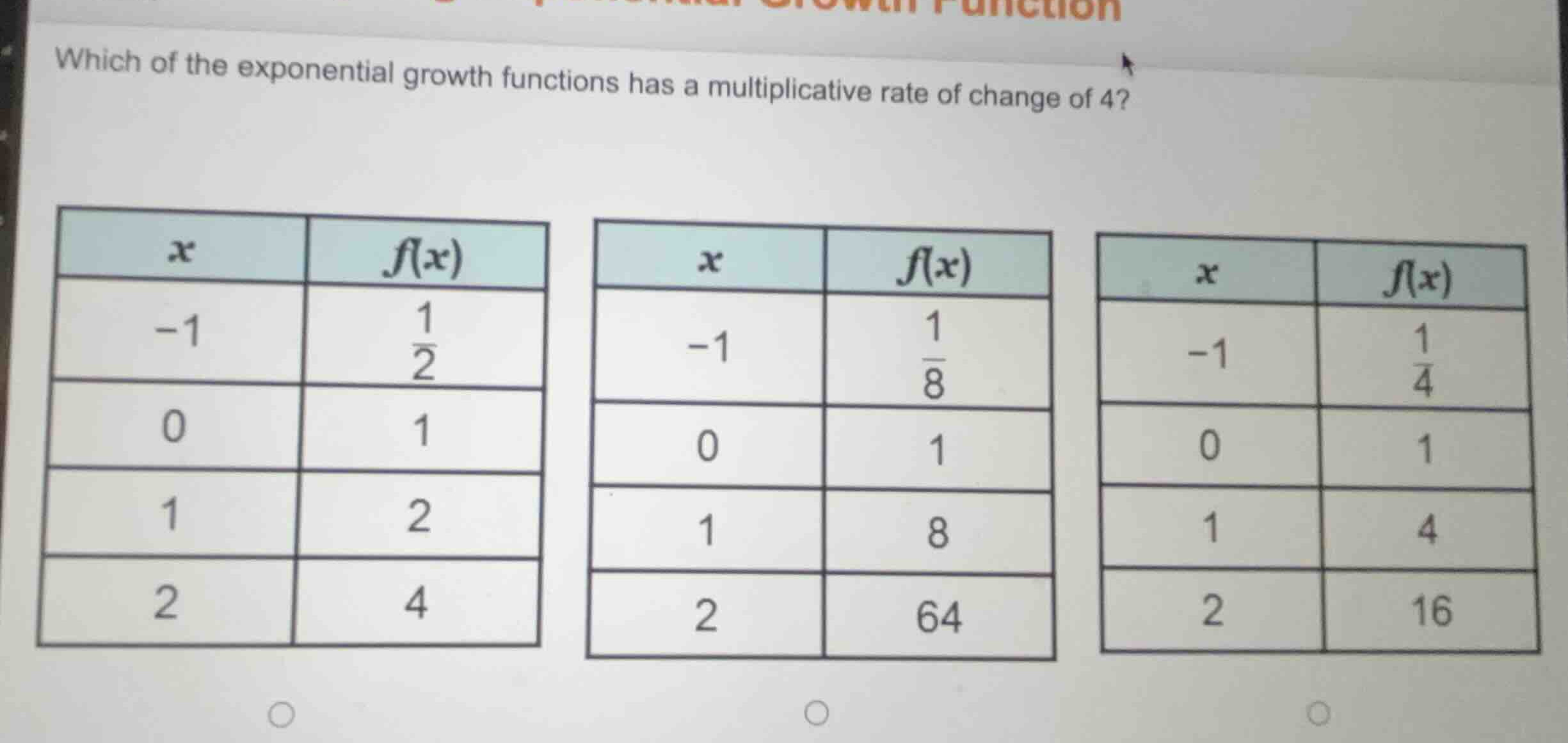
which of the exponential growth functions has a multiplicative rate of change of 4?
table 1:
\
$$\begin{array}{|c|c|}
\\hline
x & f(x) \\\\
\\hline
-1 & \\frac{1}{2} \\\\
\\hline
0 & 1 \\\\
\\hline
1 & 2 \\\\
\\hline
2 & 4 \\\\
\\hline
\\end{array}$$
table 2:
\
$$\begin{array}{|c|c|}
\\hline
x & f(x) \\\\
\\hline
-1 & \\frac{1}{8} \\\\
\\hline
0 & 1 \\\\
\\hline
1 & 8 \\\\
\\hline
2 & 64 \\\\
\\hline
\\end{array}$$
table 3:
\
$$\begin{array}{|c|c|}
\\hline
x & f(x) \\\\
\\hline
-1 & \\frac{1}{4} \\\\
\\hline
0 & 1 \\\\
\\hline
1 & 4 \\\\
\\hline
2 & 16 \\\\
\\hline
\\end{array}$$
Define multiplicative rate of change
$$
\text{Multiplicative rate of change } (b) = \frac{f(x+1)}{f(x)}
$$
Calculate the ratio for each table
$$
LATEXBLOCK0
$$
Identify the correct table
$$
b = 4 \implies \text{Table 3}
$$

Snap & solve any problem in the app
Get step-by-step solutions on Sovi AI
Photo-based solutions with guided steps
Explore more problems and detailed explanations
- (A) The first table with values \((-1, \frac{1}{2})\), \((0, 1)\), \((1, 2)\), \((2, 4)\)
- (B) The second table with values \((-1, \frac{1}{8})\), \((0, 1)\), \((1, 8)\), \((2, 64)\)
- (C) The third table with values \((-1, \frac{1}{4})\), \((0, 1)\), \((1, 4)\), \((2, 16)\) (Correct answer)