QUESTION IMAGE
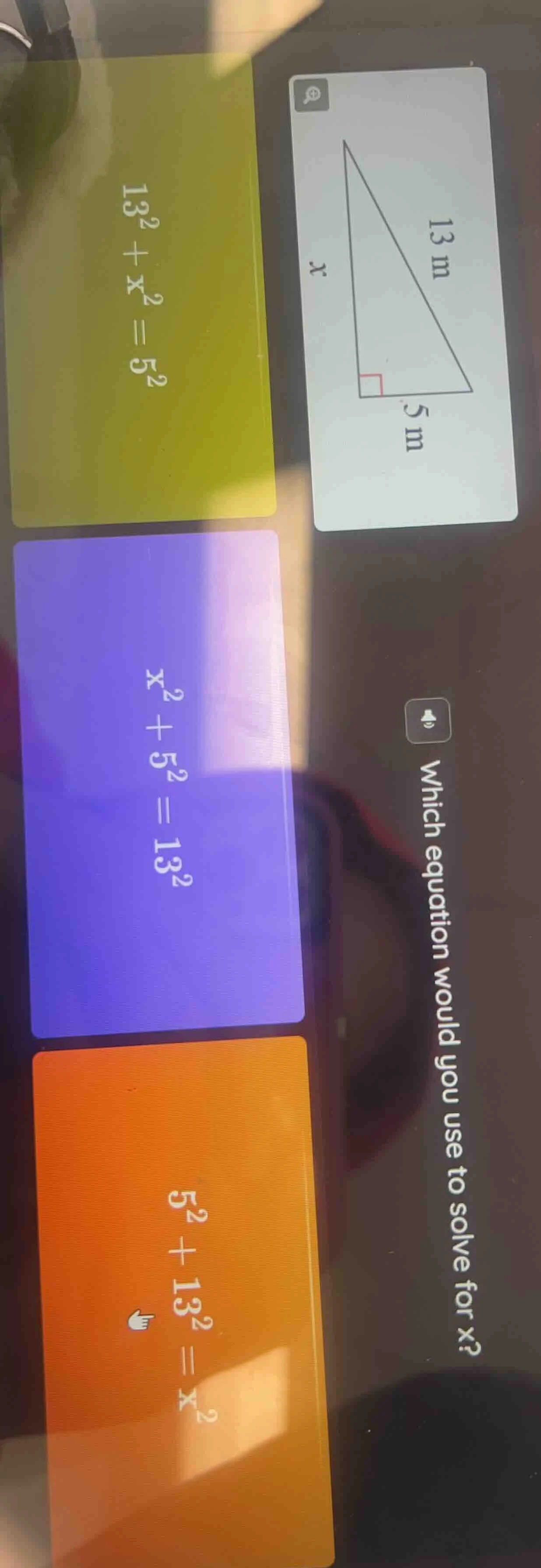
Question
which equation would you use to solve for x?
$13^2 + x^2 = 5^2$
$x^2 + 5^2 = 13^2$
$5^2 + 13^2 = x^2$
Step1: Recall Pythagorean theorem
For a right triangle, $a^2 + b^2 = c^2$, where $c$ is the hypotenuse (longest side, opposite the right angle).
Step2: Match sides to the theorem
Here, hypotenuse $c=13$ m, legs $x$ and $5$ m. Substitute into theorem:
$x^2 + 5^2 = 13^2$

Snap & solve any problem in the app
Get step-by-step solutions on Sovi AI
Photo-based solutions with guided steps
Explore more problems and detailed explanations
$\boldsymbol{x^2 + 5^2 = 13^2}$ (the equation in the purple box)