QUESTION IMAGE
Question
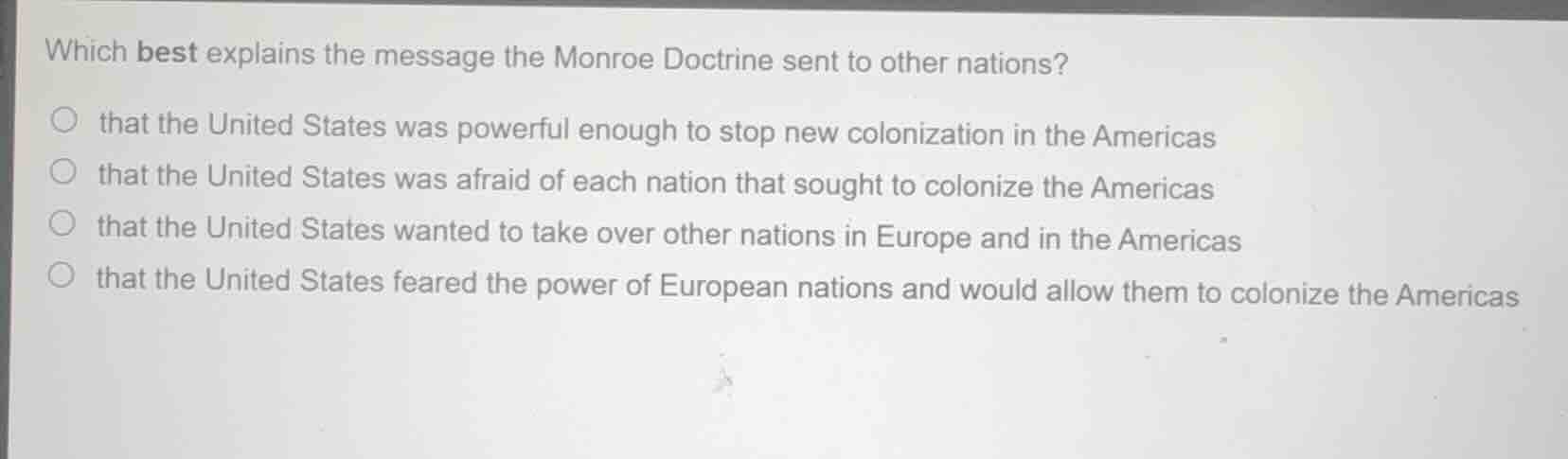
which best explains the message the monroe doctrine sent to other nations?
that the united states was powerful enough to stop new colonization in the americas
that the united states was afraid of each nation that sought to colonize the americas
that the united states wanted to take over other nations in europe and in the americas
that the united states feared the power of european nations and would allow them to colonize the americas
<pre_analysis>
{
"quality": "clear",
"question_count": 1,
"skills_matched": [
"direct_cot",
"multiple_choice_formatter",
"explain_then_answer",
"quick"
],
"needs_drawing": false,
"concepts_used": [
"Monroe Doctrine"
],
"new_concepts": [],
"current_concepts": [
"Monroe Doctrine",
"US Foreign Policy"
]
}
</pre_analysis>
<reasoning>
Analyze the core message of the Monroe Doctrine
The Monroe Doctrine, introduced in 1823, declared that the Western Hemisphere was closed to further European colonization. It warned European powers that any attempts to intervene or establish new colonies in the Americas would be viewed as a hostile act against the United States.
Evaluate the given options
- Option 1 ("that the United States was powerful enough to stop new colonization in the Americas"): This correctly reflects the assertive stance of the doctrine, signaling to foreign powers that the U.S. would actively prevent new colonization efforts in its hemisphere.
- Option 2 ("that the United States was afraid..."): Incorrect, as the doctrine was a projection of strength and warning, not an expression of fear.
- Option 3 ("that the United States wanted to take over other nations..."): Incorrect, as the doctrine focused on preventing European interference rather than declaring U.S. intent to conquer Europe or existing American nations.
- Option 4 ("that the United States feared... and would allow them to colonize..."): Incorrect, as the doctrine explicitly opposed further colonization.
</reasoning>
<answer>
<mcq-correct>(A) that the United States was powerful enough to stop new colonization in the Americas</mcq-correct>
<mcq-option>(B) that the United States was afraid of each nation that sought to colonize the Americas</mcq-option>
<mcq-option>(C) that the United States wanted to take over other nations in Europe and in the Americas</mcq-option>
<mcq-option>(D) that the United States feared the power of European nations and would allow them to colonize the Americas</mcq-option>
</answer>
<post_analysis>
{
"subject": "Social Science",
"question_type": "Multiple Choice",
"knowledge_point": [
"Social Science",
"History",
"Monroe Doctrine"
]
}
</post_analysis>
Snap & solve any problem in the app
Get step-by-step solutions on Sovi AI
Photo-based solutions with guided steps
Explore more problems and detailed explanations
<pre_analysis>
{
"quality": "clear",
"question_count": 1,
"skills_matched": [
"direct_cot",
"multiple_choice_formatter",
"explain_then_answer",
"quick"
],
"needs_drawing": false,
"concepts_used": [
"Monroe Doctrine"
],
"new_concepts": [],
"current_concepts": [
"Monroe Doctrine",
"US Foreign Policy"
]
}
</pre_analysis>
<reasoning>
Analyze the core message of the Monroe Doctrine
The Monroe Doctrine, introduced in 1823, declared that the Western Hemisphere was closed to further European colonization. It warned European powers that any attempts to intervene or establish new colonies in the Americas would be viewed as a hostile act against the United States.
Evaluate the given options
- Option 1 ("that the United States was powerful enough to stop new colonization in the Americas"): This correctly reflects the assertive stance of the doctrine, signaling to foreign powers that the U.S. would actively prevent new colonization efforts in its hemisphere.
- Option 2 ("that the United States was afraid..."): Incorrect, as the doctrine was a projection of strength and warning, not an expression of fear.
- Option 3 ("that the United States wanted to take over other nations..."): Incorrect, as the doctrine focused on preventing European interference rather than declaring U.S. intent to conquer Europe or existing American nations.
- Option 4 ("that the United States feared... and would allow them to colonize..."): Incorrect, as the doctrine explicitly opposed further colonization.
</reasoning>
<answer>
<mcq-correct>(A) that the United States was powerful enough to stop new colonization in the Americas</mcq-correct>
<mcq-option>(B) that the United States was afraid of each nation that sought to colonize the Americas</mcq-option>
<mcq-option>(C) that the United States wanted to take over other nations in Europe and in the Americas</mcq-option>
<mcq-option>(D) that the United States feared the power of European nations and would allow them to colonize the Americas</mcq-option>
</answer>
<post_analysis>
{
"subject": "Social Science",
"question_type": "Multiple Choice",
"knowledge_point": [
"Social Science",
"History",
"Monroe Doctrine"
]
}
</post_analysis>