QUESTION IMAGE
Question
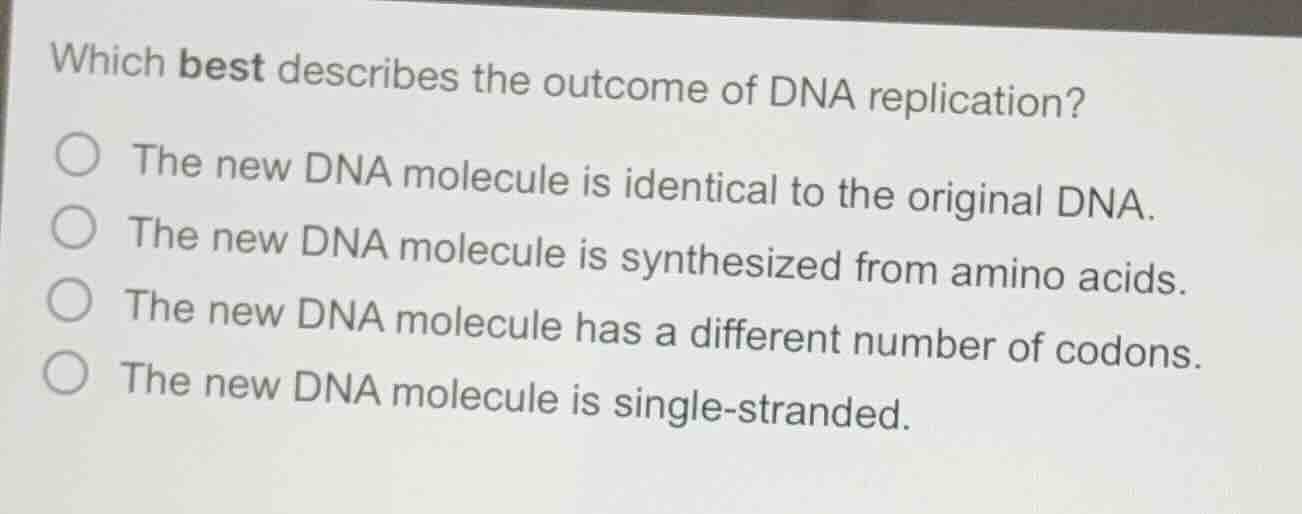
which best describes the outcome of dna replication?
the new dna molecule is identical to the original dna.
the new dna molecule is synthesized from amino acids.
the new dna molecule has a different number of codons.
the new dna molecule is single-stranded.
<pre_analysis>
{
"quality": "clear",
"question_count": 1,
"skills_matched": [
"direct_cot",
"multiple_choice_formatter",
"explain_then_answer",
"quick"
],
"needs_drawing": false,
"concepts_used": [],
"new_concepts": [
"DNA Replication Outcome"
],
"current_concepts": [
"DNA Replication",
"DNA Replication Outcome"
]
}
</pre_analysis>
<reasoning>
Analyze the purpose of DNA replication
DNA replication is the biological process of producing two identical replicas of DNA from one original DNA molecule.
Evaluate the given options
- Option 1 states that the new DNA molecule is identical to the original DNA, which matches the fundamental purpose of replication.
- Option 2 is incorrect because DNA is synthesized from nucleotides, not amino acids (which make up proteins).
- Option 3 is incorrect because replication aims to conserve the exact genetic sequence and structure, not change codon numbers.
- Option 4 is incorrect because DNA is a double-stranded molecule, and replication produces double-stranded DNA.
Select the correct option
The first option is the most accurate description of the outcome of DNA replication.
</reasoning>
<answer>
<mcq-correct>The new DNA molecule is identical to the original DNA.</mcq-correct>
<mcq-option>The new DNA molecule is synthesized from amino acids.</mcq-option>
<mcq-option>The new DNA molecule has a different number of codons.</mcq-option>
<mcq-option>The new DNA molecule is single-stranded.</mcq-option>
</answer>
<post_analysis>
{
"subject": "Natural Science",
"question_type": "Multiple Choice",
"knowledge_point": [
"Natural Science",
"Biology",
"DNA Replication"
]
}
</post_analysis>
Snap & solve any problem in the app
Get step-by-step solutions on Sovi AI
Photo-based solutions with guided steps
Explore more problems and detailed explanations
<pre_analysis>
{
"quality": "clear",
"question_count": 1,
"skills_matched": [
"direct_cot",
"multiple_choice_formatter",
"explain_then_answer",
"quick"
],
"needs_drawing": false,
"concepts_used": [],
"new_concepts": [
"DNA Replication Outcome"
],
"current_concepts": [
"DNA Replication",
"DNA Replication Outcome"
]
}
</pre_analysis>
<reasoning>
Analyze the purpose of DNA replication
DNA replication is the biological process of producing two identical replicas of DNA from one original DNA molecule.
Evaluate the given options
- Option 1 states that the new DNA molecule is identical to the original DNA, which matches the fundamental purpose of replication.
- Option 2 is incorrect because DNA is synthesized from nucleotides, not amino acids (which make up proteins).
- Option 3 is incorrect because replication aims to conserve the exact genetic sequence and structure, not change codon numbers.
- Option 4 is incorrect because DNA is a double-stranded molecule, and replication produces double-stranded DNA.
Select the correct option
The first option is the most accurate description of the outcome of DNA replication.
</reasoning>
<answer>
<mcq-correct>The new DNA molecule is identical to the original DNA.</mcq-correct>
<mcq-option>The new DNA molecule is synthesized from amino acids.</mcq-option>
<mcq-option>The new DNA molecule has a different number of codons.</mcq-option>
<mcq-option>The new DNA molecule is single-stranded.</mcq-option>
</answer>
<post_analysis>
{
"subject": "Natural Science",
"question_type": "Multiple Choice",
"knowledge_point": [
"Natural Science",
"Biology",
"DNA Replication"
]
}
</post_analysis>