QUESTION IMAGE
Question
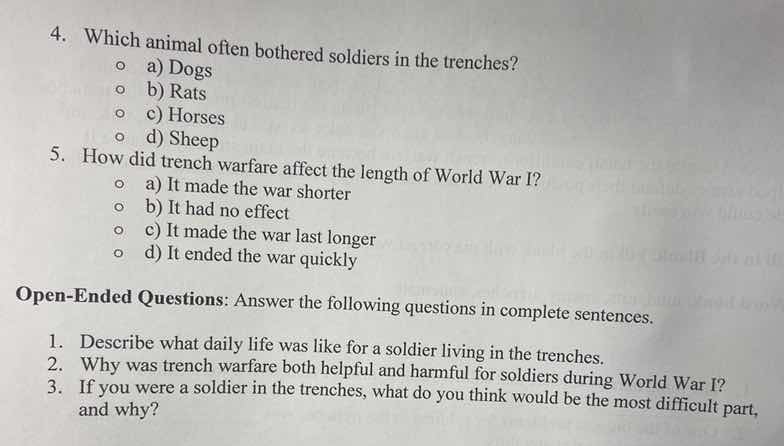
- which animal often bothered soldiers in the trenches?
a) dogs
b) rats
c) horses
d) sheep
- how did trench warfare affect the length of world war i?
a) it made the war shorter
b) it had no effect
c) it made the war last longer
d) it ended the war quickly
open - ended questions: answer the following questions in complete sentences.
- describe what daily life was like for a soldier living in the trenches.
- why was trench warfare both helpful and harmful for soldiers during world war i?
- if you were a soldier in the trenches, what do you think would be the most difficult part, and why?
Brief Explanations
- For question 4: Rats thrived in the unsanitary, food-rich trench environments of WWI, infesting living areas, spreading disease, and damaging supplies, making them a constant nuisance to soldiers.
- For question 5: Trench warfare created static, heavily fortified lines that were extremely difficult to break through, leading to prolonged, stalemated combat that extended the war's duration.
- For open-ended question 1: Trench life involved cramped, muddy, unsanitary conditions, daily exposure to enemy fire, rationed food, poor sleep, and constant threats of disease like trench foot.
- For open-ended question 2: Trench warfare provided cover from enemy fire, but it also exposed soldiers to disease, psychological trauma (shell shock), constant danger, and miserable living conditions.
- For open-ended question 3: The most difficult part would likely be the persistent psychological stress—enduring constant fear of enemy attacks, shelling, and the hopelessness of stalemated combat, which often led to long-term mental health issues.

Snap & solve any problem in the app
Get step-by-step solutions on Sovi AI
Photo-based solutions with guided steps
Explore more problems and detailed explanations
- b) Rats
- c) It made the war last longer
- Daily life for WWI trench soldiers was marked by cramped, muddy, unsanitary quarters, daily exposure to enemy fire, rationed meals, frequent sleep deprivation, and constant risk of diseases like trench foot and typhus, with little relief from the miserable conditions.
- Trench warfare was helpful because it provided soldiers with protective cover from direct enemy small-arms fire and artillery. It was harmful because it trapped soldiers in unsanitary, disease-ridden conditions, exposed them to psychological trauma from constant shelling and stalemate, and led to high casualty rates during futile frontal assaults on fortified lines.
- If I were a soldier in the trenches, the most difficult part would be the unrelenting psychological stress. The constant fear of sudden artillery barrages, surprise enemy raids, and the hopelessness of a prolonged stalemate, combined with the inability to escape the miserable, life-threatening environment, would take an unbearable toll on mental health far beyond physical hardships.