QUESTION IMAGE
Question
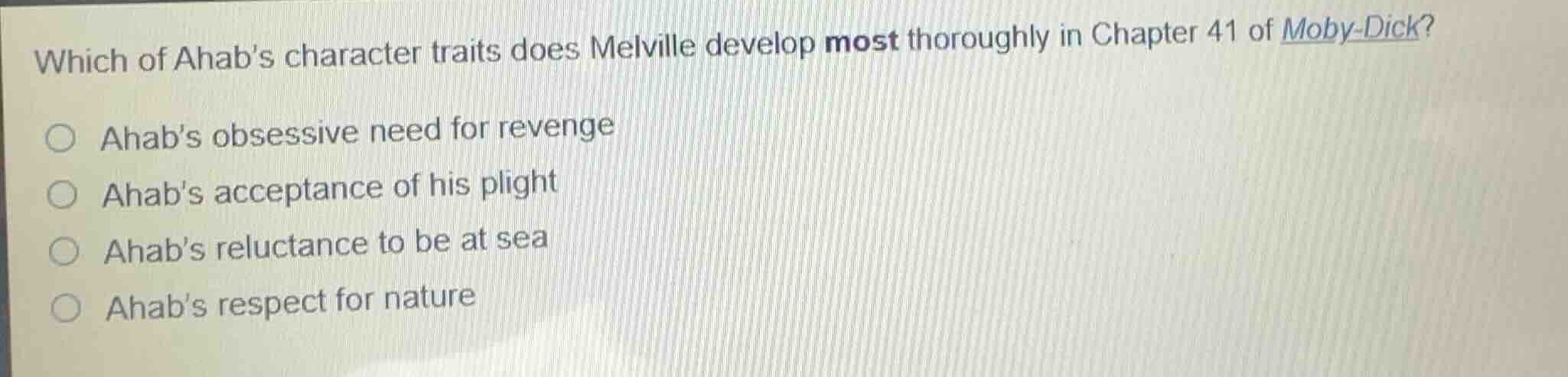
which of ahabs character traits does melville develop most thoroughly in chapter 41 of moby-dick?
ahabs obsessive need for revenge
ahabs acceptance of his plight
ahabs reluctance to be at sea
ahabs respect for nature
<pre_analysis>
{
"quality": "clear",
"question_count": 1,
"skills_matched": [
"direct_cot",
"multiple_choice_formatter",
"explain_then_answer",
"tutor",
"mastery_adaptive_brevity"
],
"needs_drawing": false,
"concepts_used": [
"Moby-Dick Analysis",
"Character Analysis"
],
"new_concepts": [],
"current_concepts": [
"Moby-Dick Analysis",
"Character Analysis",
"Literary Theme Development"
]
}
</pre_analysis>
<reasoning>
Analyze Chapter 41 of Moby-Dick
Using the Moby-Dick Analysis and Character Analysis knowledge points
- Chapter 41 is titled "Moby Dick" and focuses on Ahab's internal motivations and history with the white whale.
- The text explains that Ahab associates Moby Dick with all his bodily woes, intellectual exasperations, and spiritual rage.
- It describes how Ahab's mind has become completely consumed by a single-minded, monomaniacal pursuit to hunt down and destroy the whale that took his leg.
Evaluate the character traits
Using the Character Analysis knowledge point
- Ahab's obsessive need for revenge: This is the central focus of Chapter 41, detailing his monomania and deep-seated fury.
- Ahab's acceptance of his plight: Incorrect; Ahab fiercely rebels against his fate and mutilation.
- Ahab's reluctance to be at sea: Incorrect; Ahab is driven to be at sea specifically to hunt the whale.
- Ahab's respect for nature: Incorrect; Ahab views the white whale (and nature) as a malicious agent to be conquered and destroyed.
</reasoning>
<answer>
<mcq-correct>Ahab's obsessive need for revenge</mcq-correct>
<mcq-option>Ahab's acceptance of his plight</mcq-option>
<mcq-option>Ahab's reluctance to be at sea</mcq-option>
<mcq-option>Ahab's respect for nature</mcq-option>
</answer>
<post_analysis>
{
"subject": "Arts",
"question_type": "Multiple Choice",
"knowledge_point": [
"Arts",
"Literature",
"Moby-Dick Analysis"
]
}
</post_analysis>
Snap & solve any problem in the app
Get step-by-step solutions on Sovi AI
Photo-based solutions with guided steps
Explore more problems and detailed explanations
<pre_analysis>
{
"quality": "clear",
"question_count": 1,
"skills_matched": [
"direct_cot",
"multiple_choice_formatter",
"explain_then_answer",
"tutor",
"mastery_adaptive_brevity"
],
"needs_drawing": false,
"concepts_used": [
"Moby-Dick Analysis",
"Character Analysis"
],
"new_concepts": [],
"current_concepts": [
"Moby-Dick Analysis",
"Character Analysis",
"Literary Theme Development"
]
}
</pre_analysis>
<reasoning>
Analyze Chapter 41 of Moby-Dick
Using the Moby-Dick Analysis and Character Analysis knowledge points
- Chapter 41 is titled "Moby Dick" and focuses on Ahab's internal motivations and history with the white whale.
- The text explains that Ahab associates Moby Dick with all his bodily woes, intellectual exasperations, and spiritual rage.
- It describes how Ahab's mind has become completely consumed by a single-minded, monomaniacal pursuit to hunt down and destroy the whale that took his leg.
Evaluate the character traits
Using the Character Analysis knowledge point
- Ahab's obsessive need for revenge: This is the central focus of Chapter 41, detailing his monomania and deep-seated fury.
- Ahab's acceptance of his plight: Incorrect; Ahab fiercely rebels against his fate and mutilation.
- Ahab's reluctance to be at sea: Incorrect; Ahab is driven to be at sea specifically to hunt the whale.
- Ahab's respect for nature: Incorrect; Ahab views the white whale (and nature) as a malicious agent to be conquered and destroyed.
</reasoning>
<answer>
<mcq-correct>Ahab's obsessive need for revenge</mcq-correct>
<mcq-option>Ahab's acceptance of his plight</mcq-option>
<mcq-option>Ahab's reluctance to be at sea</mcq-option>
<mcq-option>Ahab's respect for nature</mcq-option>
</answer>
<post_analysis>
{
"subject": "Arts",
"question_type": "Multiple Choice",
"knowledge_point": [
"Arts",
"Literature",
"Moby-Dick Analysis"
]
}
</post_analysis>