QUESTION IMAGE
Question
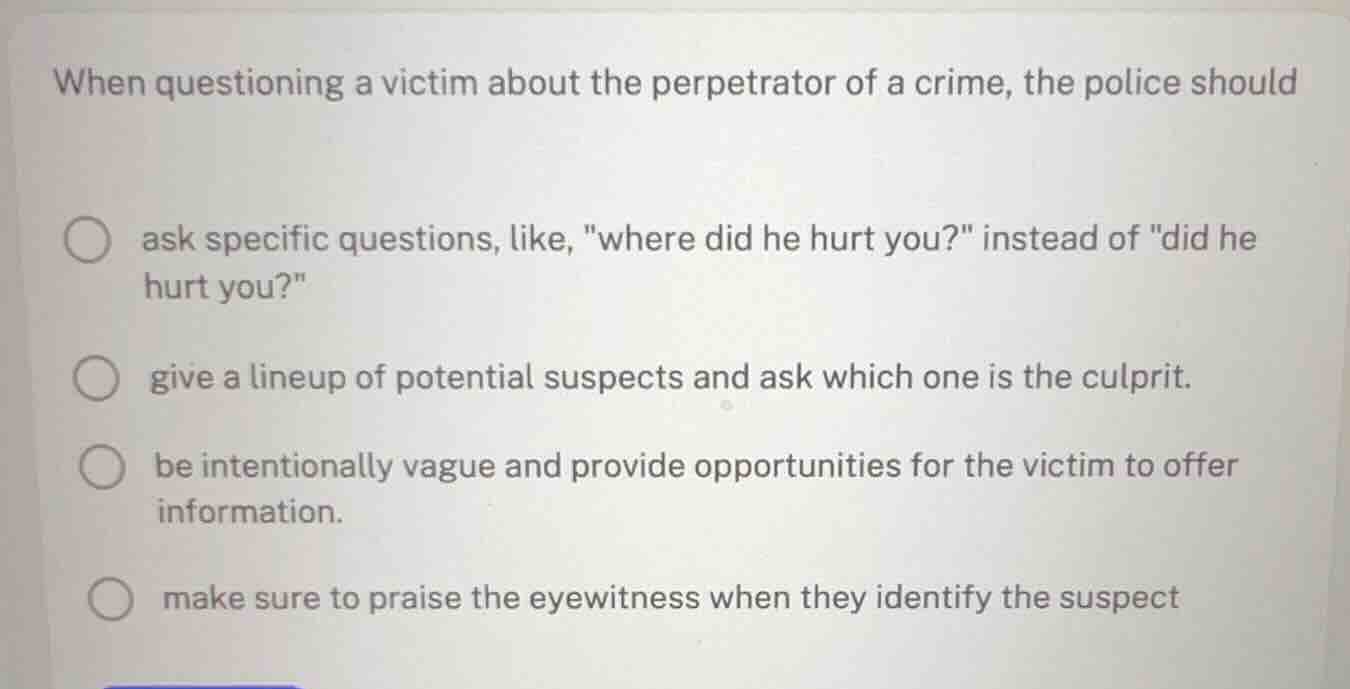
when questioning a victim about the perpetrator of a crime, the police should
- ask specific questions, like, \where did he hurt you?\ instead of \did he hurt you?\
- give a lineup of potential suspects and ask which one is the culprit.
- be intentionally vague and provide opportunities for the victim to offer information.
- make sure to praise the eyewitness when they identify the suspect
Analyze the impact of questioning techniques on memory
In cognitive psychology, specifically regarding Eyewitness Testimony and Memory Reconstruction, research shows that human memory is highly malleable and susceptible to suggestion. Leading or highly specific questions can introduce false details, a phenomenon known as the Misinformation Effect.
Evaluate the options based on cognitive principles
- Option 1: Asking highly specific questions like "where did he hurt you?" assumes a fact (that the perpetrator hurt the victim) which can lead or bias the victim's memory.
- Option 2: Standard simultaneous lineups can lead to relative judgment (picking the person who looks most like the culprit relative to others) rather than absolute recognition.
- Option 3: Being intentionally vague and allowing open-ended, free recall minimizes the risk of introducing misinformation, allowing the victim to retrieve accurate details from memory without external suggestion.
- Option 4: Praising an eyewitness after an identification can artificially inflate their confidence in a potentially incorrect memory, distorting subsequent testimony.
Determine the best police practice
To preserve the integrity of memory retrieval, law enforcement should use open-ended, non-leading, and neutral questioning techniques. Therefore, being intentionally vague and providing opportunities for the victim to offer information is the most scientifically supported approach.

Snap & solve any problem in the app
Get step-by-step solutions on Sovi AI
Photo-based solutions with guided steps
Explore more problems and detailed explanations
- ask specific questions, like, "where did he hurt you?" instead of "did he hurt you?"
- give a lineup of potential suspects and ask which one is the culprit.
- be intentionally vague and provide opportunities for the victim to offer information. (Correct answer)
- make sure to praise the eyewitness when they identify the suspect