QUESTION IMAGE
Question
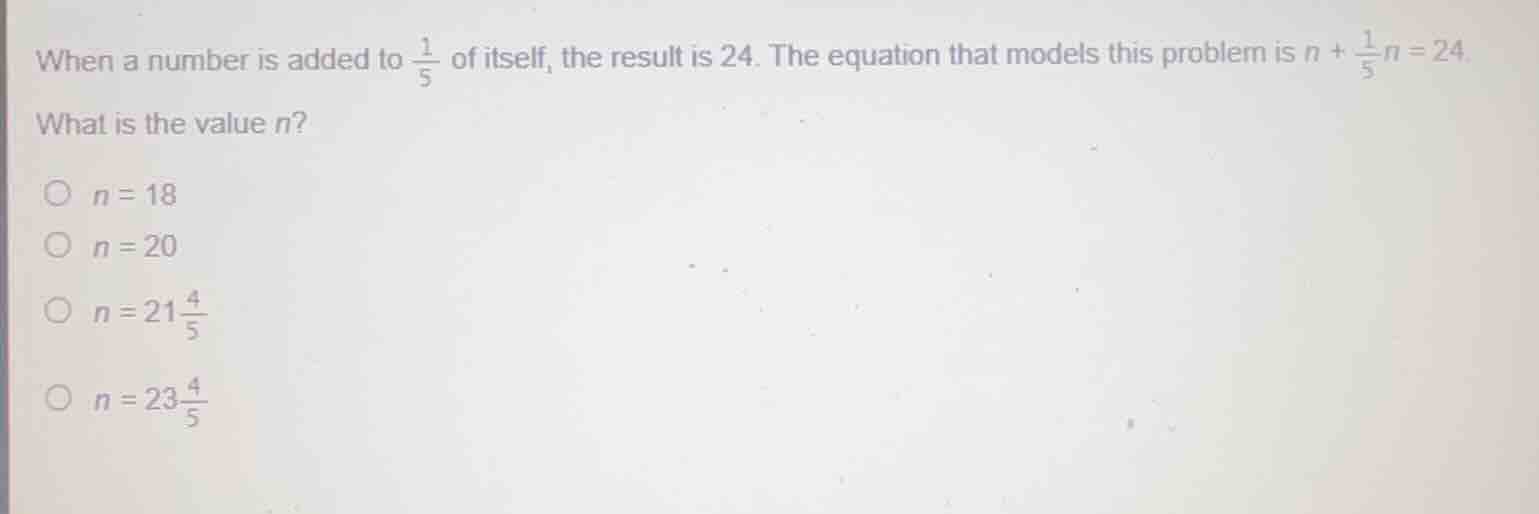
when a number is added to \\(\frac{1}{5}\\) of itself, the result is 24. the equation that models this problem is \\(n + \frac{1}{5}n = 24\\).
what is the value \\(n\\)?
\\(n = 18\\)
\\(n = 20\\)
\\(n = 21\frac{4}{5}\\)
\\(n = 23\frac{4}{5}\\)
Identify the given equation
We are given the linear equation that models the word problem:
Our goal is to solve this equation for the unknown variable \(n\).
Combine the like terms
To combine the terms on the left side, we find a common denominator for the coefficients of \(n\). The coefficient of the first term is \(1\), which can be written as \(\frac{5}{5}\):
Adding the fractions gives:
Isolate the variable n
To solve for \(n\), we multiply both sides of the equation by the reciprocal of \(\frac{6}{5}\), which is \(\frac{5}{6}\):
Simplify the expression
We simplify the multiplication by dividing \(24\) by \(6\) first:
This matches the second option.

Snap & solve any problem in the app
Get step-by-step solutions on Sovi AI
Photo-based solutions with guided steps
Explore more problems and detailed explanations
- (A) \(n = 18\)
- (B) \(n = 20\) (Correct answer)
- (C) \(n = 21\frac{4}{5}\)
- (D) \(n = 23\frac{4}{5}\)