QUESTION IMAGE
Question
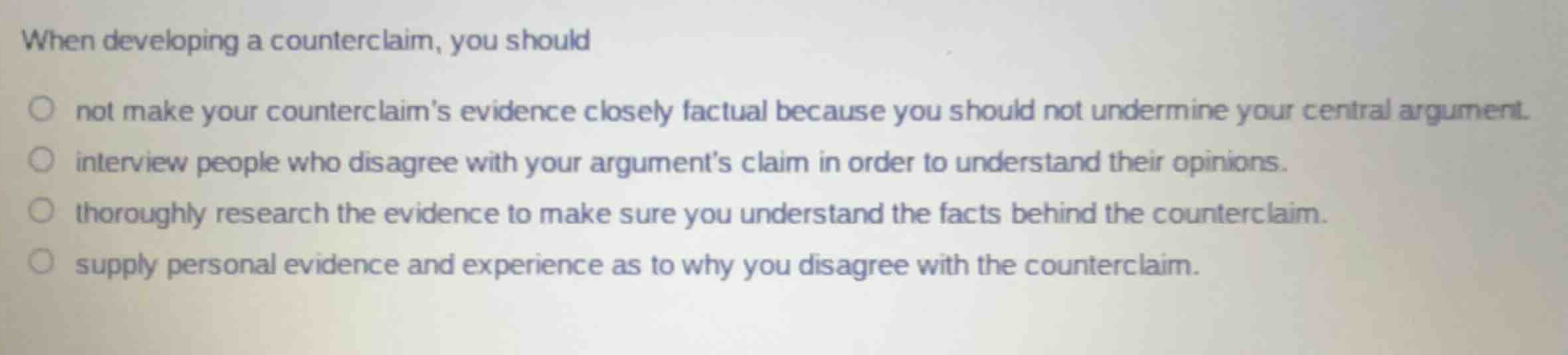
when developing a counterclaim, you should
not make your counterclaims evidence closely factual because you should not undermine your central argument.
interview people who disagree with your arguments claim in order to understand their opinions.
thoroughly research the evidence to make sure you understand the facts behind the counterclaim.
supply personal evidence and experience as to why you disagree with the counterclaim.
Analyze the purpose of a counterclaim
A counterclaim represents an opposing viewpoint in an argument. To address it effectively and maintain credibility, a writer must present it accurately and fairly rather than using weak or unresearched evidence.
Evaluate the given options
- Option 1 suggests avoiding factual evidence, which weakens the academic integrity of the writing.
- Option 2 suggests conducting interviews, which is not a standard or necessary requirement for developing a counterclaim.
- Option 3 emphasizes thoroughly researching the evidence to understand the facts behind the opposing view, which ensures the counterclaim is represented accurately before it is refuted.
- Option 4 focuses on personal experience, which is less objective and persuasive than factual research in formal argumentation.
Determine the correct choice
Thoroughly researching the opposing facts allows a writer to build a strong, credible argument and construct a precise rebuttal.

Snap & solve any problem in the app
Get step-by-step solutions on Sovi AI
Photo-based solutions with guided steps
Explore more problems and detailed explanations
- not make your counterclaim's evidence closely factual because you should not undermine your central argument.
- interview people who disagree with your argument's claim in order to understand their opinions.
- thoroughly research the evidence to make sure you understand the facts behind the counterclaim. (Correct answer)
- supply personal evidence and experience as to why you disagree with the counterclaim.