Sovi.AI - AI Math Tutor

Scan to solve math questions

QUESTION IMAGE

when is a case considered work-related? - if it occurs outside of work …

Question

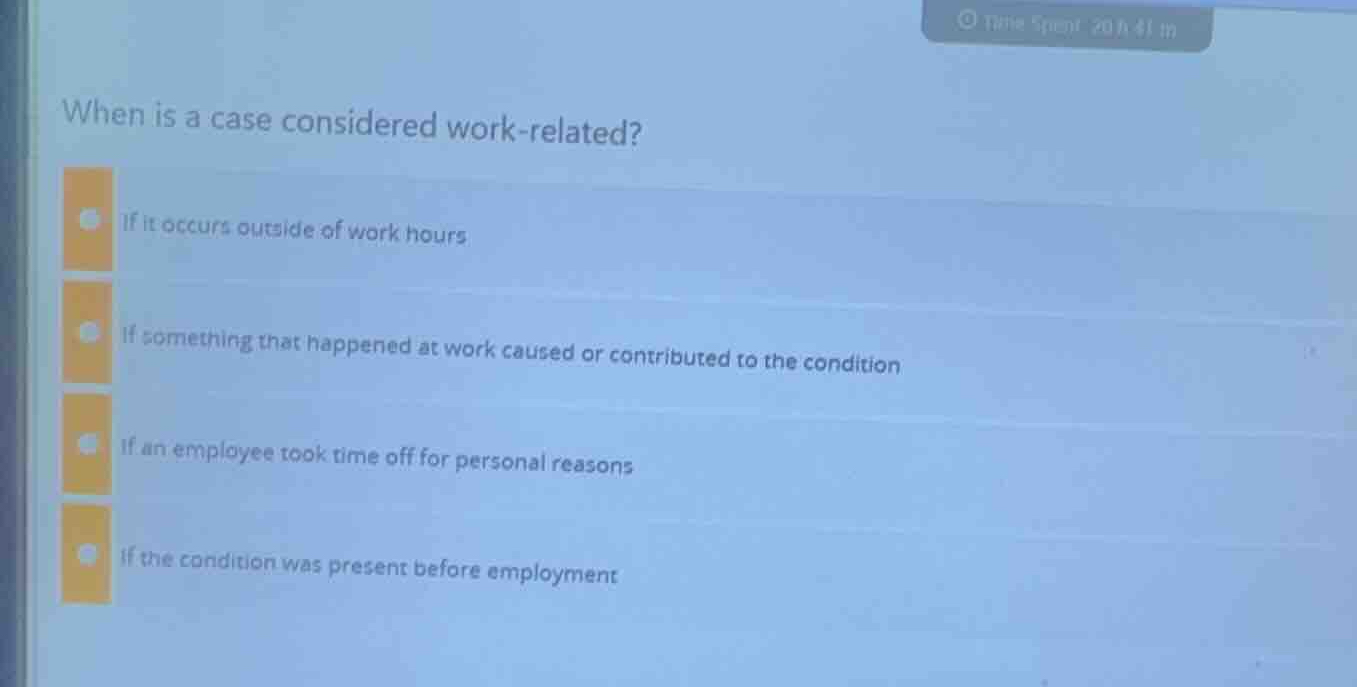
when is a case considered work-related?

  • if it occurs outside of work hours
  • if something that happened at work caused or contributed to the condition
  • if an employee took time off for personal reasons
  • if the condition was present before employment

Explanation:

Response

<pre_analysis>
{
"quality": "clear",
"question_count": 1,
"skills_matched": [
"direct_cot",
"multiple_choice_formatter",
"explain_then_answer",
"quick"
],
"needs_drawing": false,
"concepts_used": [
"OSHA Reporting Requirements"
],
"new_concepts": [
"Work-Related Injury Criteria"
],
"current_concepts": [
"OSHA Reporting Requirements",
"Work-Related Injury Criteria"
]
}
</pre_analysis>

<reasoning>

Analyze the definition of work-relatedness

Under OSHA recordkeeping standards, an injury or illness is considered work-related if an event or exposure in the work environment either caused or contributed to the resulting condition, or significantly aggravated a pre-existing condition.

Evaluate the given options

  • Option 1: "If it occurs outside of work hours" — Generally, injuries occurring outside of work hours and off-premises are not work-related.
  • Option 2: "If something that happened at work caused or contributed to the condition" — This directly matches the OSHA definition of work-relatedness.
  • Option 3: "If an employee took time off for personal reasons" — Personal time off is unrelated to work-related injuries.
  • Option 4: "If the condition was present before employment" — Pre-existing conditions are not work-related unless significantly aggravated by work events.

</reasoning>

<answer>
<mcq-option>If it occurs outside of work hours</mcq-option>
<mcq-correct>If something that happened at work caused or contributed to the condition</mcq-correct>
<mcq-option>If an employee took time off for personal reasons</mcq-option>
<mcq-option>If the condition was present before employment</mcq-option>
</answer>

<post_analysis>
{
"subject": "Natural Science",
"question_type": "Multiple Choice",
"knowledge_point": [
"Natural Science",
"Occupational Health",
"OSHA Reporting Requirements"
]
}
</post_analysis>

Answer:

<pre_analysis>
{
"quality": "clear",
"question_count": 1,
"skills_matched": [
"direct_cot",
"multiple_choice_formatter",
"explain_then_answer",
"quick"
],
"needs_drawing": false,
"concepts_used": [
"OSHA Reporting Requirements"
],
"new_concepts": [
"Work-Related Injury Criteria"
],
"current_concepts": [
"OSHA Reporting Requirements",
"Work-Related Injury Criteria"
]
}
</pre_analysis>

<reasoning>

Analyze the definition of work-relatedness

Under OSHA recordkeeping standards, an injury or illness is considered work-related if an event or exposure in the work environment either caused or contributed to the resulting condition, or significantly aggravated a pre-existing condition.

Evaluate the given options

  • Option 1: "If it occurs outside of work hours" — Generally, injuries occurring outside of work hours and off-premises are not work-related.
  • Option 2: "If something that happened at work caused or contributed to the condition" — This directly matches the OSHA definition of work-relatedness.
  • Option 3: "If an employee took time off for personal reasons" — Personal time off is unrelated to work-related injuries.
  • Option 4: "If the condition was present before employment" — Pre-existing conditions are not work-related unless significantly aggravated by work events.

</reasoning>

<answer>
<mcq-option>If it occurs outside of work hours</mcq-option>
<mcq-correct>If something that happened at work caused or contributed to the condition</mcq-correct>
<mcq-option>If an employee took time off for personal reasons</mcq-option>
<mcq-option>If the condition was present before employment</mcq-option>
</answer>

<post_analysis>
{
"subject": "Natural Science",
"question_type": "Multiple Choice",
"knowledge_point": [
"Natural Science",
"Occupational Health",
"OSHA Reporting Requirements"
]
}
</post_analysis>