QUESTION IMAGE
Question
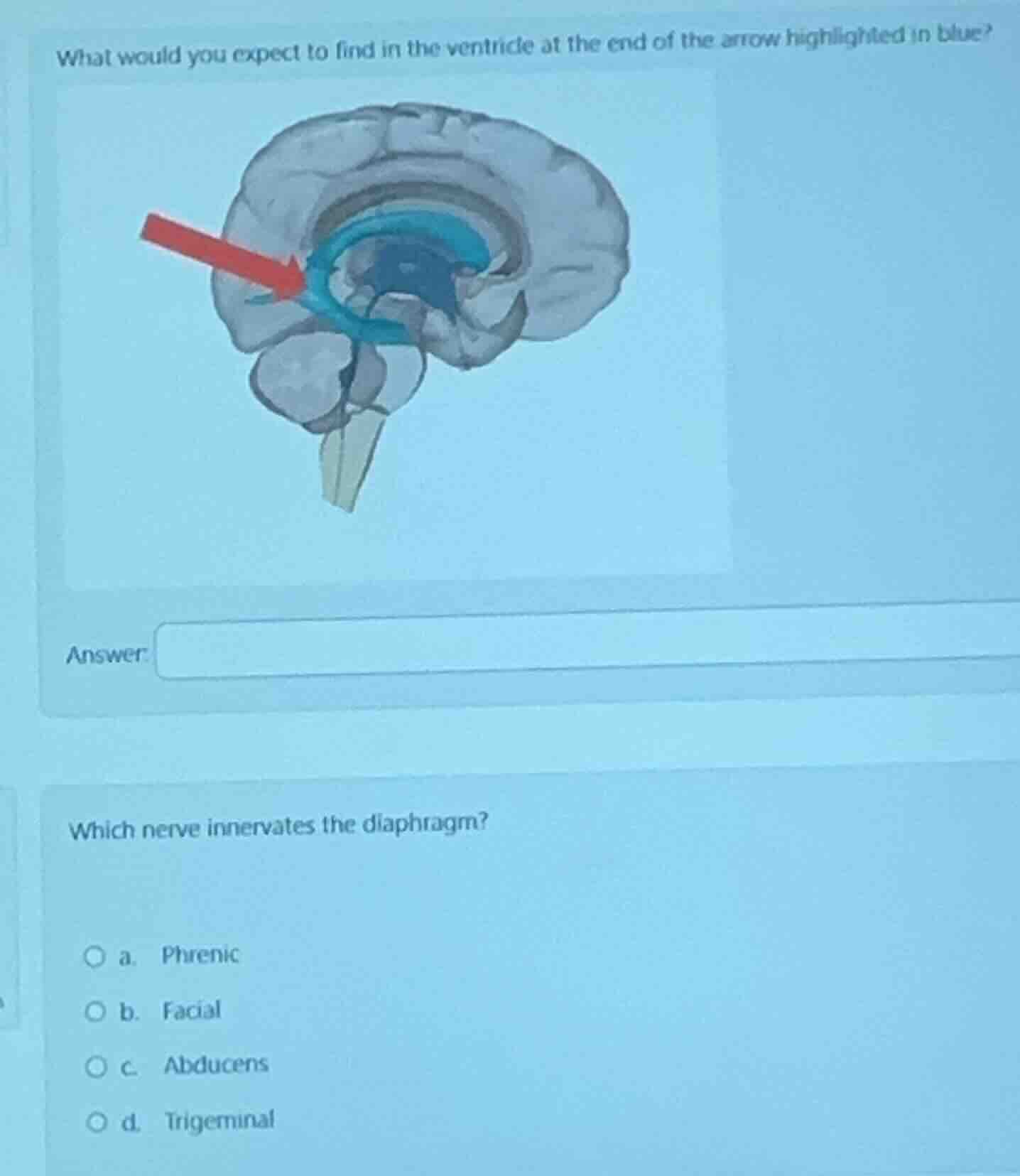
what would you expect to find in the ventricle at the end of the arrow highlighted in blue?
which nerve innervates the diaphragm?
a. phrenic
b. facial
c. abducens
d. trigeminal
Identify the brain structure and its contents
The first question asks: "What would you expect to find in the ventricle at the end of the arrow highlighted in blue?"
The diagram shows the ventricular system of the human brain. The red arrow points to the lateral ventricle (specifically the anterior horn/body region of the lateral ventricle, highlighted in blue). The ventricles of the brain are hollow cavities filled with cerebrospinal fluid (CSF), which is produced by the choroid plexus located within these ventricles. Therefore, we expect to find cerebrospinal fluid (CSF) inside this ventricle.
Identify the nerve innervating the diaphragm
The second question asks: "Which nerve innervates the diaphragm?"
The diaphragm is the primary muscle of respiration. It is innervated by the phrenic nerve, which arises from the cervical spinal cord segments C3, C4, and C5 ("C3, 4, 5 keep the diaphragm alive").
Let's evaluate the given multiple-choice options:
- a. Phrenic: Correct, as it directly innervates the diaphragm.
- b. Facial: Incorrect, innervates muscles of facial expression.
- c. Abducens: Incorrect, innervates the lateral rectus muscle of the eye.
- d. Trigeminal: Incorrect, innervates muscles of mastication and provides facial sensation.

Snap & solve any problem in the app
Get step-by-step solutions on Sovi AI
Photo-based solutions with guided steps
Explore more problems and detailed explanations
Question 1
Cerebrospinal fluid (CSF)
Question 2
- a. Phrenic (Correct answer)
- b. Facial
- c. Abducens
- d. Trigeminal