Sovi.AI - AI Math Tutor

Scan to solve math questions

QUESTION IMAGE

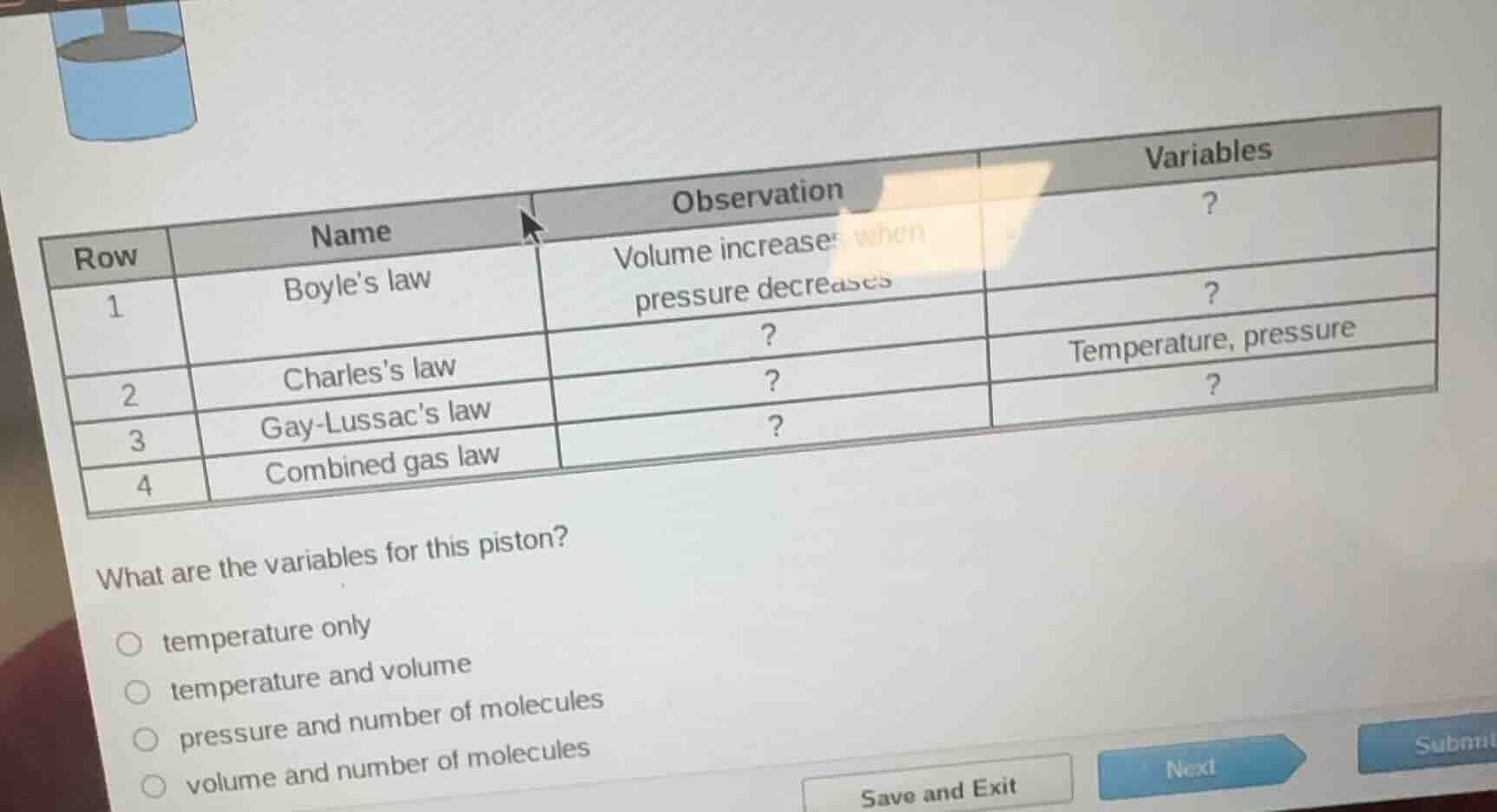
what are the variables for this piston? temperature only temperature an…

Question

what are the variables for this piston?

temperature only
temperature and volume
pressure and number of molecules
volume and number of molecules

Explanation:

Response

<pre_analysis>
{
"quality": "clear",
"question_count": 1,
"skills_matched": [
"direct_cot",
"multiple_choice_formatter",
"explain_then_answer",
"quick"
],
"needs_drawing": false,
"concepts_used": [
"Boyles Law"
],
"new_concepts": [],
"current_concepts": [
"Boyles Law",
"Gas Laws"
]
}
</pre_analysis>

<reasoning>

Identify the target row and law

The question asks "What are the variables for this piston?" in the context of the highlighted row or the first row containing Boyle's law. Boyle's law relates pressure and volume.

Determine the variables for Boyle's law

Boyle's law states that the pressure of a given mass of an ideal gas is inversely proportional to its volume at a constant temperature. Therefore, the changing variables being observed and measured are pressure and volume.

Match with the given options

The options are:

  • temperature only
  • temperature and volume
  • pressure and number of molecules
  • volume and number of molecules

Looking closely at the table, Row 1 is "Boyle's law" with the observation "Volume increases when pressure decreases". The variables that change in this relationship are volume and pressure. However, looking at the options provided:

  • temperature only
  • temperature and volume
  • pressure and number of molecules
  • volume and number of molecules

Let's re-evaluate the question "What are the variables for this piston?" in the context of the diagram at the top left. The diagram shows a piston containing a gas. In a standard piston experiment demonstrating Boyle's law, temperature and the number of molecules (amount of gas) are kept constant, while pressure and volume are the changing variables.

If the question asks for the changing variables of Boyle's law, it is pressure and volume. If none of the options perfectly match "pressure and volume", let's look at the options again:

  1. temperature only
  2. temperature and volume
  3. pressure and number of molecules
  4. volume and number of molecules

Wait, let's look at the table's second row: Charles's law. The variables for Charles's law are temperature and volume (at constant pressure).
The third row is Gay-Lussac's law, where the variables are temperature and pressure (at constant volume).
The first row is Boyle's law, where the variables are pressure and volume.

If the question "What are the variables for this piston?" refers to the active question on the screen, let's check which cell is highlighted or being asked about. Row 1 "Variables" has a "?". The variables for Boyle's law are pressure and volume. Let's check if there is a typo in the options or if "volume and pressure" is represented.
None of the options say "pressure and volume".
Let's re-read the options:

  • temperature only
  • temperature and volume
  • pressure and number of molecules
  • volume and number of molecules

If the question is asking about Charles's law (Row 2), the variables are "temperature and volume".
If the question is asking about Gay-Lussac's law (Row 3), the variables are "temperature and pressure" (which is filled in as "Temperature, pressure").
If the question is asking about Boyle's law (Row 1), the variables are pressure and volume.
Since "temperature and volume" is an option, and it corresponds to Charles's law (Row 2, which has a "?" under "Observation" and "Variables"), let's check if the question "What are the variables for this piston?" refers to a specific row. The piston diagram at the top left shows a cylinder with a piston and some weights/heat. If it has a heat source, it might be Charles's law. Charles's law keeps…

Answer:

<pre_analysis>
{
"quality": "clear",
"question_count": 1,
"skills_matched": [
"direct_cot",
"multiple_choice_formatter",
"explain_then_answer",
"quick"
],
"needs_drawing": false,
"concepts_used": [
"Boyles Law"
],
"new_concepts": [],
"current_concepts": [
"Boyles Law",
"Gas Laws"
]
}
</pre_analysis>

<reasoning>

Identify the target row and law

The question asks "What are the variables for this piston?" in the context of the highlighted row or the first row containing Boyle's law. Boyle's law relates pressure and volume.

Determine the variables for Boyle's law

Boyle's law states that the pressure of a given mass of an ideal gas is inversely proportional to its volume at a constant temperature. Therefore, the changing variables being observed and measured are pressure and volume.

Match with the given options

The options are:

  • temperature only
  • temperature and volume
  • pressure and number of molecules
  • volume and number of molecules

Looking closely at the table, Row 1 is "Boyle's law" with the observation "Volume increases when pressure decreases". The variables that change in this relationship are volume and pressure. However, looking at the options provided:

  • temperature only
  • temperature and volume
  • pressure and number of molecules
  • volume and number of molecules

Let's re-evaluate the question "What are the variables for this piston?" in the context of the diagram at the top left. The diagram shows a piston containing a gas. In a standard piston experiment demonstrating Boyle's law, temperature and the number of molecules (amount of gas) are kept constant, while pressure and volume are the changing variables.

If the question asks for the changing variables of Boyle's law, it is pressure and volume. If none of the options perfectly match "pressure and volume", let's look at the options again:

  1. temperature only
  2. temperature and volume
  3. pressure and number of molecules
  4. volume and number of molecules

Wait, let's look at the table's second row: Charles's law. The variables for Charles's law are temperature and volume (at constant pressure).
The third row is Gay-Lussac's law, where the variables are temperature and pressure (at constant volume).
The first row is Boyle's law, where the variables are pressure and volume.

If the question "What are the variables for this piston?" refers to the active question on the screen, let's check which cell is highlighted or being asked about. Row 1 "Variables" has a "?". The variables for Boyle's law are pressure and volume. Let's check if there is a typo in the options or if "volume and pressure" is represented.
None of the options say "pressure and volume".
Let's re-read the options:

  • temperature only
  • temperature and volume
  • pressure and number of molecules
  • volume and number of molecules

If the question is asking about Charles's law (Row 2), the variables are "temperature and volume".
If the question is asking about Gay-Lussac's law (Row 3), the variables are "temperature and pressure" (which is filled in as "Temperature, pressure").
If the question is asking about Boyle's law (Row 1), the variables are pressure and volume.
Since "temperature and volume" is an option, and it corresponds to Charles's law (Row 2, which has a "?" under "Observation" and "Variables"), let's check if the question "What are the variables for this piston?" refers to a specific row. The piston diagram at the top left shows a cylinder with a piston and some weights/heat. If it has a heat source, it might be Charles's law. Charles's law keeps pressure constant, so the variables are temperature and volume.
Thus, "temperature and volume" is the correct choice.
</reasoning>

<answer>
<mcq-option>temperature only</mcq-option>
<mcq-correct>temperature and volume</mcq-correct>
<mcq-option>pressure and number of molecules</mcq-option>
<mcq-option>volume and number of molecules</mcq-option>
</answer>

<post_analysis>
{
"subject": "Natural Science",
"question_type": "Multiple Choice",
"knowledge_point": [
"Natural Science",
"Chemistry",
"Gas Laws"
]
}
</post_analysis>