QUESTION IMAGE
Question
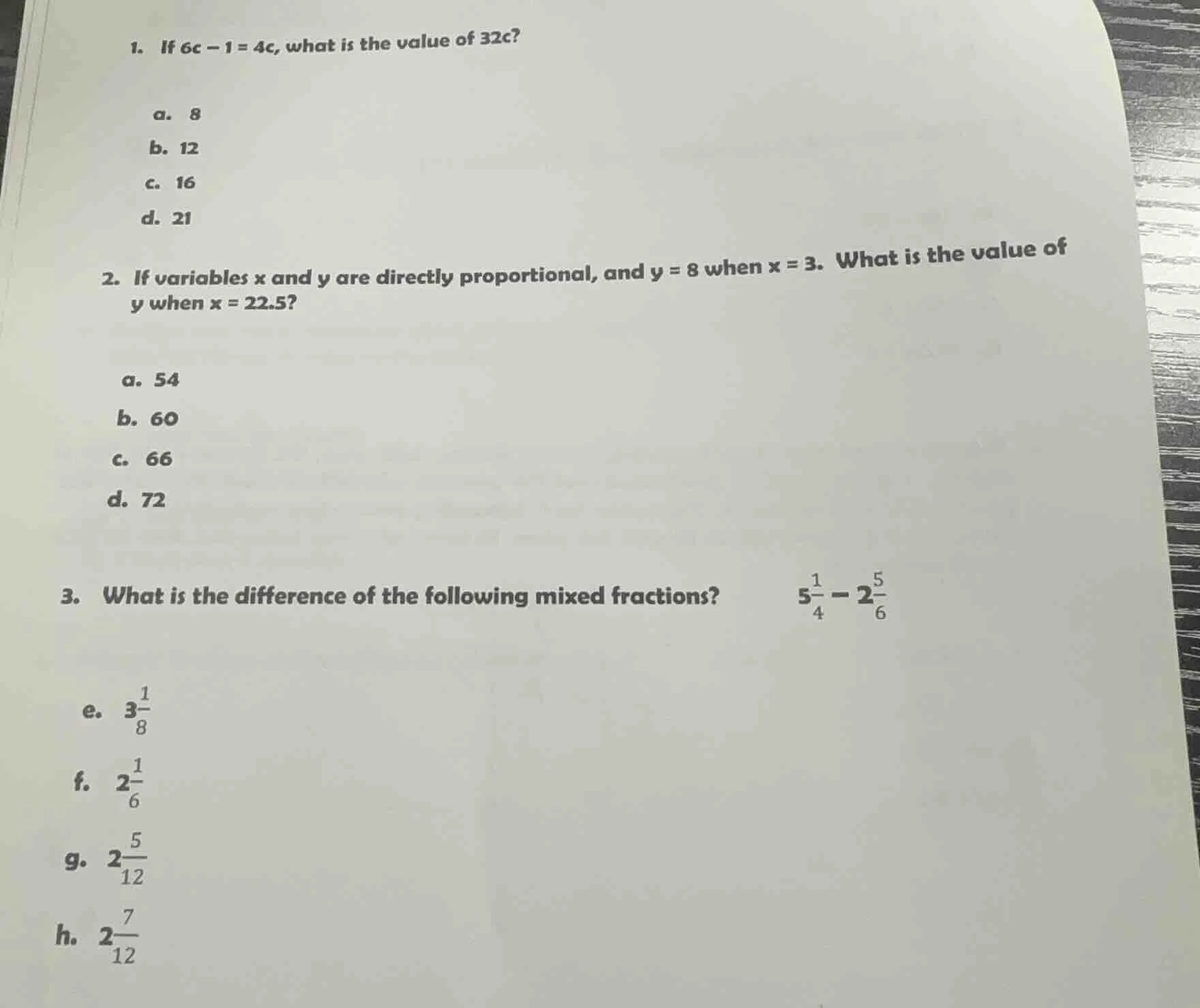
- if $6c - 1 = 4c$, what is the value of $32c$?
a. 8
b. 12
c. 16
d. 21
- if variables $x$ and $y$ are directly proportional, and $y = 8$ when $x = 3$. what is the value of $y$ when $x = 22.5$?
a. 54
b. 60
c. 66
d. 72
- what is the difference of the following mixed fractions? $5\frac{1}{4} - 2\frac{5}{6}$
e. $3\frac{1}{8}$
f. $2\frac{1}{6}$
g. $2\frac{5}{12}$
h. $2\frac{7}{12}$
Question 1
Step1: Solve for \( c \) from \( 6c - 1 = 4c \)
Subtract \( 4c \) from both sides: \( 6c - 4c - 1 = 0 \) → \( 2c - 1 = 0 \). Then add 1 to both sides: \( 2c = 1 \). Divide by 2: \( c = \frac{1}{2} \).
Step2: Calculate \( 32c \)
Substitute \( c = \frac{1}{2} \) into \( 32c \): \( 32 \times \frac{1}{2} = 16 \).
Step1: Recall direct proportionality formula
For direct proportion, \( y = kx \) (where \( k \) is the constant of proportionality).
Step2: Find \( k \) using \( y = 8 \), \( x = 3 \)
Substitute into \( y = kx \): \( 8 = k \times 3 \) → \( k = \frac{8}{3} \).
Step3: Find \( y \) when \( x = 22.5 \)
Use \( y = kx \) with \( k = \frac{8}{3} \) and \( x = 22.5 \): \( y = \frac{8}{3} \times 22.5 \). Calculate \( 22.5 \times \frac{8}{3} = 7.5 \times 8 = 60 \).
Step1: Convert mixed fractions to improper fractions
\( 5\frac{1}{4} = \frac{5 \times 4 + 1}{4} = \frac{21}{4} \), \( 2\frac{5}{6} = \frac{2 \times 6 + 5}{6} = \frac{17}{6} \).
Step2: Find a common denominator (12)
\( \frac{21}{4} = \frac{21 \times 3}{4 \times 3} = \frac{63}{12} \), \( \frac{17}{6} = \frac{17 \times 2}{6 \times 2} = \frac{34}{12} \).
Step3: Subtract the fractions
\( \frac{63}{12} - \frac{34}{12} = \frac{29}{12} \).
Step4: Convert back to mixed fraction
\( \frac{29}{12} = 2\frac{5}{12} \)? Wait, no—wait, \( 29 - 24 = 5 \)? Wait, no, \( 12 \times 2 = 24 \), \( 29 - 24 = 5 \)? Wait, no, let's recalculate: \( 5\frac{1}{4} = \frac{21}{4} = \frac{63}{12} \), \( 2\frac{5}{6} = \frac{17}{6} = \frac{34}{12} \). \( 63 - 34 = 29 \), so \( \frac{29}{12} = 2\frac{5}{12} \)? Wait, the options have \( 2\frac{7}{12} \). Wait, did I make a mistake? Wait, \( 5\frac{1}{4} = 5 + \frac{1}{4} \), \( 2\frac{5}{6} = 2 + \frac{5}{6} \). Subtract integers: \( 5 - 2 = 3 \). Subtract fractions: \( \frac{1}{4} - \frac{5}{6} \). Common denominator 12: \( \frac{3}{12} - \frac{10}{12} = -\frac{7}{12} \). So total is \( 3 - \frac{7}{12} = 2 + 1 - \frac{7}{12} = 2 + \frac{12 - 7}{12} = 2\frac{5}{12} \)? Wait, no, the options: g is \( 2\frac{5}{12} \), h is \( 2\frac{7}{12} \). Wait, maybe my initial conversion is wrong. Wait, \( 5\frac{1}{4} = \frac{21}{4} = 5.25 \), \( 2\frac{5}{6} \approx 2.833 \). Subtract: \( 5.25 - 2.833 \approx 2.416 \). \( 2\frac{5}{12} \approx 2.416 \), \( 2\frac{7}{12} \approx 2.583 \). Wait, maybe I messed up the subtraction. Wait, \( 5\frac{1}{4} = \frac{21}{4} = \frac{63}{12} \), \( 2\frac{5}{6} = \frac{17}{6} = \frac{34}{12} \). \( 63 - 34 = 29 \), \( 29/12 = 2\frac{5}{12} \), which is option g. Wait, but let me check again. Wait, the problem says "difference", so \( 5\frac{1}{4} - 2\frac{5}{6} \). Yes, that's correct. So:
Step1: Convert to improper fractions: \( \frac{21}{4} - \frac{17}{6} \)
Step2: Common denominator 12: \( \frac{63}{12} - \frac{34}{12} = \frac{29}{12} = 2\frac{5}{12} \)

Snap & solve any problem in the app
Get step-by-step solutions on Sovi AI
Photo-based solutions with guided steps
Explore more problems and detailed explanations
c. 16