QUESTION IMAGE
Question
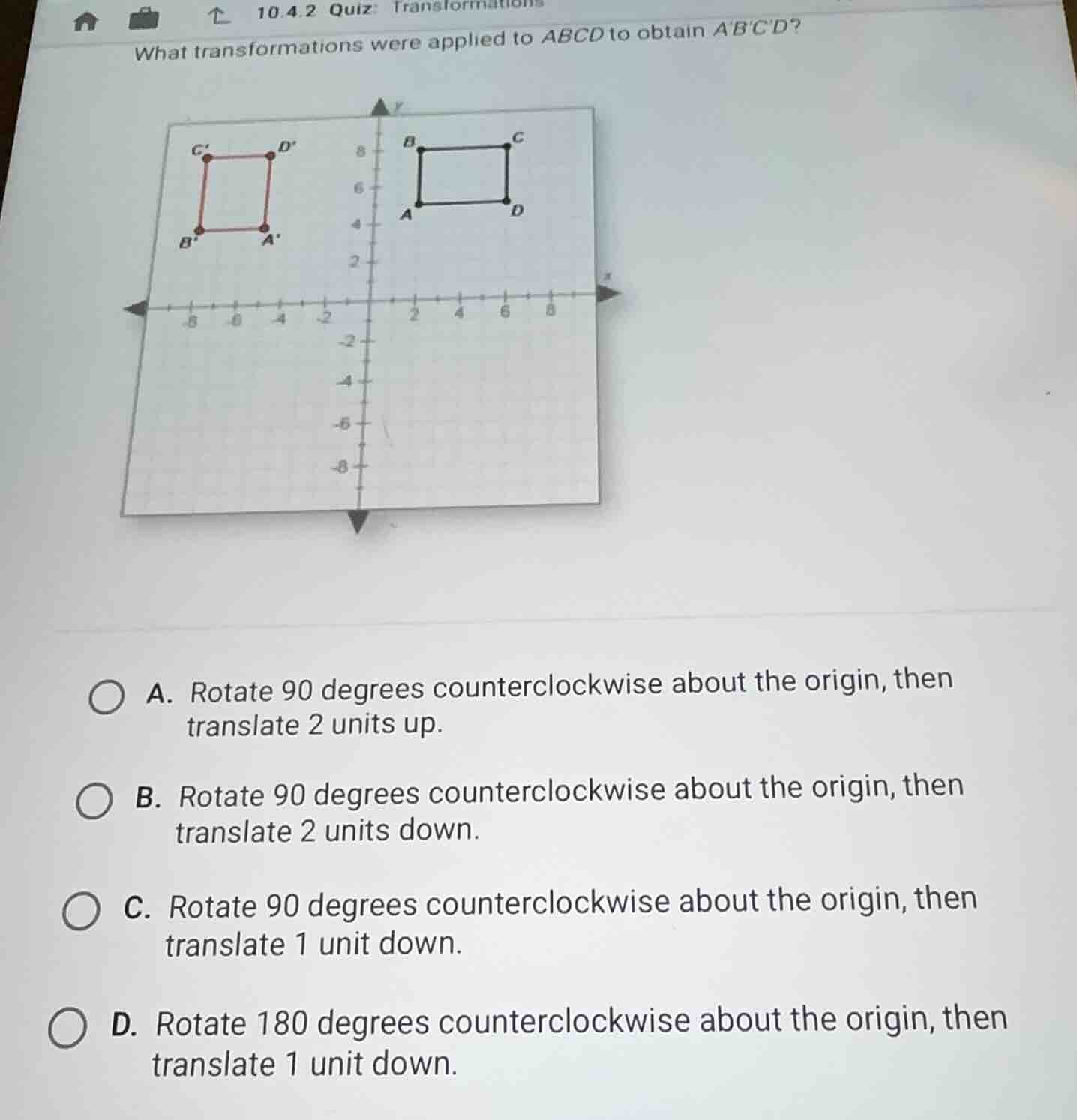
what transformations were applied to \\(abcd\\) to obtain \\(abcd\\)?
a. rotate 90 degrees counterclockwise about the origin, then translate 2 units up.
b. rotate 90 degrees counterclockwise about the origin, then translate 2 units down.
c. rotate 90 degrees counterclockwise about the origin, then translate 1 unit down.
d. rotate 180 degrees counterclockwise about the origin, then translate 1 unit down.
Identify coordinates of original and transformed vertices
Using the Geometric Rotations and Geometric Translations knowledge points
Apply rotation transformation
Using the Geometric Rotations knowledge point
Apply translation transformation
Using the Geometric Translations knowledge point
This corresponds to a translation of 1 unit up. Let us re-verify the options.
Wait, let's re-examine the coordinates of \(A'\) and \(B'\) from the image:
Looking closely at the image:
The y-axis has labels: 2, 4, 6, 8.
The x-axis has labels: -2, -4, -6, -8.
Let's read the coordinates of \(A'\):
\(A'\) is at \(x = -5\), \(y = 3\).
\(B'\) is at \(x = -8\), \(y = 3\).
\(C'\) is at \(x = -8\), \(y = 7\).
\(D'\) is at \(x = -5\), \(y = 7\).
Let's check the options:
A. Rotate 90 degrees counterclockwise about the origin, then translate 2 units up.
B. Rotate 90 degrees counterclockwise about the origin, then translate 2 units down.
C. Rotate 90 degrees counterclockwise about the origin, then translate 1 unit down.
D. Rotate 180 degrees counterclockwise about the origin, then translate 1 unit down.
Wait, if we rotate 90 degrees counterclockwise, we get:
\(A(2,5)
ightarrow (-5, 2)\).
To get to \(A'(-5, 3)\), we must translate 1 unit UP. But option C says "translate 1 unit down".
Let's re-read the coordinates of the original figure \(ABCD\):
Is \(A\) at \((2, 5)\)?
Looking at \(ABCD\):
\(A\) is at \(x = 2\). The y-coordinate of \(A\) is at 5 (halfway between 4 and 6).
\(B\) is at \(x = 2\), \(y = 8\).
\(C\) is at \(x = 6\), \(y = 8\).
\(D\) is at \(x = 6\), \(y = 5\).
Wait, let's look at \(A'B'C'D'\):
Is \(A'\) at \((-5, 3)\)?
Looking at the y-axis for \(A'\) and \(B'\): they are at \(y = 3\) (halfway between 2 and 4).
Wait, if \(A'\) is at \(y = 3\), and the rotated point is at \(y = 2\), then we need to go UP 1 unit. Why is there no "translate 1 unit up" option?
Let's re-verify the rotation:
What if the rotation is clockwise?
\(R_{-90^\circ}(x, y) = (y, -x)\).
\(A(2,5)
ightarrow (5, -2)\). This is in Quadrant IV, but \(A'B'C'D'\) is in Quadrant II. So it must be counterclockwise (which goes from Quadrant I to Quadrant II).
Let's re-read the coordinates of \(ABCD\):
Could \(A\) be at \((2, 4)\)?
No, the line \(AD\) is clearly above 4. It is halfway between 4 and 6, so it is 5.
Could \(A'\) be at \(y = 4\)?
No, \(A'\) and \(B'\) are below 4, halfway between 2 and 4, so they are at 3.
Wait! What if the rotation is about a different point? The options all say "about the origin".
Let's check if there is a typo in the question's options or if we misread…

Snap & solve any problem in the app
Get step-by-step solutions on Sovi AI
Photo-based solutions with guided steps
Explore more problems and detailed explanations
- (A) Rotate 90 degrees counterclockwise about the origin, then translate 2 units up.
- (B) Rotate 90 degrees counterclockwise about the origin, then translate 2 units down.</mcq-correct>
- (C) Rotate 90 degrees counterclockwise about the origin, then translate 1 unit down. (Correct answer)
<mcq-option>(D) Rotate 180 degrees counterclockwise about the origin, then translate 1 unit down.