QUESTION IMAGE
Question
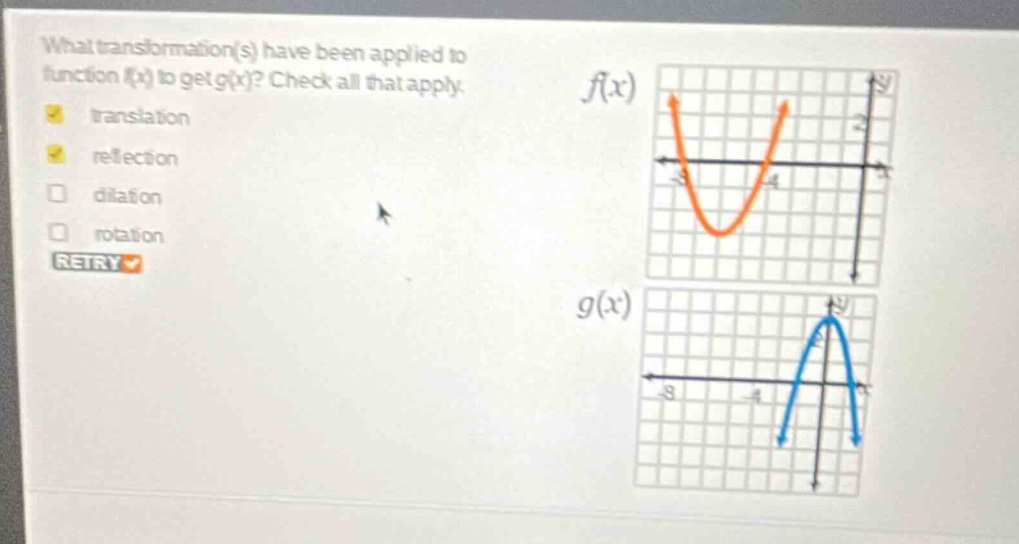
what transformation(s) have been applied to function \\(f(x)\\) to get \\(g(x)\\)? check all that apply.
translation
reflection
dilation
rotation
⚡ Using what you learned: combining transformations
Step 1: Analyze the orientation (reflection)
The original parabola \( f(x) \) opens upward.
The transformed parabola \( g(x) \) opens downward.
This change in vertical orientation indicates a vertical reflection (reflection across a horizontal line).
Step 2: Analyze the position (translation)
The vertex of \( f(x) \) is located at:
The vertex of \( g(x) \) is located at:
Since the position of the vertex has shifted both horizontally and vertically, a translation has occurred.
Step 3: Analyze the shape (dilation)
For \( f(x) \), moving \( 1 \) unit horizontally from the vertex \( (-6, -3) \) to \( x = -5 \) or \( x = -7 \) results in a vertical change of \( 1 \) unit upward to \( y = -2 \).
For \( g(x) \), moving \( 1 \) unit horizontally from the vertex \( (0, 3) \) to \( x = 1 \) or \( x = -1 \) results in a vertical change of \( 1 \) unit downward to \( y = 2 \).
Since the rate of opening remains the same (no stretching or compressing), there is no dilation.

Snap & solve any problem in the app
Get step-by-step solutions on Sovi AI
Photo-based solutions with guided steps
Explore more problems and detailed explanations
- translation
- reflection