QUESTION IMAGE
Question
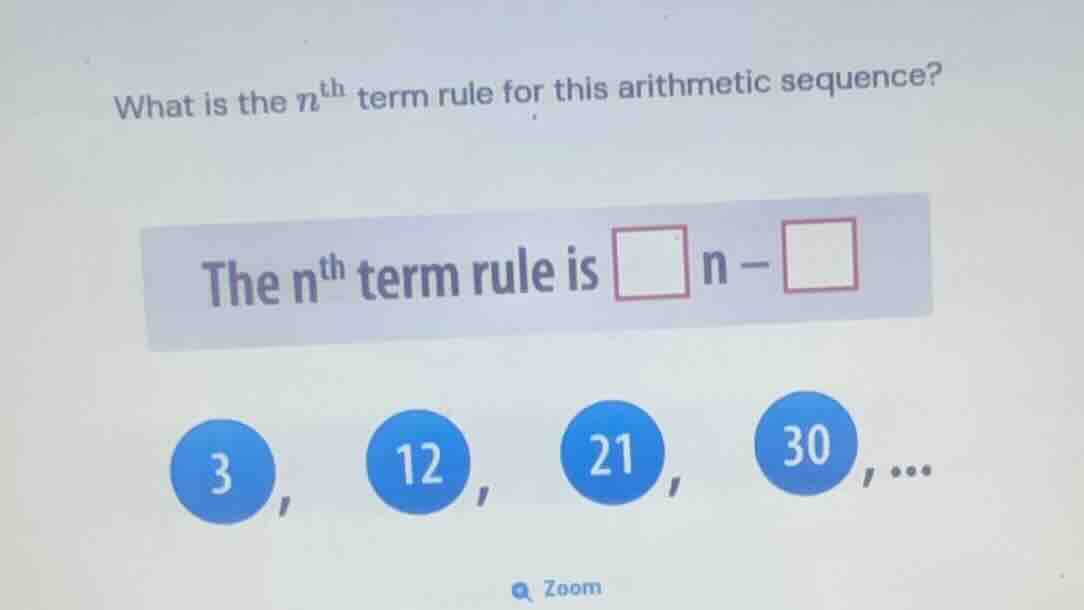
what is the \\(n^{\text{th}}\\) term rule for this arithmetic sequence?
the \\(n^{\text{th}}\\) term rule is \\(\square n - \square\\)
3, 12, 21, 30, ...
<pre_analysis>
{
"quality": "clear",
"question_count": 1,
"skills_matched": [
"step_cot",
"blank_filling_formatter",
"explain_then_answer",
"tutor"
],
"needs_drawing": false,
"concepts_used": [],
"new_concepts": [
"Arithmetic Sequence",
"nth Term Rule",
"Common Difference"
],
"current_concepts": [
"Arithmetic Sequence",
"nth Term Rule",
"Common Difference"
]
}
</pre_analysis>
<reasoning>
Identify the sequence terms
The given arithmetic sequence is:
\[ 3, 12, 21, 30, \dots \]
The first term is \( a_1 = 3 \).
The second term is \( a_2 = 12 \).
The third term is \( a_3 = 21 \).
The fourth term is \( a_4 = 30 \).
Find the common difference
An arithmetic sequence changes by a constant amount between consecutive terms. Let's calculate the common difference \( d \):
\[ d = a_2 - a_1 = 12 - 3 = 9 \]
\[ d = a_3 - a_2 = 21 - 12 = 9 \]
\[ d = a_4 - a_3 = 30 - 21 = 9 \]
The common difference is \( d = 9 \).
Determine the general nth term formula
The general formula for the \( n^{\text{th}} \) term of an arithmetic sequence is:
\[ a_n = a_1 + (n - 1)d \]
Substitute the known values \( a_1 = 3 \) and \( d = 9 \):
\[ a_n = 3 + (n - 1)9 \]
Simplify the expression
Expand and simplify the formula to match the required format \( \square n - \square \):
\[ a_n = 3 + 9n - 9 \]
\[ a_n = 9n - 6 \]
Comparing this to the template:
\[ \text{The } n^{\text{th}} \text{ term rule is } \square n - \square \]
We find that the first box contains \( 9 \) and the second box contains \( 6 \).
</reasoning>
<answer>
What is the \( n^{\text{th}} \) term rule for this arithmetic sequence?
The \( n^{\text{th}} \) term rule is <blank>9</blank>\(n -\) <blank>6</blank>
</answer>
<post_analysis>
{
"subject": "Mathematics",
"question_type": "Fill-in-the-blank",
"knowledge_point": [
"Mathematics",
"Algebra",
"Arithmetic Sequence"
]
}
</post_analysis>
Snap & solve any problem in the app
Get step-by-step solutions on Sovi AI
Photo-based solutions with guided steps
Explore more problems and detailed explanations
<pre_analysis>
{
"quality": "clear",
"question_count": 1,
"skills_matched": [
"step_cot",
"blank_filling_formatter",
"explain_then_answer",
"tutor"
],
"needs_drawing": false,
"concepts_used": [],
"new_concepts": [
"Arithmetic Sequence",
"nth Term Rule",
"Common Difference"
],
"current_concepts": [
"Arithmetic Sequence",
"nth Term Rule",
"Common Difference"
]
}
</pre_analysis>
<reasoning>
Identify the sequence terms
The given arithmetic sequence is:
\[ 3, 12, 21, 30, \dots \]
The first term is \( a_1 = 3 \).
The second term is \( a_2 = 12 \).
The third term is \( a_3 = 21 \).
The fourth term is \( a_4 = 30 \).
Find the common difference
An arithmetic sequence changes by a constant amount between consecutive terms. Let's calculate the common difference \( d \):
\[ d = a_2 - a_1 = 12 - 3 = 9 \]
\[ d = a_3 - a_2 = 21 - 12 = 9 \]
\[ d = a_4 - a_3 = 30 - 21 = 9 \]
The common difference is \( d = 9 \).
Determine the general nth term formula
The general formula for the \( n^{\text{th}} \) term of an arithmetic sequence is:
\[ a_n = a_1 + (n - 1)d \]
Substitute the known values \( a_1 = 3 \) and \( d = 9 \):
\[ a_n = 3 + (n - 1)9 \]
Simplify the expression
Expand and simplify the formula to match the required format \( \square n - \square \):
\[ a_n = 3 + 9n - 9 \]
\[ a_n = 9n - 6 \]
Comparing this to the template:
\[ \text{The } n^{\text{th}} \text{ term rule is } \square n - \square \]
We find that the first box contains \( 9 \) and the second box contains \( 6 \).
</reasoning>
<answer>
What is the \( n^{\text{th}} \) term rule for this arithmetic sequence?
The \( n^{\text{th}} \) term rule is <blank>9</blank>\(n -\) <blank>6</blank>
</answer>
<post_analysis>
{
"subject": "Mathematics",
"question_type": "Fill-in-the-blank",
"knowledge_point": [
"Mathematics",
"Algebra",
"Arithmetic Sequence"
]
}
</post_analysis>