QUESTION IMAGE
Question
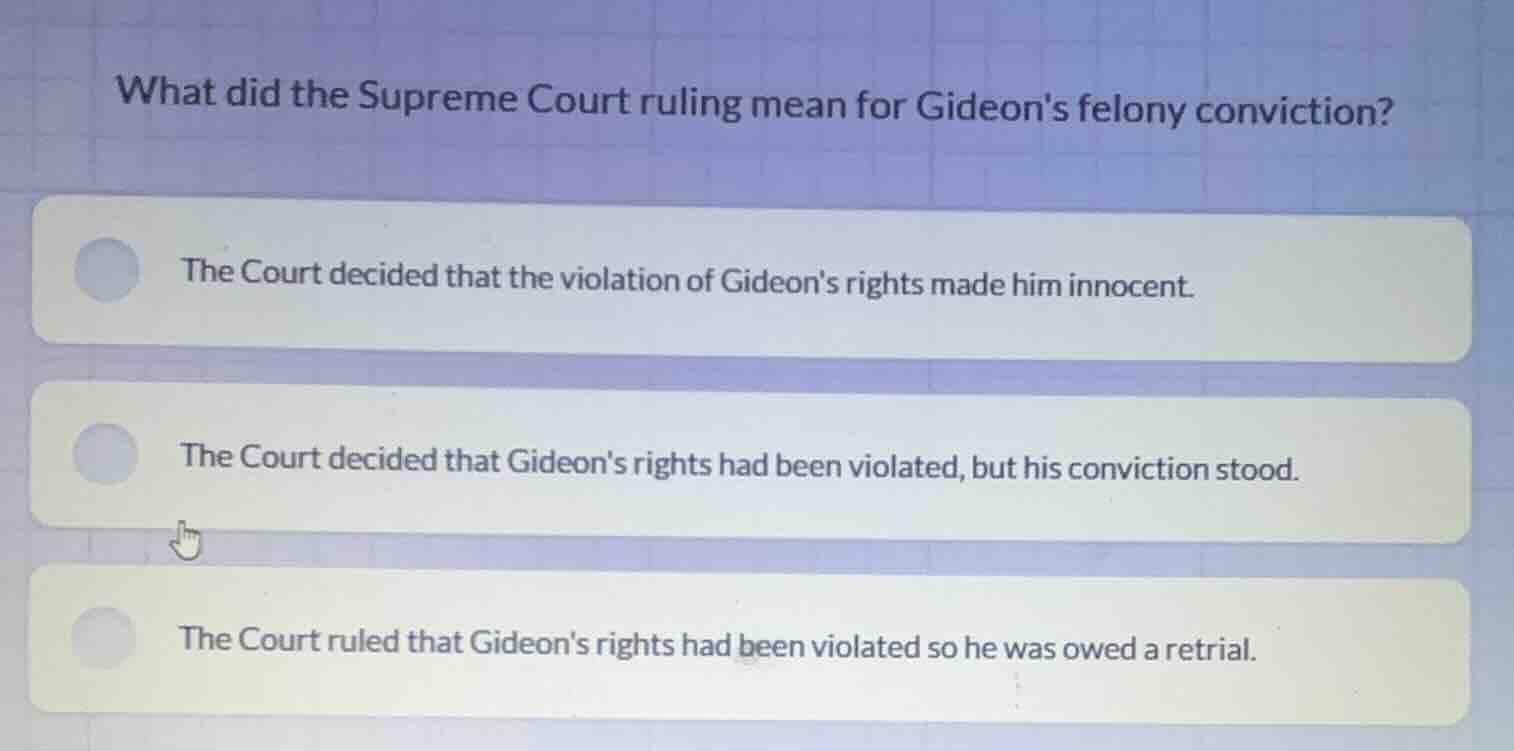
what did the supreme court ruling mean for gideons felony conviction?
the court decided that the violation of gideons rights made him innocent.
the court decided that gideons rights had been violated, but his conviction stood.
the court ruled that gideons rights had been violated so he was owed a retrial.
Analyze the impact on the conviction
Using the Gideon v. Wainwright and Right to Counsel knowledge points, the Supreme Court ruled that the Sixth Amendment's guarantee of counsel is essential for a fair trial. However, a constitutional violation during trial does not automatically mean the defendant is declared innocent; rather, it invalidates the original unconstitutional conviction and requires a new trial where the defendant's rights are fully respected.
Evaluate the legal outcome
Using the Sixth Amendment and Due Process knowledge points, the ruling overturned Clarence Earl Gideon's original conviction because he was denied an attorney. This decision meant his constitutional rights were violated, which legally entitled him to a new trial (retrial) with court-appointed counsel, rather than an immediate acquittal or letting the conviction stand.

Snap & solve any problem in the app
Get step-by-step solutions on Sovi AI
Photo-based solutions with guided steps
Explore more problems and detailed explanations
- The Court decided that the violation of Gideon's rights made him innocent.
- The Court decided that Gideon's rights had been violated, but his conviction stood.
- The Court ruled that Gideon's rights had been violated so he was owed a retrial. (Correct answer)